28 Other Ways to Say “Please Be Patient” in Customer Service and Business Emails
Picture a customer waiting on hold, a client expecting an email reply, or a team member stuck behind a delayed project update. At some point, almost everyone has to ask someone else to wait, and the easiest words to reach for are usually “please be patient.” It’s a familiar, polite request, the kind of line that fits into a phone script, a support email, or a quick verbal apology without much thought.
The trouble is, please be patient gets used so often in customer support, emails, and everyday conversation that it can start to feel a little flat or even slightly canned. When a customer hears the exact same line every time something goes wrong, it stops sounding sincere and starts sounding like a script. That’s not great for business communication, especially in moments where the person on the other end is already a little frustrated and just wants to feel heard.
This article walks through what the phrase actually means, when it works well, and why having other options matters so much. You’ll get twenty-eight alternatives, each with its own tone, a real example, and a clear sense of where it fits best — so the next time you need to ask someone to wait, you’ve got more than one way to say it with genuine warmth and respect.
What Does “Please Be Patient” Mean?
At its core, please be patient is a polite request asking someone to stay calm and wait without frustration while something is being resolved, prepared, or completed. It’s a gentle way of acknowledging that a delay exists without necessarily explaining every detail of why. The phrase works as a kind of social cushion, softening the discomfort of waiting by directly asking for understanding rather than just leaving the person to figure things out on their own.
The phrase has been part of everyday English for a long time, showing up in spoken conversation long before it became a staple of customer service scripts and email templates. As call centers, support tickets, and automated systems became more common, “please be patient” naturally carried over into written and recorded messages, since it’s short, clear, and universally understood across nearly every industry and culture.
In practice, you’ll see this phrase most often in situations involving some kind of delay or disruption — a slow website, a backed-up support queue, a delayed shipment, or a technical issue being fixed. It’s flexible enough to apply almost anywhere patience is needed, which is exactly why it’s become such a default choice, and also why finding fresh alternatives can make your professional communication feel more thoughtful and less automatic.
When to Use “Please Be Patient”
Knowing where this phrase genuinely fits helps you decide when it’s the right call and when something else might land better.
The first situation is customer support, especially when a representative needs a few extra minutes to look into an account, troubleshoot an issue, or check with another department. Saying “please be patient” here works as a simple, respectful way to ask the customer to hold on without overexplaining the situation.
The second common use is during technical outages or system disruptions, where a company needs to communicate with many people at once through a status page, email, or social media post. In these moments, the phrase helps set expectations broadly, letting everyone know that a fix is in progress even before specific details are available.
A third case involves in-person service settings, like a busy restaurant, a medical office, or a retail counter, where staff need to ask waiting customers to hold on for just a little longer. The phrase works naturally in spoken conversation here, especially when paired with a warm tone and a brief explanation.
The fourth situation shows up in project-based work, where a colleague or client is waiting on a deliverable that’s taking longer than expected. A quick “please be patient as we finalize the details” can buy a little goodwill while the actual work continues behind the scenes.
And finally, the phrase fits naturally into shipping and order-related communication, where a company needs to manage expectations around a service delay without making any specific promises about exact timing. It works as a gentle, low-commitment way to ask for understanding while logistics get sorted out.
Is It Professional or Polite to Say “Please Be Patient”?
The honest answer is that it’s generally polite and professional, but it works best in moderation rather than as your only go-to phrase. On its own, there’s nothing wrong with the wording — it’s respectful, clear, and widely accepted across industries. The catch is that overusing it, especially with the exact same wording every time, can start to feel impersonal or even mildly dismissive, almost like the words are doing the apologizing instead of an actual person.
Context also plays a role here. In a quick verbal exchange, “please be patient” feels natural and warm, especially with a friendly tone of voice. In a formal written notice or a serious service disruption affecting many customers, it can feel a little thin compared to a more detailed, respectful message that explains what’s happening and what to expect next.
| Pros of using it | Cons of using it |
| Polite, simple, and instantly understood by almost anyone | Can feel generic or scripted if repeated too often |
| Works across spoken, written, and automated communication | Doesn’t explain why the wait is happening or how long it’ll last |
| Fits naturally into both casual and semi-formal settings | May feel insufficient for serious or extended service delay situations |
| Short enough to use quickly in fast-paced support settings | Offers no reassurance beyond a basic request for calm waiting |
So it’s a fine phrase to keep in your back pocket, but leaning on a wider set of polite alternatives helps you sound more genuine and considerate, especially with customers or clients who are already feeling a bit impatient.
Before diving into each option individually, here’s a quick look at how a handful of common alternatives compare in tone and best-fit setting.
| Alternative Phrase | Best Use Case | Tone |
| Please bear with us | Formal | Professional |
| Thank you for holding | Semi-formal | Warm |
| We’re working on it | Informal | Friendly |
| Kindly wait | Formal | Polite |
| Hang tight | Informal | Warm |
| Thank you for your patience | Semi-formal | Professional |
| We appreciate your cooperation | Formal | Professional |
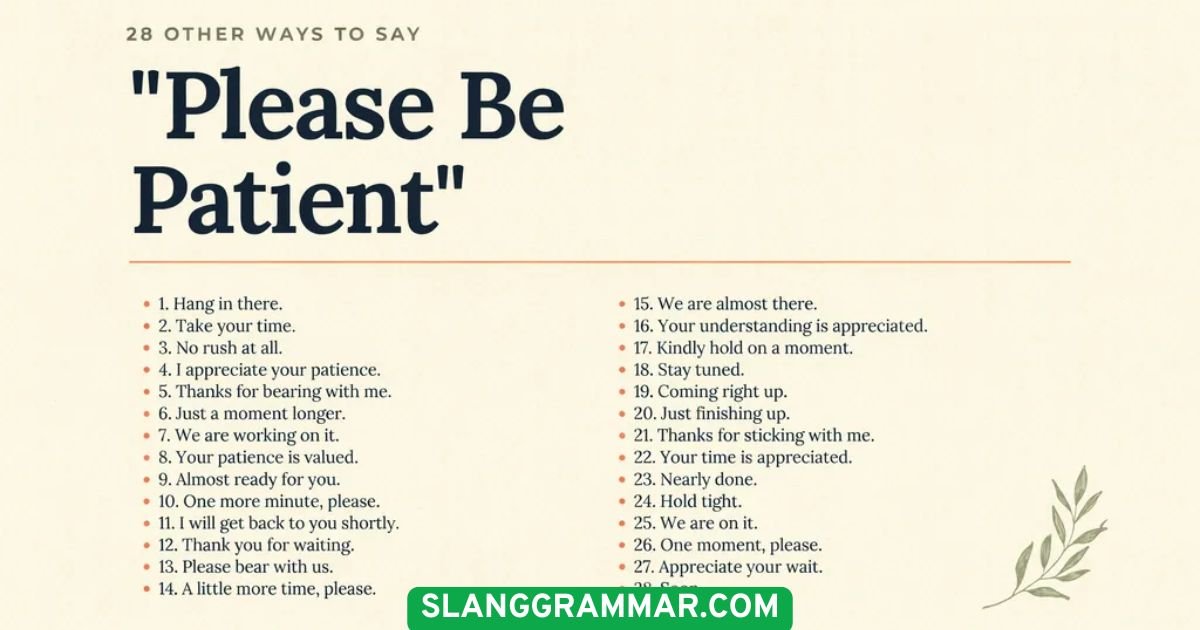
28 Other Ways to Say “Please Be Patient”
Each of these alternatives carries its own personality, so think of this less as a simple word swap and more as a toolkit for matching tone to the situation in front of you.
Please Bear With Us
This phrase reads as polite and slightly formal, the kind of wording you’d hear in a customer service response or a company-wide update during an outage. It goes beyond a simple request to wait — it gently acknowledges that the wait might require real effort from the listener, not just passive patience. The tone is polite and professional, which makes it ideal for support tickets and service status updates.
Example: “Please bear with us as we work through a temporary technical issue.”
It’s a great fit for formal customer service communication during a known disruption. It does feel slightly impersonal in a one-on-one conversation with someone you know well, so for that kind of exchange, simpler wording would land better.
We’ll Be With You Shortly
This phrase reads as warm and reassuring, the kind of line a receptionist or live agent would use to keep someone calm during a short wait. It goes beyond a vague request for patience — it promises that help is actively coming and frames the wait as genuinely temporary. The tone is warm and dependable, which makes it ideal for front-desk situations and phone queues.
Example: “We’ll be with you shortly — thank you for your patience.”
It’s a great fit for live or in-person service settings with a short, predictable wait. It does feel misleading when the wait turns out to be much longer than expected, so for those situations, more honest wording would land better.
Thank You for Holding
This phrase reads as appreciative and professional, the kind of line you’d hear from a call center agent picking up after a queue. It goes beyond asking someone to continue waiting — it specifically thanks them for the time they’ve already spent on hold. The tone is appreciative and professional, which makes it ideal for phone support and call centers.
Example: “Thank you for holding. A representative will be with you in just a few minutes.”
It’s a great fit for phone-based customer service interactions. It does feel out of place in written communication like email, so for that format, a different phrase would land better.
Your Patience Is Appreciated
This phrase reads as formal and respectful, the kind of wording you’d find in an official notice or written service update. It goes beyond a direct instruction to wait — it leans into gratitude, acknowledging the inconvenience without explicitly telling anyone what to do. The tone is formal and respectful, which makes it ideal for email announcements and service status pages.
Example: “Your patience is appreciated while we resolve this issue.”
It’s a great fit for formal written updates affecting many people at once. It does feel a little distant in casual conversation, so for that setting, something warmer would land better.
We Appreciate Your Cooperation
This phrase reads as formal and corporate, the kind of wording you’d see in a company-wide email about a system change or scheduled disruption. It goes beyond a one-sided request — it frames patience as a shared effort between the company and the audience. The tone is formal and professional, which makes it ideal for company-wide announcements.
Example: “We appreciate your cooperation as we update our systems this weekend.”
It’s a great fit for formal internal or external communication about planned disruptions. It does feel stiff and overly corporate for everyday customer interactions, so for those, simpler wording would land better.
We Ask for Your Patience
This phrase reads as direct and formal, the kind of wording you’d expect in an official public statement rather than a casual exchange. It goes beyond simply hoping for patience — it openly and clearly requests it, which adds a note of seriousness. The tone is formal and businesslike, which makes it ideal for public notices and crisis updates.
Example: “We ask for your patience as our team investigates the matter further.”
It’s a great fit for formal public communication during a serious issue. It does feel overly bureaucratic for lighter, everyday customer service exchanges, so for those, something less formal would land better.
Read Also: 28 Other Ways to Say “Stay Tuned” in Business and Social Media
We Appreciate Your Continued Patience
This phrase reads as respectful and slightly apologetic, the kind of wording reserved for situations where the wait has already been going on for some time. It goes beyond a fresh request for patience — it specifically acknowledges that the person has already been waiting, not just starting to. The tone is respectful and considerate, which makes it ideal for extended outages or long-running issues.
Example: “We appreciate your continued patience as we work to fully restore service.”
It’s a great fit for ongoing disruptions where time has already passed. It does feel repetitive if used too early, before any real wait has occurred, so for new delays, a fresher phrase would land better.
Please Allow Us a Moment
This phrase reads as polite and slightly formal, the kind of wording used during a live interaction when a short, specific pause is needed. It goes beyond an open-ended request to wait — it frames the delay as brief and bounded rather than indefinite. The tone is polite and measured, which makes it ideal for quick pauses during phone calls or in-person conversations.
Example: “Please allow us a moment to pull up your account details.”
It’s a great fit for short, predictable pauses during live interactions. It does feel mismatched for longer delays, so for those, wording that doesn’t imply brevity would land better.
We’re Working on It
This phrase reads as casual and reassuring, the kind of wording you’d see in a quick status update rather than a formal notice. It goes beyond passively asking someone to wait — it emphasizes active effort happening behind the scenes. The tone is friendly and direct, which makes it ideal for social media updates and chat support.
Example: “We’re working on it and will update you as soon as we know more.”
It’s a great fit for quick, informal status updates. It does feel too casual for a formal written notice, so for that, more measured wording would land better.
Thanks for Waiting
This phrase reads as friendly and conversational, the kind of line you’d hear in an everyday spoken interaction rather than a written document. It goes beyond a generic thank-you — it specifically acknowledges the waiting itself in a warm, casual way. The tone is warm and conversational, which makes it ideal for in-person service moments and casual phone calls.
Example: “Thanks for waiting — I just needed to check one more thing.”
It’s a great fit for casual, spoken customer interactions. It does feel too relaxed for formal written business communication, so for that, something more polished would land better.
Bear With Me
This phrase reads as friendly and personal, the kind of wording an individual would use rather than a company speaking on behalf of a whole team. It goes beyond a generic request — it centers the speaker directly, making the moment feel more individual. The tone is friendly and slightly informal, which makes it ideal for one-on-one conversations, whether in person or by phone.
Example: “Bear with me — I’m pulling up the file now.”
It’s a great fit for personal, one-on-one exchanges. It does feel too casual for formal written correspondence representing an entire organization, so for that, more neutral wording would land better.
Hold On
This phrase reads as casual and direct, the kind of line used in quick, informal spoken exchanges rather than careful written communication. It goes beyond a polite request — it signals urgency and immediacy with very little softening. The tone is casual and brisk, which makes it ideal for quick verbal exchanges and informal calls.
Example: “Hold on, let me check that for you real quick.”
It’s a great fit for fast, informal spoken interactions. It does feel abrupt or even slightly rude in written customer service messages, so for those, softer wording would land better.
Hang Tight
This phrase reads as relaxed and friendly, the kind of wording used to keep someone calm during a short wait without sounding overly formal. It goes beyond a plain request to wait — it carries a casual warmth that puts the listener at ease. The tone is warm and approachable, which makes it ideal for customer support chats and casual updates.
Example: “Hang tight, your order is being processed right now.”
It’s a great fit for informal customer support interactions. It does feel too casual for formal legal notices or executive communication, so for those, something more formal would land better.
Kindly Wait
This phrase reads as formal and somewhat traditional, the kind of wording found in older or more international business communication styles. It goes beyond a casual request — it adds a layer of courteous formality that signals respect through structure rather than warmth. The tone is formal and courteous, which makes it ideal for traditional phone systems and formal customer service scripts.
Example: “Kindly wait while we connect you to the next available representative.”
It’s a great fit for formal, script-based customer service settings. It does feel stiff or old-fashioned in casual, modern conversations between peers, so for those, more relaxed wording would land better.
One Moment, Please
This phrase reads as respectful and professional, the kind of wording recognized almost universally across spoken and written customer service. It goes beyond a vague pause — it specifically frames the wait as brief and intentional. The tone is respectful and professional, which makes it ideal for customer service calls and live chats.
Example: “One moment, please, while I look into this for you.”
It’s a great fit for quick, professional pauses during live interactions. It does feel impersonal if repeated too often within the same conversation, so for longer exchanges, varied wording would land better.
Just a Moment
This phrase reads as friendly and natural, the kind of wording that fits comfortably into everyday speech without losing its underlying politeness. It goes beyond a formal pause request — it softens the moment slightly compared to more rigid alternatives. The tone is friendly and approachable, which makes it ideal for both spoken and written customer interactions.
Example: “Just a moment, I’ll grab that information for you.”
It’s a great fit for everyday customer interactions needing a brief pause. It does feel mismatched if the wait turns out to be much longer than implied, so for longer delays, more honest wording would land better.
Give Me a Moment
This phrase reads as casual and direct, the kind of wording an individual uses rather than a company speaking formally. It goes beyond a generic pause request — it personalizes the moment by centering the speaker’s own need for time. The tone is casual and direct, which makes it ideal for one-on-one conversations and informal written messages.
Example: “Give me a moment to double-check those numbers.”
It’s a great fit for casual, individual exchanges. It does feel a bit abrupt in formal client communication, so for that, a more measured phrase would land better.
Stay With Me
This phrase reads as warm and personal, the kind of wording used in live conversations where the speaker wants the listener to remain present rather than disengage. It goes beyond a simple wait request — it frames the pause as something shared between two people. The tone is warm and personal, which makes it ideal for phone calls and face-to-face service interactions.
Example: “Stay with me — I’m almost done pulling up your account.”
It’s a great fit for live, personal interactions involving a short pause. It does feel unusual in written formats like email, so for those, a different phrase would land better.
Hold the Line
This phrase reads as formal and instructional, the kind of wording built specifically for phone-based interactions rather than general use. It goes beyond a generic pause request — it asks the listener to remain connected to a specific call rather than disengage. The tone is formal and instructional, which makes it ideal for call center scripts and phone-based customer service.
Example: “Please hold the line while I transfer your call.”
It’s a great fit for phone conversations involving a transfer or pause. It does feel completely out of place outside of phone calls, so for written or in-person contexts, something else would land better.
Thank You for Your Patience
This phrase reads as warm yet professional, the kind of wording recognized and accepted almost universally across formal and semi-formal communication. It goes beyond a basic thank-you — it combines gratitude with a clear acknowledgment of inconvenience. The tone is warm and professional, which makes it ideal for emails, phone scripts, and most customer-facing communication.
Example: “Thank you for your patience while we resolve this technical issue.”
It’s a great fit for almost any customer service situation involving delay. It does feel slightly generic if it’s the only phrase you ever use, so for variety, other alternatives would land better in rotation.
Read Also: 28 Professional Ways to Say “Please See Below” in Emails
Thanks for Your Understanding
This phrase reads as warm and considerate, the kind of wording that shifts focus from patience toward empathy for the listener’s situation. It goes beyond simple gratitude — it acknowledges that the situation might genuinely be frustrating rather than just inconvenient. The tone is warm and considerate, which makes it ideal for situations involving real disruption.
Example: “Thanks for your understanding as we navigate this unexpected delay.”
It’s a great fit for genuinely disruptive situations needing empathy. It does feel like an overstatement for very minor, short waits, so for those, a lighter phrase would land better.
We’re Almost There
This phrase reads as friendly and encouraging, the kind of wording used when the end of a wait is genuinely close rather than uncertain. It goes beyond open-ended patience — it commits to the idea that the wait is nearly over. The tone is friendly and encouraging, which makes it ideal for situations where you can confidently confirm the end is near.
Example: “We’re almost there — just finalizing the last few details.”
It’s a great fit for confirmed, near-complete processes. It does feel misleading if the process actually takes much longer afterward, so for uncertain timelines, more cautious wording would land better.
We’re Looking Into It
This phrase reads as professional and proactive, the kind of wording used when a real problem is being investigated rather than a routine delay simply passing time. It goes beyond passive waiting — it emphasizes active effort toward a solution. The tone is professional and proactive, which makes it ideal for technical support and troubleshooting situations.
Example: “We’re looking into it and will follow up with an update soon.”
It’s a great fit for active investigations needing reassurance. It does feel vague if repeated without ever providing a real update, so for that, a more specific follow-up would land better.
Allow Me a Moment
This phrase reads as polite and somewhat formal, the kind of wording an individual might use in a professional or service-oriented setting. It goes beyond a casual pause request — it adds a layer of courtesy while still centering the speaker directly. The tone is polite and formal, which makes it ideal for professional verbal exchanges like meetings or service counters.
Example: “Allow me a moment to verify this information.”
It’s a great fit for professional, individual interactions needing a brief pause. It does feel overly polished in very casual, friendly conversations between coworkers, so for those, something more relaxed would land better.
Please Stay on the Line
This phrase reads as formal and courteous, the kind of wording built specifically for modern phone systems and automated messages. It goes beyond a blunt instruction — it softens the request compared to more direct alternatives like “hold the line.” The tone is formal and courteous, which makes it ideal for call center systems and phone-based support.
Example: “Please stay on the line, and the next available agent will assist you shortly.”
It’s a great fit for phone-based support involving a queue. It does feel completely inapplicable outside of phone conversations, so for other formats, a different phrase would land better.
We Appreciate Your Patience and Understanding
This phrase reads as respectful and considerate, the kind of wording reserved for more serious or extended disruptions affecting many people at once. It goes beyond a single idea — it combines patience and empathy into one slightly longer, more formal expression. The tone is respectful and considerate, which makes it ideal for significant outages or major service issues.
Example: “We appreciate your patience and understanding during this unexpected outage.”
It’s a great fit for serious disruptions affecting a broad audience. It does feel overly heavy for small, everyday delays, so for minor inconveniences, a shorter phrase would land better.
Hang in There
This phrase reads as warm and supportive, the kind of wording used to motivate someone through a frustrating wait rather than simply describing the delay itself. It goes beyond a neutral request — it adds genuine encouragement and emotional support. The tone is warm and informal, which makes it ideal for casual, supportive exchanges like chat support.
Example: “Hang in there, we’re almost done processing your request.”
It’s a great fit for casual, supportive customer interactions. It does feel too informal and overly familiar for formal written business communication, so for that, more neutral wording would land better.
We’re Doing Our Best to Resolve This Quickly
This phrase reads as sincere and professional, the kind of wording used to reassure someone that a delay isn’t being ignored or treated casually. It goes beyond a simple status update — it emphasizes genuine effort and urgency behind the scenes. The tone is sincere and professional, which makes it ideal for service outages and technical issues needing reassurance.
Example: “We’re doing our best to resolve this quickly and will update you as soon as possible.”
It’s a great fit for situations where reassurance about effort matters most. It does feel slightly defensive if used too often without any actual follow-up resolution, so for repeated delays, a more concrete update would land better.
Quick Reference Table
Here’s a condensed view of every alternative covered above, organized by tone and best-fit setting so you can scan quickly when you’re writing a message and need the right phrase fast.
| Alternative Phrase | Tone | Best Use Case |
| Please bear with us | Professional | Formal |
| We’ll be with you shortly | Warm | Semi-formal |
| Thank you for holding | Professional | Semi-formal |
| Your patience is appreciated | Formal | Formal |
| We appreciate your cooperation | Professional | Formal |
| We ask for your patience | Professional | Formal |
| We appreciate your continued patience | Respectful | Formal |
| Please allow us a moment | Polite | Semi-formal |
| We’re working on it | Friendly | Informal |
| Thanks for waiting | Warm | Informal |
| Bear with me | Friendly | Informal |
| Hold on | Casual | Informal |
| Hang tight | Warm | Informal |
| Kindly wait | Formal | Formal |
| One moment, please | Professional | Semi-formal |
| Just a moment | Friendly | Semi-formal |
| Give me a moment | Casual | Informal |
| Stay with me | Warm | Informal |
| Hold the line | Formal | Formal |
| Thank you for your patience | Professional | Semi-formal |
| Thanks for your understanding | Warm | Semi-formal |
| We’re almost there | Friendly | Informal |
| We’re looking into it | Professional | Semi-formal |
| Allow me a moment | Polite | Semi-formal |
| Please stay on the line | Formal | Formal |
| We appreciate your patience and understanding | Respectful | Formal |
| Hang in there | Warm | Informal |
| We’re doing our best to resolve this quickly | Sincere | Semi-formal |
FAQ
Is it “please be patient” or “please be patience”?
The correct phrase is “please be patient.”
“Patient” is an adjective, while “patience” is a noun.
What does “please be patient” mean?
“Please be patient” means to wait calmly without getting upset.
People use it when something needs more time.
How do you say “please be patient”?
You can say “Please be patient” or “Kindly wait for a moment.”
For a polite tone, say “Thank you for your patience.”
Is it correct to say “be patient”?
Yes, “be patient” is correct English.
It means stay calm and wait without frustration.
How to use “be patient” in a sentence?
Please be patient while we process your request.
You need to be patient when learning something new.
Conclusion
Asking someone to be patient is never really about the exact words you choose — it’s about making the person feel respected and informed while they wait. Whether you go with something warm and casual like “hang tight” or something more formal like “we appreciate your continued patience,” the goal stays the same: acknowledge the delay honestly and reassure the other person that things are moving forward. Please be patient works perfectly well on its own, but leaning on a wider range of phrases helps your communication feel more genuine, especially with customers or clients who deal with delays often.
The simplest way to choose the right phrase is to think about your setting first. Formal written notices call for more measured language, casual conversations can handle something friendlier, and phone-based support often benefits from phrases built specifically for that format, like “hold the line” or “thank you for holding.” Matching the phrase to the moment, rather than defaulting to the same line every time, makes all the difference in how the wait actually feels to the person on the other end.
If you found this useful, you might also want to look into alternatives for other common service phrases, like different ways to say “we apologize for the inconvenience” or “thank you for your patience,” since these tend to show up in the same conversations and benefit from the same kind of variety.
Related Guides:
1: 28 Other Ways to Say “More Than Happy to Help” (With Examples)
2: 28 Other Ways to Say “Thanks for the Clarification” (With Examples)
3: 28 Other Ways to Say “Thank You for Your Consideration” (With Examples)
4: 28 Other Ways to Say “You Got This” (With Real Examples)
5: 28 Other Ways to Say “It Was a Pleasure Meeting You” (Professional & Polite Alternatives)