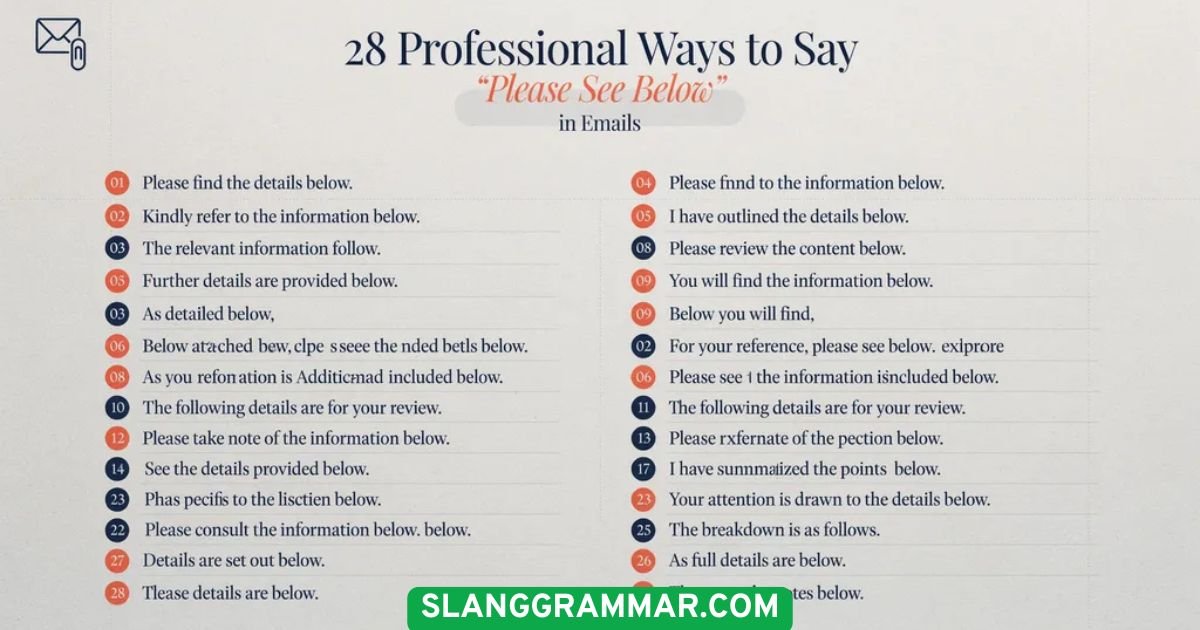
28 Professional Ways to Say “Please See Below” in Emails
Most of us type it without thinking twice. You finish explaining something in an email, you’ve attached a file or added details further down the page, and you tack on a quick “please see below” before hitting send. It’s one of those phrases that’s become so automatic in business communication that nobody really stops to ask if it’s the best choice for the moment.
The truth is, please see below works fine in plenty of situations, but it can also feel a little flat, repetitive, or even slightly abrupt depending on who’s reading it and what kind of relationship you have with them. If you send dozens of emails a day, using the same phrase every single time makes your writing sound mechanical, and that’s not great for email clarity or for keeping your client emails feeling personal and thoughtful.
This article walks through what the phrase actually means, when it fits naturally, and when you might want to reach for something else. You’ll get a full list of alternatives — twenty-eight of them — each with its own tone, a real example, and guidance on where it shines and where it falls flat. By the end, you’ll have a much bigger toolkit for formal email wording and casual notes alike, so you’re never stuck typing the same five words over and over.
What Does “Please See Below” Mean?
At its core, please see below is a simple directional phrase. It tells the reader that the information they need — an answer, a list, a quote, an attachment reference, or further explanation — is located further down in the same message, rather than somewhere else entirely. It’s a navigational cue more than anything emotional or persuasive. You’re essentially saying, “don’t stop reading yet, there’s more important stuff coming.”
The phrase grew out of standard email etiquette practices from the early days of corporate email, when long message threads and forwarded chains made it genuinely useful to point readers toward the right section. Before that, similar wording showed up in printed memos and reports, where “see below” or “see attached” guided readers through paper documents. As email became the default mode of workplace communication, the phrase carried over almost unchanged, and it’s stuck around because it’s short, clear, and universally understood.
In terms of email tone, it sits in a neutral-to-formal zone. It’s not warm, but it’s not cold either — it’s simply functional. That neutrality is exactly why so many alternatives exist: depending on your audience, you might want something a bit friendlier, a bit more formal, or a bit more specific about what exactly is “below.”
When to Use “Please See Below”
There are a handful of situations where this phrase genuinely does its job well, and recognizing them helps you decide when to keep it and when to swap it out.
The first is when you’re sending a longer email with details, instructions, or numbers that don’t fit neatly into the opening paragraph. Maybe you’re sharing a project timeline, a pricing breakdown, or a list of next steps. Telling the reader upfront that the details are coming helps them mentally prepare to keep scrolling instead of assuming the email is short and stopping after the first line.
The second common use is in reply chains, especially when you’re answering several questions at once. If a colleague sent you three or four questions in their last message, replying with something like “answers below” or “please see below” right after your opening line signals that you’re about to go through each point in order, which keeps the conversation organized.
The third situation is when forwarding information from another source — a report, a set of specs, or notes from a meeting. Saying the content is below lets the recipient know they’re not missing anything; the substance of the message lives further down rather than being summarized only in the first few sentences.
A fourth case worth mentioning is technical or operational emails, like IT tickets, status updates, or system logs, where readers expect data-heavy sections and a quick heads-up phrase keeps things efficient. And finally, it works in semi-formal internal memos where you don’t need a particularly warm tone, just clear direction — think internal policy updates or routine status reports where getting straight to the point matters more than building rapport.
Is It Professional or Polite to Say “Please See Below”?
Honestly, it’s professional enough for most contexts, but it’s not always the most polite or polished option, and the difference matters more than people realize. The phrase is grammatically fine and widely accepted in formal communication, so nobody is going to think less of you for using it. At the same time, it can come across as a bit impersonal or even slightly curt, especially in client-facing emails where a touch of warmth goes a long way toward building trust.
The honest answer is that context decides everything. In a quick internal email between coworkers who already have a comfortable working relationship, it reads as efficient and totally normal. In a first email to a new client, a formal proposal, or a message where you’re trying to smooth over a misunderstanding, it can feel a little blunt — almost like you’re rushing the reader along rather than guiding them.
| Pros of using it | Cons of using it |
| Quick, clear, and instantly understood by any reader | Can sound impersonal or routine if overused |
| Works well in both formal and semi-formal settings | Doesn’t add warmth, which matters in client relationships |
| Saves time when writing high-volume or repetitive emails | Repetition across many emails makes writing feel robotic |
| Universally recognized across industries and cultures | Offers no specific cue about what kind of information follows |
So it’s not a phrase to avoid entirely — it’s more that relying on it constantly limits your professional alternatives and makes your writing sound a little one-note. Mixing in some of the options below keeps your messages feeling fresh without sacrificing clarity.
A quick look at how these alternatives stack up against each other can help before going through each one individually. The table below shows the phrase, the setting it suits best, and the overall tone it carries.
| Alternative Phrase | Best Use Case | Tone |
| Kindly review the details below | Formal | Professional |
| Please refer to the information below | Formal | Neutral |
| Here are the details you requested | Semi-formal | Friendly |
| Below is the information you need | Semi-formal | Neutral |
| Please take a look at the information below | Informal | Warm |
| As outlined below | Formal | Professional |
| For your review, please see the following | Formal | Professional |
Other Ways to Say “Please See Below”
Each of the alternatives below carries its own shade of meaning, so think of this less as a simple swap-in list and more as a set of tools for different moods, audiences, and levels of formality.
Kindly Review the Details Below
This phrase carries a polished, somewhat traditional courtesy that immediately signals respect for the reader’s time and attention. It goes beyond a flat instruction — it invites the reader to slow down and genuinely study what follows rather than skim past it. The tone is formal and respectful, which makes it ideal for client proposals, HR notices, or any message where careful reading actually matters.
Example: “Kindly review the details below and confirm your availability by Friday.”
It’s a great fit for formal external communication where courtesy and precision both count. It does feel a touch ceremonial for everyday back-and-forth, so for a quick note to a teammate you talk to daily, something more relaxed would land better.
Please Refer to the Information Below
This phrase reads as straightforward and businesslike, the kind of wording you’d expect in a well-organized report or technical update. It goes beyond simply pointing downward — it frames what follows as a reference point the reader can return to, not just a one-time read. The tone is neutral and efficient, which makes it ideal for documentation-heavy emails and status updates.
Example: “Please refer to the information below for the updated shipping schedule.”
It’s a great fit for technical or operational emails where clarity matters more than warmth. It does feel a little dry for relationship-building messages, so for a thank-you note or a first outreach to a new contact, something friendlier would land better.
Here Are the Details You Requested
This phrase has a responsive, attentive quality that makes the reader feel heard rather than simply informed. It goes beyond a generic announcement — it confirms that you registered their specific question and followed through on it. The tone is warm and service-minded, which makes it ideal for client emails and direct answers to a prior ask.
Example: “Here are the details you requested regarding our pricing tiers.”
It’s a great fit for situations where someone explicitly asked you for something. It does feel slightly mismatched when nobody actually requested anything, so for unprompted updates, a more neutral opener would land better.
Below Is the Information You Need
This phrase comes across as confident and anticipatory, almost like you’re a step ahead of the reader’s questions. It goes beyond stating availability — it signals that you’ve already considered what matters most to them and prepared accordingly. The tone is direct and helpful, which makes it ideal for onboarding emails and welcome packets.
Example: “Below is the information you need to set up your new account.”
It’s a great fit for instructional messages where you’re guiding someone through a process. It does feel a touch presumptuous if you’re not fully certain what the reader needs, so for open-ended updates, something more tentative would land better.
Please Take a Look at the Information Below
This phrase has an easygoing, conversational quality that softens what could otherwise feel like an instruction. It goes beyond a plain directive — it invites collaboration, almost like you’re asking for their thoughts rather than just their attention. The tone is warm and low-pressure, which makes it ideal for team updates and casual collaborative threads.
Example: “Please take a look at the information below and let me know your thoughts.”
It’s a great fit for informal exchanges between colleagues who already know each other well. It does feel underdressed for formal legal or executive communication, so for a message to a senior stakeholder you don’t know well, something more formal would land better.
As Outlined Below
This phrase has a clean, structured feel that fits naturally into plans, agreements, and recaps. It goes beyond simply pointing to content — it implies the information has already been organized into a logical sequence worth following closely. The tone is professional and slightly formal, which makes it ideal for project plans and contractual language.
Example: “Your responsibilities for this phase are as outlined below.”
It’s a great fit for structured or numbered content that benefits from a businesslike frame. It does feel oddly stiff in a single casual line between familiar teammates, so for quick informal check-ins, something looser would land better.
For Your Review, Please See the Following
This phrase makes the reader’s role explicit, signaling that their feedback or approval is expected, not just their passive attention. It goes beyond a neutral pointer — it sets up an action item rather than a simple read. The tone is formal and purposeful, which makes it ideal for draft approvals and proposal sign-offs.
Example: “For your review, please see the following revised budget figures.”
It’s a great fit for approval workflows where a decision is actually needed. It does feel misleading when no review is actually required, so for purely informational updates, a simpler phrase would land better.
Kindly Find the Details Below
This phrase carries a gentle, courteous quality, suggesting the information is simply available rather than something demanding active study. It goes beyond plain delivery — it adds a layer of old-fashioned politeness that softens administrative or transactional messages. The tone is polite and somewhat formal, which makes it ideal for order confirmations and customer service replies.
Example: “Kindly find the details below regarding your recent order.”
It’s a great fit for transactional emails where courtesy still matters. It does feel a touch old-fashioned for fast-moving internal threads, so for quick day-to-day updates among coworkers, something more modern would land better.
Read Also: 28 Other Ways to Say “More Than Happy to Help” (With Examples)
I’ve Listed the Information Below
This phrase has a personal, accountable quality, making clear that you specifically organized the content rather than it simply appearing on its own. It goes beyond a passive pointer — it signals effort and ownership on your part. The tone is warm yet organized, which makes it ideal for project updates and detailed personal correspondence.
Example: “I’ve listed the information below in the order we discussed.”
It’s a great fit for semi-formal messages where showing initiative helps. It does feel slightly self-referential in very formal documents, so for official notices where the focus should stay on the content, something more impersonal would land better.
The Following Information May Help
This phrase has a gentle, suggestive quality that frames what follows as useful context rather than mandatory reading. It goes beyond stating facts — it gives the reader permission to skim or skip if it’s not relevant to them. The tone is soft and considerate, which makes it ideal for support emails and optional background details.
Example: “The following information may help clarify our return policy.”
It’s a great fit for FAQs and supplementary explanations. It does feel a little too tentative when the information is actually essential, so for must-read instructions, something more assertive would land better.
Here’s What You Need to Know
This phrase has a punchy, confident quality that’s become especially common in modern email communication. It goes beyond a neutral pointer — it promises the reader exactly the right amount of information, no more and no less. The tone is friendly yet assertive, which makes it ideal for announcements and quick status updates.
Example: “Here’s what you need to know about the upcoming system maintenance.”
It’s a great fit for internal and external announcements that need to grab attention fast. It does feel a touch casual for traditional industries like law or finance, so for highly formal notices, more measured wording would land better.
For Your Convenience, the Information Is Below
This phrase leans into hospitality, making the reader feel like you’ve gone out of your way to simplify things for them. It goes beyond simple delivery — it frames the act of organizing information as a courtesy rather than a routine task. The tone is warm and service-oriented, which makes it ideal for client and customer-facing emails.
Example: “For your convenience, the information is below in a single table.”
It’s a great fit for messages where a little extra politeness builds goodwill. It does feel slightly excessive in quick internal notes, so for routine team updates, something more efficient would land better.
Please Review the Following Notes
This phrase signals that what’s coming isn’t raw data but considered commentary, making it well suited to feedback and observations rather than lists or attachments. It goes beyond a generic pointer — it sets the expectation of thoughtful, written analysis. The tone is formal and measured, which makes it ideal for meeting recaps and performance reviews.
Example: “Please review the following notes from yesterday’s client call.”
It’s a great fit for emails summarizing discussion or feedback. It does feel mismatched when what follows is actually a simple list or attachment, so for that kind of content, a more literal phrase would land better.
Take a Look at the Section Below
This phrase adds helpful precision by pointing to one specific part of a longer message rather than the whole thing. It goes beyond a general directive — it saves the reader time by narrowing exactly where to focus. The tone is easygoing and conversational, which makes it ideal for long internal emails with multiple sections or headers.
Example: “Take a look at the section below titled ‘Next Steps.'”
It’s a great fit for teams that already communicate informally and need quick navigation cues. It does feel too casual for short, formal client communications, so for that kind of message, more polished wording would land better.
Here’s the Summary Below
This phrase sets clear expectations upfront, letting the reader know they’re getting a condensed version rather than every last detail. It goes beyond a plain pointer — it signals brevity, which helps readers mentally prepare for a quick read. The tone is friendly and efficient, which makes it ideal for status updates and wrap-up emails.
Example: “Here’s the summary below, with the full report attached for reference.”
It’s a great fit for emails giving a quick overview before a deeper document. It does feel misleading if what follows is actually lengthy or highly detailed, so for that kind of content, a different phrase would land better.
Please Find the Details Below
This phrase has a neutral, slightly formal businesslike quality, common in administrative and transactional messages. It goes beyond a bare pointer — it carries a small note of formality without sounding overly courteous or stiff. The tone is professional and even-keeled, which makes it ideal for invoices, confirmations, and policy notices.
Example: “Please find the details below regarding your subscription renewal.”
It’s a great fit for procedural or administrative communication. It does feel a bit generic if used in every single message, so for emails meant to feel more personal, something warmer would land better.
See Below for More Information
This phrase strips away extra politeness markers in favor of speed and efficiency, which fits fast-moving conversations between people who already know each other. It goes beyond formality — it gets straight to the point without softening the instruction. The tone is neutral and utilitarian, which makes it ideal for quick internal notes and rapid back-and-forth threads.
Example: “See below for more information on the budget changes.”
It’s a great fit for fast internal communication where speed matters more than tone. It does feel a touch curt for client-facing emails, so for those, a warmer alternative would land better.
Below, You’ll Find the Relevant Details
This phrase reassures the reader that what follows has been filtered for relevance rather than dumped in full. It goes beyond a simple pointer — it implies a bit of editorial care on your part. The tone is thoughtful and organized, which makes it ideal for detailed reports and research summaries.
Example: “Below, you’ll find the relevant details from our market analysis.”
It’s a great fit for analytical or research-heavy emails with a lot of supporting material. It does feel unnecessarily wordy for a short, simple message, so for those, a shorter phrase would land better.
For Your Reference, the Information Is Below
This phrase has an archival, documentation-style quality, implying the reader might want to save or revisit it rather than act on it right away. It goes beyond immediate delivery — it frames the content as something worth keeping on file. The tone is formal and record-oriented, which makes it ideal for compliance notices and policy summaries.
Example: “For your reference, the information is below regarding our updated terms of service.”
It’s a great fit for legal-adjacent or compliance communication. It does feel overly formal for a casual exchange where immediate action is the actual goal, so for that, something more direct would land better.
I’ve Outlined Everything Below

This phrase suggests real thoroughness, implying you’ve taken the time to organize the content carefully rather than just listing it. It goes beyond a basic pointer — it reassures the reader they won’t need to ask follow-up questions. The tone is warm and conscientious, which makes it ideal for complex project handoffs.
Example: “I’ve outlined everything below so you don’t have to ask follow-up questions.”
It’s a great fit for detailed handoffs where completeness matters. It does feel like an overstatement if the email only covers part of a larger topic, so for partial updates, a more modest phrase would land better.
Please Consult the Information Below
This phrase has a technical, almost instructional quality, fitting naturally into manuals and detailed documentation. It goes beyond a casual pointer — it implies the reader may need to actively apply what follows, not just read it. The tone is formal and precise, which makes it ideal for IT and technical support emails.
Example: “Please consult the information below before configuring the new software.”
It’s a great fit for technical instructions requiring careful application. It does feel needlessly stiff in everyday correspondence between colleagues, so for casual updates, something simpler would land better.
Read Also: 28 Other Ways to Say “Thanks for the Clarification” (With Examples)
The Relevant Details Are Outlined Below
This phrase combines structure and selectivity, reassuring the reader that the content has been both organized and filtered specifically for them. It goes beyond a plain pointer — it signals two layers of care: relevance and order. The tone is formal and organized, which makes it ideal for multi-section reports and structured proposals.
Example: “The relevant details are outlined below for each department.”
It’s a great fit for longer, categorized emails with several distinct sections. It does feel redundant in a short message where “relevant” doesn’t need separate mention, so for brief notes, a simpler phrase would land better.
Here’s a Quick Overview Below
This phrase sets a light, approachable tone by promising something brief and digestible rather than dense or exhaustive. It goes beyond a neutral pointer — it tells the reader exactly how much effort to expect before they even start reading. The tone is casual and welcoming, which makes it ideal for newsletters and digest-style updates.
Example: “Here’s a quick overview below of what changed this month.”
It’s a great fit for digest emails meant to be read quickly. It does feel like it undersells the message if what follows is actually long or detailed, so for that kind of content, a different phrase would land better.
Please Go Through the Information Below
This phrase implies a bit more effort from the reader than simply glancing, suggesting careful, sequential reading rather than a quick skim. It goes beyond a soft suggestion — it sets a clear expectation of attention. The tone is formal and direct, which makes it ideal for pre-meeting prep and onboarding materials.
Example: “Please go through the information below before our meeting tomorrow.”
It’s a great fit for situations where preparation genuinely matters. It does feel demanding in quick, casual exchanges, so for those, a lighter phrase would land better.
For Additional Context, Please See Below
This phrase makes clear that what follows is supporting detail, not the main point of the message, which helps the reader calibrate how closely to read it. It goes beyond a generic pointer — it manages expectations about the role of the content below. The tone is helpful and clarifying, which makes it ideal for explanatory emails and background notes.
Example: “For additional context, please see below regarding why the deadline shifted.”
It’s a great fit for messages where the real point was already made and this is just backup detail. It does feel out of place if the content below is actually the main subject, so for that, a more direct phrase would land better.
The Information You Requested Is Below
This phrase is direct and accountable, clearly tying the content back to an earlier request from the reader. It goes beyond a generic announcement — it closes a loop that was already opened in a previous conversation. The tone is professional and responsive, which makes it ideal for formal business correspondence answering a specific ask.
Example: “The information you requested is below, along with two supporting documents.”
It’s a great fit for situations where there was an actual prior request to point back to. It does feel confusing when no request was ever made, so for unprompted information, a different opener would land better.
Please Review the Attached Details Below
This phrase covers both an attachment and in-body text at once, making it useful when your email genuinely includes both. It goes beyond a single-purpose pointer — it asks the reader to engage with two different sources of information together. The tone is formal and thorough, which makes it ideal for contracts and forms requiring both reading and a signature.
Example: “Please review the attached details below and sign where indicated.”
It’s a great fit for emails combining a document and supporting context. It does feel redundant when there’s no actual attachment involved, so for those cases, a simpler phrase would land better.
As Detailed Below
This phrase is compact and formal, often showing up in legal, financial, or highly structured communication where brevity carries its own kind of authority. It goes beyond casual pointing — it signals precision and a no-nonsense register. The tone is neutral and businesslike, which makes it ideal for statements and formal notices.
Example: “Your account adjustments are as detailed below.”
It’s a great fit for formal financial or legal communication. It does feel cold in personal or relationship-building correspondence, so for those, something warmer would land better.
Quick Reference Table
Here’s a condensed view of every alternative covered above, organized by tone and best-fit setting so you can scan quickly when you’re drafting an email and need the right phrase fast.
| Alternative Phrase | Tone | Best Use Case |
| Kindly review the details below | Professional | Formal |
| Please refer to the information below | Neutral | Formal |
| Here are the details you requested | Friendly | Semi-formal |
| Below is the information you need | Neutral | Semi-formal |
| Please take a look at the information below | Warm | Informal |
| As outlined below | Professional | Formal |
| For your review, please see the following | Professional | Formal |
| Kindly find the details below | Polite | Formal |
| I’ve listed the information below | Warm | Semi-formal |
| The following information may help | Friendly | Informal |
| Here’s what you need to know | Friendly | Semi-formal |
| For your convenience, the information is below | Warm | Semi-formal |
| Please review the following notes | Professional | Formal |
| Take a look at the section below | Friendly | Informal |
| Here’s the summary below | Friendly | Semi-formal |
| Please find the details below | Neutral | Formal |
| See below for more information | Neutral | Informal |
| Below, you’ll find the relevant details | Professional | Semi-formal |
| For your reference, the information is below | Professional | Formal |
| I’ve outlined everything below | Warm | Semi-formal |
| Please consult the information below | Professional | Formal |
| The relevant details are outlined below | Professional | Formal |
| Here’s a quick overview below | Friendly | Informal |
| Please go through the information below | Professional | Formal |
| For additional context, please see below | Helpful | Semi-formal |
| The information you requested is below | Professional | Formal |
| Please review the attached details below | Professional | Formal |
| As detailed below | Neutral | Formal |
FAQ’s
What is the meaning of “please see below”?
“Please see below” means the reader should look at the information written under that sentence.
How do I say “see below” in an email?
You can say “Please see below,” “Please review the details below,” or “Kindly find the information below.”
Is “see below” correct?
Yes, “see below” is correct, but “please see below” sounds more polite and professional in emails.
How do you say “please find below” in an email?
You can write “Please find the details below” or “Kindly find the requested information below.”
How do I ask politely in an email?
Use polite words like “please,” “kindly,” and “would you mind” to make your request sound respectful.
Conclusion
Every email needs clear and simple words to work well. The phrase “please see below” works well in many situations. It points the reader to the right place in the message. This small phrase saves time and avoids confusion. Good writers always pick the right words for the right moment. They match their tone to the reader and the purpose of each email.
Many other phrases can replace “please see below” in a smart way. Each phrase carries its own tone and style. A student can learn these phrases and use them with full confidence. Practice helps every writer build strong email skills over time. Simple steps lead to clear and correct writing. Anyone can master these phrases with patience and care.
Related Guides:
1: 28 Other Ways to Say “Thank You for Your Consideration” (With Examples)
2: 28 Other Ways to Say “You Got This” (With Real Examples)
3: 28 Other Ways to Say “It Was a Pleasure Meeting You” (Professional & Polite Alternatives)
4: 26 Other Ways to Say Okay (Formal, Casual & Professional)
5: 28 Professional Ways to Say “I Am Interested in This Position”