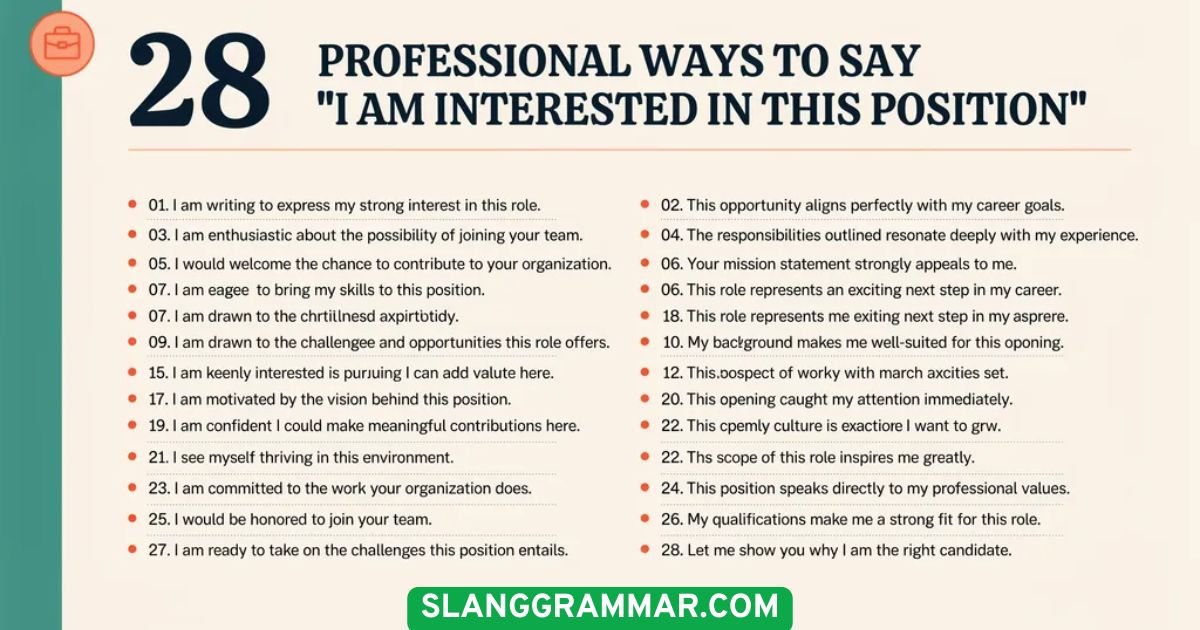
28 Professional Ways to Say “I Am Interested in This Position”
Picture this: you’ve found the perfect job posting. The role fits your experience, the company excites you, and you’re ready to apply. But when you sit down to write your cover letter or shoot off that email to the hiring manager, every sentence starts with the same flat phrase — I am interested in this position. It gets the message across, sure, but does it really capture how much you want this role?
Saying I am interested in this position is perfectly acceptable, but it can sometimes land as generic or uninspired, especially when a recruiter is reading through dozens of applications. Swapping it out for a more intentional, specific phrase can make your opening line feel more confident, more genuine, and far more memorable. The right wording signals not just that you want the job, but why — and that distinction matters more than most candidates realize.
This article walks you through 28 strong alternatives, each explained with tone, context, and a real example. Whether you’re writing a cover letter, reaching out on LinkedIn, following up after a networking call, or sending a cold email to a hiring manager, you’ll find the right phrase for every situation here.
What Does “I Am Interested in This Position” Mean?
At its core, I am interested in this position is a straightforward declaration of intent. It tells the reader that you’ve seen the job listing and you want to be considered for it. The phrase has been a staple of job application language for decades, and there’s nothing technically wrong with using it. It’s clear, direct, and universally understood.
The phrase is most commonly used at the opening of a cover letter, in the subject line of a job application email, or in the first message to a recruiter. It sets up everything that follows — your qualifications, your enthusiasm, your reasons for applying. The problem isn’t the meaning. It’s the energy (or lack of it). The phrase is neutral to the point of being almost invisible, and in a competitive job market, blending in with every other applicant is rarely a winning strategy.
Understanding the alternatives doesn’t mean abandoning the phrase entirely. It means knowing when to use it, when to upgrade it, and how to match your wording to the specific context, audience, and tone of the role you’re applying for.
When to Use “I Am Interested in This Position”
There are genuine situations where this phrase works just fine, and it’s worth knowing them before you start swapping things out.
If you’re applying to a highly formal industry — law, government, traditional finance, or institutional academia — plain, direct language is often preferred over enthusiastic phrasing. A straightforward declaration like I am interested in this position can read as professional and measured rather than flat. Similarly, when you’re filling out an online application form that asks you to briefly state your reason for applying, keeping it simple is entirely appropriate.
The phrase also works well in situations where you’ve been referred by someone inside the company. You don’t need to oversell yourself in the opening line when your contact has already done some groundwork for you. A clean, simple opener followed by a strong paragraph about your qualifications gets the job done.
When you’re applying to multiple roles at the same company and want to keep your tone consistent, using this phrase as a neutral baseline can help. And finally, if you’re a student or early-career candidate writing one of your first formal application letters, this phrase is a solid, safe starting point — especially if you’re still developing your voice in professional writing.
Is It Professional or Polite to Say “I Am Interested in This Position”?
Honestly? Yes — it’s both professional and polite. But being professional and being impressive are two different things.
The phrase is grammatically correct, widely accepted, and never offensive. A recruiter reading it won’t be put off by it. What it lacks is specificity and energy. It tells the reader you applied; it doesn’t tell them why this role, this company, or this team stood out to you. And that “why” is often what separates a forgettable application from one that gets a callback.
Here’s a quick look at the honest pros and cons:
| Factor | Using “I am interested in this position” |
| Professionalism | ✅ Fully professional and appropriate |
| Clarity | ✅ Clear and direct |
| Warmth / Personality | ❌ Neutral — doesn’t show enthusiasm |
| Memorability | ❌ Generic — easy to overlook |
| Specificity | ❌ Doesn’t explain your “why” |
| Versatility | ✅ Works across industries and formats |
The takeaway: the phrase is a reliable baseline, but for most applications — especially competitive ones — upgrading it with a more specific, energetic alternative will serve you better.
28 Other Ways to Say “I Am Interested in This Position”
1. I Am Excited About the Opportunity to Join Your Team
This phrase does several things at once. It expresses enthusiasm about the opportunity, uses inclusive language (“your team”), and feels warm without being over the top. The tone is semi-formal and genuinely friendly, making it well-suited to company cultures that value collaboration and personality alongside credentials.
Example: “I am excited about the opportunity to join your team and contribute to the work you’re doing in sustainable product design.”
It works especially well in cover letters for creative, marketing, or startup roles. It would feel slightly out of place applying for a senior-level government position where measured, formal language is the norm.
2. I Would Love the Opportunity to Contribute to Your Organization
Warm, humble, and forward-looking — this phrase shifts the focus from your desire to what you can offer. That subtle pivot from “I want” to “I want to contribute” is meaningful. It signals that your interest is grounded in genuine motivation to add value, not just in landing a paycheck.
Example: “I would love the opportunity to contribute to your organization’s mission of expanding access to financial literacy.”
This works well in nonprofit, education, or mission-driven roles. It’s a touch too casual for strict corporate or legal environments.
3. I Am Eager to Apply My Skills to This Role
Eager is a word that carries quiet energy — it’s enthusiastic without being over-the-top, and it instantly tells the reader that you’re ready to act. Pairing it with a reference to your skills makes this phrase both expressive and substantive. The tone sits in a professional-to-semi-formal range, and it lands best when followed by a sentence that names a specific skill or achievement.
Example: “I am eager to apply my skills in data analysis and process optimization to this operations manager role.”
It fits well in technical, analytical, or project-management fields. If the company culture is very casual or creative, it might feel just slightly stiff.
4. This Role Aligns Perfectly with My Career Goals
One of the most powerful alternatives because it reframes the conversation entirely. Instead of starting with what you want, you start with role alignment — which is exactly what a recruiter wants to hear. It tells them immediately that you’ve done your homework, that this isn’t a spray-and-pray application, and that you’ve thought carefully about why this role matters to your trajectory.
Example: “This role aligns perfectly with my career goals of leading cross-functional teams in the healthcare technology space.”
Ideal for mid-career to senior-level applications and for roles in fields where career development is an important part of the conversation. Not the best fit for entry-level applications where career trajectory is still being established.
5. I Am Enthusiastic About the Possibility of Joining [Company Name]
Personalizing with the company name might seem like a small touch, but it signals that this message was written for them specifically — not copied and pasted. Enthusiastic is a strong, positive word that suggests genuine investment. The tone is warm and professional, landing well for companies that emphasize culture fit.
Example: “I am enthusiastic about the possibility of joining Greenwave Technologies and being part of a team that’s reshaping energy infrastructure.”
This works beautifully in cover letters and LinkedIn outreach. It requires you to name the company, which means you shouldn’t use it if you’re sending a template to multiple employers without personalizing.
6. I Am Confident That My Background Makes Me an Excellent Fit for This Position
This phrase takes a bold, assured tone that’s appropriate for candidates who have strong, directly relevant experience. The word “confident” does real work here — it sets a decisive energy that stands out from more tentative openers. This is the kind of phrasing that reads as assertive rather than arrogant when backed up by evidence in the paragraphs that follow.
Example: “I am confident that my background in B2B software sales makes me an excellent fit for this account executive position.”
Best suited for experienced professionals applying to roles that closely match their history. It can backfire slightly if you’re applying for a stretch role or making a significant career pivot.
7. I Was Thrilled to Come Across This Opening
Casual, genuine, and hard to fake — this phrase sounds like something a real person would actually say, and that authenticity can be refreshing to read. The friendly tone signals warmth and real excitement without being performative. It works best when the rest of the message backs it up with substance.
Example: “I was thrilled to come across this opening and immediately saw how closely it matched the work I’ve been doing in UX research.”
Perfect for startups, creative agencies, small businesses, or any company whose culture skews informal and values personality. It would read as too casual for traditional corporate or legal environments.
8. I Am Writing to Express My Strong Interest in the [Job Title] Role
This is the classic formal opener that never goes out of style in traditional professional contexts. It’s clean, unambiguous, and appropriately direct. The phrase works especially well in industries where formality signals respect and seriousness — finance, law, medicine, government, and academia.
Example: “I am writing to express my strong interest in the Senior Compliance Officer role listed on your careers page.”
A reliable choice for formal cover letters and email applications to hiring managers in traditional sectors. In casual or startup environments, it can feel overly stiff.
9. I Am Drawn to This Position Because of [Specific Reason]
This is one of the smartest structures on the list because it forces specificity. The phrase announces your interest and immediately anchors it to a real reason, which instantly separates you from applicants who offer no context. The tone is thoughtful and genuine, and it works across almost any industry when you fill in the second half meaningfully.
Example: “I am drawn to this position because of the company’s commitment to building tools that serve underrepresented communities.”
Excellent for roles at mission-driven companies, B-corps, nonprofits, or any organization where values are central to the brand. If you leave the “because” empty or vague, though, the phrase loses all its power.
Read Also: 25 Other Ways to Say “Sorry I Missed Your Call” (Professional & Polite Alternatives)
10. The [Job Title] Role at [Company] Is an Exciting Opportunity That I Would Welcome
Slightly more elaborate, this phrase leads with the role itself rather than with “I” — a subtle structural change that can feel refreshing to a reader who has processed hundreds of “I”-first applications. The tone is polished and confident, fitting well in senior-level applications.
Example: “The Director of Communications role at Meridian Health is an exciting opportunity that I would welcome with great enthusiasm.”
Works well in senior-to-executive cover letters and formal professional correspondence. It’s a bit long for subject lines or brief email openers.
11. I Would Be Honored to Be Considered for This Role
This phrase carries a tone of genuine humility and respect that lands beautifully in highly competitive or prestigious applications. When you’re applying for a dream role at a company you deeply admire, this phrasing communicates sincerity without going over the top. It’s formal in tone but emotionally resonant.
Example: “I would be honored to be considered for this role and to bring my decade of experience in urban planning to your organization.”
Ideal for prestigious institutions, industry leaders, or roles you’ve actively aspired to. In a casual company context, it might come across as overly formal or stiff.
12. I Am Motivated to Bring My Expertise in [Skill] to This Team
This phrase leads with motivation and value, making it a strong choice when you want your opener to immediately signal what you bring to the table. By naming a specific skill or area of expertise, you turn a vague expression of interest into a mini value proposition.
Example: “I am motivated to bring my expertise in supply chain analytics to this team and help improve end-to-end visibility across your global operations.”
Works well in technical, operational, and specialist roles. Make sure the skill you name is genuinely relevant to the position — otherwise this phrase can sound disconnected.
13. I Believe My Skills and Experience Make Me an Ideal Candidate for This Position

Measured and professional, this phrase lands with quiet confidence. “I believe” softens it just enough to avoid sounding arrogant, while the rest of the sentence makes a clear, direct claim. The tone is professional and serious, and it pairs well with applications to established corporations, mid-size firms, and competitive roles.
Example: “I believe my skills and experience in clinical trial coordination make me an ideal candidate for this position.”
A strong choice for formal industries and mid-to-senior-level roles. It’s a touch impersonal for companies that put a heavy emphasis on culture and personality fit.
14. This Opportunity Excites Me Because It Combines [Two Relevant Aspects]
A creative and highly specific opener, this structure works by naming two things about the role or company that genuinely excite you. That specificity is the whole point — it shows you’ve read the job description carefully and that your interest is authentic rather than generic.
Example: “This opportunity excites me because it combines my background in editorial strategy with my growing interest in podcast production.”
Perfect for creative, media, content, and hybrid roles where showing range and genuine curiosity is valued. It requires real personalization — don’t use it if you can’t fill in the brackets with something true and relevant.
15. I Am Passionate About the Work [Company] Is Doing and Would Love to Be Part of It
Passion is a word that can go either way in job applications — used carelessly, it sounds hollow; used with specificity, it’s genuinely compelling. This phrase pairs the emotional word with a concrete reference to the company’s work, which keeps it grounded.
Example: “I am passionate about the work Clearwater Conservation is doing to restore watershed ecosystems, and I would love to be part of that mission.”
Best for mission-driven organizations, purpose-led companies, and roles in sustainability, education, healthcare, and nonprofit sectors. In corporate or finance environments, “passionate” can occasionally read as overselling.
16. I Am Applying for This Position as It Aligns with My Professional Strengths
This is a focused, practical alternative that’s particularly useful when you want to signal alignment without sounding effusive. It respects the reader’s time and leads directly into what you can offer. The tone is professional and grounded, which suits industries where results matter more than personality.
Example: “I am applying for this position as it aligns closely with my professional strengths in project management and stakeholder communication.”
Works across most industries and experience levels, especially in formal or corporate settings. It’s slightly less warm than some of the other options, so it may not be the best fit for companies that emphasize culture and personality heavily.
17. I Am Inspired by [Company]’s Mission and Would Welcome the Chance to Contribute
When a company’s purpose genuinely resonates with you, saying so openly is both honest and strategically smart. Recruiters for mission-driven organizations often place enormous weight on cultural alignment and shared values — and this phrase speaks directly to that.
Example: “I am inspired by Brightpath Education’s mission to close learning gaps in underserved communities and would welcome the chance to contribute as a curriculum designer.”
Highly effective for nonprofits, social enterprises, B-corps, and companies with strong brand values. In purely commercial or profit-focused industries, it may come across as slightly idealistic if not paired with equally strong qualifications.
18. Having Followed [Company]’s Growth Closely, I Am Eager to Be Part of Your Next Chapter
This phrase does something most openers don’t — it demonstrates that your awareness of the company predates the job posting. That kind of informed interest signals genuine engagement rather than a reactive application. It works best when your follow-up content backs up the claim with specific observations.
Example: “Having followed Novaris’s growth in the diagnostics space closely over the past two years, I am eager to be part of your next chapter as a regulatory affairs specialist.”
Excellent for high-growth startups, scale-ups, or companies that have had notable recent developments. Avoid it if you can’t back up the “having followed closely” claim with real specifics.
19. I Believe This Role Is an Excellent Match for Both My Background and My Aspirations
This phrase is quietly powerful because it addresses the two things every hiring manager cares about: what you’ve already done, and where you’re headed. Role alignment with both experience and ambition gives this opener a full-picture feel that stands out.
Example: “I believe this role is an excellent match for both my background in digital marketing and my aspiration to lead brand strategy at a global scale.”
Works particularly well for mid-career candidates who are ready to take the next step. Less suited to entry-level roles where “aspirations” may feel ahead of the experience level.
20. I Am Reaching Out to Express My Interest in Joining the [Team/Department] at [Company]
This is a slightly warmer, more conversational take on the formal classic. Using “reaching out” gives it a slightly more human and direct tone, as though you’re initiating a genuine professional conversation rather than submitting a form.
Example: “I am reaching out to express my interest in joining the product team at Fieldstone Labs, particularly following the launch of your new automation platform.”
Ideal for networking emails, LinkedIn messages, and cold outreach to recruiters or hiring managers. It fits better in digital communication than in a traditional formatted cover letter.
21. Your [Job Title] Opening Caught My Attention Because [Specific Reason]
A strong, attention-grabbing structure that leads with the company rather than with yourself. Starting with “Your” puts the focus immediately on what drew you to them, which is a refreshing change of direction in a sea of self-centered openers. The tone is engaged and specific.
Example: “Your Senior UX Researcher opening caught my attention because the focus on accessibility-first design is exactly the work I’ve been doing for the past four years.”
Works beautifully in cover letters and direct outreach. Requires genuine specificity — if the “because” is vague, the whole phrase falls apart.
22. I Am Seeking a Role Where I Can [Specific Contribution], and This Position Feels Like the Right Fit
This structure works in reverse: instead of saying you want the job, you describe what you’re looking for — and then show how this role delivers it. That structure makes your application feel purposeful and self-aware, which is highly appealing to thoughtful hiring managers.
Example: “I am seeking a role where I can mentor early-career engineers and shape technical culture, and this engineering lead position feels like the right fit.”
Works particularly well for senior or leadership-level candidates who have earned the right to be selective. It can read as overconfident at the entry level.
Read Also: 25 Other Ways to Say “I Appreciate Your Help” (With Real Examples)
23. I Am Confident This Role Will Allow Me to Make a Meaningful Impact
A confident, forward-looking opener that positions you as someone focused on outcomes rather than just title or compensation. The phrase signals impact orientation, which is music to the ears of growth-focused companies and high-performance teams. The tone is assertive and professional.
Example: “I am confident this role will allow me to make a meaningful impact on customer retention through the data-driven strategies I’ve been refining over the past six years.”
Ideal for results-oriented companies, consultancies, and organizations that track performance closely. It can feel slightly presumptuous if you’re light on credentials to back it up.
24. After Learning More About [Company], I Am Convinced This Is the Right Opportunity for Me
This phrase signals that your interest is the result of research, not impulse — and that matters to any recruiter who wants candidates that genuinely care about the company they’re joining. The tone is thoughtful and deliberate, which works well across industries.
Example: “After learning more about Arcada’s approach to community-centered urban development, I am convinced this is the right opportunity for me at this stage of my career.”
Works best in follow-up messages and informational-interview-to-application pipelines. It’s less natural as a cold opener when you haven’t had prior contact with the company.
25. I Would Be Delighted to Discuss How My Experience Can Support Your Team’s Goals
Particularly effective as a closing statement or a transitional opener, this phrase communicates interest while immediately pivoting to action — a coffee chat, a phone call, or an interview. The tone is professional and approachable, with a warm invitation built into it.
Example: “I would be delighted to discuss how my experience in healthcare IT implementation can support your team’s goals in the coming fiscal year.”
Great for cover letter closings, follow-up emails, and LinkedIn outreach messages. As an opening line in a cold application, it can feel like you’re jumping ahead too quickly.
26. This Opportunity Resonates with Me on Both a Professional and Personal Level
A more emotionally layered phrase that works well when the company’s mission or the role’s nature genuinely connects with your life or values — not just your résumé. The tone is sincere and warm, and it can be highly memorable when backed up authentically.
Example: “This opportunity resonates with me on both a professional and personal level — I grew up in a community that lacked quality mental health resources, which is why your organization’s work feels so important to me.”
Incredibly powerful for roles in social services, healthcare, community development, and education. It risks feeling forced or hollow if the “personal level” connection isn’t genuine and specific.
27. I Am Particularly Interested in This Role Because of the Emphasis on [Specific Aspect]
Adding “particularly” adds weight and precision to a standard interest statement. It tells the reader that you’ve looked at many options and this one stood out for a specific reason. That selectivity is a compliment to the company and demonstrates thoughtful candidate motivation.
Example: “I am particularly interested in this role because of the emphasis on cross-functional collaboration and the opportunity to work at the intersection of product and marketing.”
Works well for roles where specific responsibilities are a differentiating factor. Best used when you have a genuinely specific aspect of the role to highlight — don’t manufacture one just to fill the template.
28. The Chance to Work on [Specific Project or Initiative] Is What Draws Me Most to This Role
One of the most specific alternatives on the list, and also one of the most effective. Naming a concrete project, product, initiative, or challenge that the company is working on shows that your interest is researched and real. It’s the kind of opener that prompts a hiring manager to sit up and pay closer attention.
Example: “The chance to work on the expansion of Sable’s mobile payments infrastructure across Sub-Saharan Africa is what draws me most to this role.”
Powerful for companies with publicly known projects, active research initiatives, or recently announced launches. Requires real homework — you need to know enough about the company to make this specific.
Quick Reference Table
Here’s a summary of all 28 alternatives to help you choose at a glance.
| Alternative Phrase | Tone | Best Use Case |
| I am excited about the opportunity to join your team | Warm, semi-formal | Cover letter, startup roles |
| I would love the opportunity to contribute to your organization | Warm, humble | Mission-driven roles, nonprofits |
| I am eager to apply my skills to this role | Professional, energetic | Technical and analytical positions |
| This role aligns perfectly with my career goals | Thoughtful, confident | Mid-to-senior career applications |
| I am enthusiastic about the possibility of joining [Company] | Personalized, warm | Any personalized application |
| I am confident my background makes me an excellent fit | Assertive, professional | Experienced candidates, close matches |
| I was thrilled to come across this opening | Casual, genuine | Startups, creative agencies |
| I am writing to express my strong interest in the [Title] role | Formal, classic | Law, finance, government |
| I am drawn to this position because of [reason] | Genuine, specific | Any — requires real specificity |
| The [Title] role at [Company] is an exciting opportunity I would welcome | Polished, senior | Senior-to-executive applications |
| I would be honored to be considered for this role | Humble, formal | Prestigious or competitive roles |
| I am motivated to bring my expertise in [skill] to this team | Value-forward, direct | Specialist and technical roles |
| I believe my skills and experience make me an ideal candidate | Measured, professional | Corporate and formal industries |
| This opportunity excites me because it combines [aspects] | Specific, creative | Hybrid or multi-skill roles |
| I am passionate about the work [Company] is doing | Emotional, sincere | Purpose-led and mission-driven orgs |
| I am applying as this aligns with my professional strengths | Grounded, direct | Most formal and corporate contexts |
| I am inspired by [Company]’s mission | Values-forward, warm | Nonprofits, social enterprises |
| Having followed [Company]’s growth closely, I am eager… | Informed, engaged | High-growth startups, scale-ups |
| I believe this role matches my background and aspirations | Balanced, forward-looking | Mid-career transition candidates |
| I am reaching out to express my interest in joining… | Human, conversational | Emails, LinkedIn, networking |
| Your [Title] opening caught my attention because… | Specific, direct | Cover letters, cold outreach |
| I am seeking a role where I can [contribution] | Purposeful, self-aware | Senior and leadership candidates |
| I am confident this role will allow me to make a meaningful impact | Assertive, outcomes-focused | Results-driven organizations |
| After learning more about [Company], I am convinced… | Deliberate, researched | Follow-ups, post-informational interviews |
| I would be delighted to discuss how my experience supports your goals | Warm, action-oriented | Closing statements, follow-ups |
| This opportunity resonates with me professionally and personally | Sincere, emotional | Social/healthcare/education roles |
| I am particularly interested because of the emphasis on [aspect] | Precise, thoughtful | Roles with specific differentiators |
| The chance to work on [project] draws me most to this role | Highly specific, engaged | Known-project roles, research |
FAQ’s
How Do I Say I Am Interested in This Position?
You can say, “I am very interested in this position because it matches my skills, experience, and career goals.”
“I believe I can add value to your team and grow professionally in this role.”
How Do I Professionally Say I’m Interested?
Professionally, say, “I am excited about this opportunity and would be grateful to be considered for the position.”
“This role strongly aligns with my background and professional interests.”
How to Express Interest for a Position?
Express interest by showing why the role fits your skills and why you want to join the company.
Keep your answer clear, positive, and focused on the value you can bring.
What Makes Me Interested in This Position?
I am interested in this position because it allows me to use my skills in a meaningful way.
It also offers a chance to learn, grow, and contribute to the company’s success.
What Made You Interested in This Position Sample Answer?
“I became interested in this position because it matches my experience and career goals.”
“I admire your company’s work and believe I can contribute effectively to this role.”
Conclusion
The phrase I am interested in this position has served job seekers for a long time, and it will continue to do so. There’s nothing wrong with it. But language is one of the few things in a job application that you have complete control over — and using it intentionally can give you a real edge. The 28 alternatives in this guide aren’t about impressing recruiters with vocabulary. They’re about choosing words that accurately reflect why you’re applying, what you bring to the table, and how seriously you’ve thought about the opportunity.
When you’re deciding which phrase to use, think about three things: the formality of the industry, the culture of the company, and the strength of your specific reasons for applying. A formal tone works best in law, finance, and government. A warm and personalized tone works best in creative, nonprofit, and mission-driven spaces. A confident, value-focused opener works best when your experience is a strong direct match for the role.
Get that first sentence right, and everything else you write has a better foundation to stand on.
Related Guides:
1: How to Say Thank You for Your Partnership Without Sounding Like a Broken Record
2: 25+ Polite Ways to Say “Sorry for the Short Notice” (Informal & Professional Alternatives 2026 updated)
3: 30 Other Ways to Say “I Can’t Wait to See What the Future Holds”
4: Better Ways to Say Received With Thanks in Emails, Gifts, and Daily Messages
5: 28 Powerful Ways to Say Good To Know in Everyday and Professional Conversations