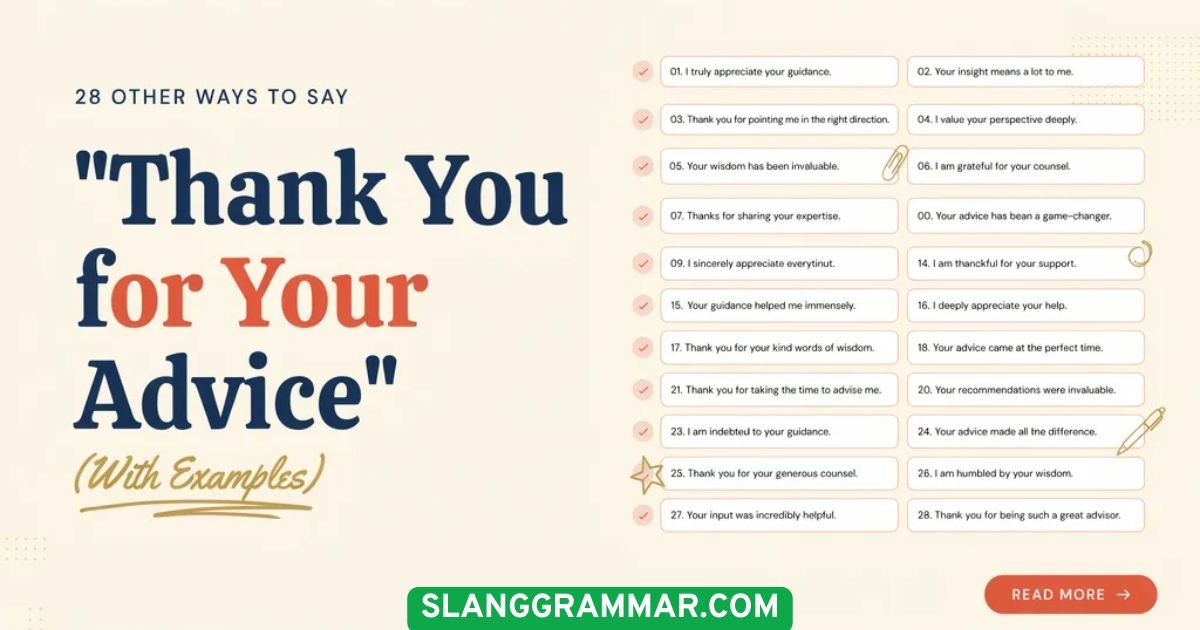
28 Other Ways to Say “Thank You for Your Advice” (With Examples)
Imagine you just got off a call with your mentor after a tough week at work. They listened, they guided you, and they gave you exactly the kind of perspective you needed. You want to send a follow-up message — something that feels genuine, not stiff or robotic. So you type out “Thank you for your advice” and then pause. It’s fine, sure. But it also feels like the verbal equivalent of a generic greeting card.
That little moment of hesitation is completely valid. The phrase thank you for your advice is everywhere — in emails, texts, LinkedIn messages, and handwritten notes. And while there’s nothing wrong with it, sometimes the situation calls for something more specific, more warm, or more polished. Using the right words can turn a forgettable message into one someone actually remembers.
This article covers 28 fresh, natural alternatives you can start using right away. Whether you’re expressing gratitude for professional guidance, thanking a friend for personal advice, or writing a formal note to a senior colleague, you’ll find the right phrase here.
What Does “Thank You for Your Advice” Mean?
At its core, thank you for your advice is a phrase of gratitude directed at someone who shared their perspective, knowledge, or recommendation to help you navigate a situation. The word “advice” refers to guidance offered — it implies the other person took the time to think about your situation and respond with helpful input. The phrase is polite, direct, and widely understood across cultures and professional settings.
Its usage is incredibly broad. You might say it to a doctor who explained your treatment options, a colleague who helped you prepare for a presentation, a parent who talked you through a big life decision, or a mentor who shared hard-earned wisdom from their own career. What ties all these situations together is the same core idea: someone cared enough to share what they know, and you want to acknowledge that.
The phrase is neither too formal nor too casual, which makes it versatile — but also somewhat neutral. In situations where you want to convey deeper appreciation, highlight something specific they said, or match the tone of a more personal or more formal relationship, a variation can do a much better job.
When to Use “Thank You for Your Advice”
This phrase works well in a surprising range of contexts, and knowing when it fits naturally helps you decide when to reach for one of the alternatives instead.
It’s perfectly appropriate after a mentorship conversation where someone shared career direction or feedback on your work. If a manager sat with you after a difficult project and offered constructive thoughts, thank you for your advice lands smoothly in your follow-up email. Similarly, when a friend or family member helps you work through a personal dilemma — a relationship conflict, a financial decision, a health concern — this phrase communicates sincere gratitude for personal advice without overthinking it.
The phrase also works in brief, transactional moments. If you asked a colleague a quick question and they pointed you in the right direction, a short “thank you for your advice” in a reply message is completely appropriate. It doesn’t require a long, elaborate response — it just closes the loop politely.
Where it starts to feel limited is when the advice genuinely changed how you think or act. In those moments, something more specific — something that names what you appreciated and why — carries far more weight. That’s exactly what the alternatives below are for.
Is It Professional or Polite to Say “Thank You for Your Advice”?
Absolutely — with some nuance worth knowing. The phrase is both professional and polite, and it’s safe to use in almost any context, from a casual Slack message to a formal business email. It’s respectful without being stiff, and warm without being overly familiar.
That said, like any frequently used phrase, it can start to feel formulaic if you rely on it too often or use it when something more specific would be more appropriate. Here’s a quick look at the pros and cons:
| Aspect | Detail |
| Tone | Neutral to warm; suitable for most relationships |
| Formality | Works in both formal and informal settings |
| Specificity | Low — doesn’t reference what the advice was |
| Impact | Moderate — polite, but not particularly memorable |
| Best use | Quick follow-ups, general gratitude, everyday exchanges |
| Less ideal for | High-stakes thank-yous, heartfelt acknowledgments, situations where specificity matters |
The conclusion? Use it freely in everyday situations, but when the advice genuinely moved the needle for you, reach for something more expressive.
28 Other Ways to Say “Thank You for Your Advice”
1. I Really Appreciate Your Guidance
This phrase reads as warm and respectful — the kind of line that feels natural coming from someone who recognizes they were genuinely helped, not just handed a quick answer. It goes beyond a surface-level thank-you by replacing “advice” with “guidance,” which implies a more sustained, thoughtful kind of support. The tone is appreciative and professional, which makes it especially well-suited to mentorship conversations and workplace relationships.
Example: “I really appreciate your guidance on navigating the promotion process — it gave me a much clearer path forward.”
It’s a great fit for follow-up emails to managers, mentors, or senior colleagues after a meaningful conversation. It does feel slightly over-formal in a casual text exchange with a friend, so for that context, something lighter would land better.
2. Your Input Means a Lot to Me
This phrase reads as personal and sincere — the kind of thing you say when you want someone to know their words actually landed. It goes beyond generic thanks by specifically calling out that their contribution carries weight with you. The tone is warm and semi-formal, leaning toward the personal side of professional.
Example: “Your input means a lot to me, especially given everything you’ve navigated in your own career.”
It’s a great fit for colleagues you have a genuine relationship with, or for people who offered support without being asked. It does feel too intimate in a first-time professional interaction with someone you barely know, so in that case a more neutral phrase would be more appropriate.
3. Thank You for Sharing Your Expertise
This phrase reads as respectful and considered — it tells the other person you didn’t just hear what they said, you recognized the knowledge and experience behind it. It goes beyond a standard thank-you by honoring the specific skill or professional depth someone brought to the conversation. The tone is professional and respectful, making it a strong choice when the person you’re thanking has real subject-matter authority.
Example: “Thank you for sharing your expertise on the legal side of this — I feel much more confident moving forward.”
It’s a great fit for conversations with consultants, specialists, or senior professionals whose knowledge you’re drawing on. It does feel mismatched in a casual exchange where a friend simply shared an opinion, since “expertise” implies a level of professional depth that may not apply.
4. I’m Grateful for Your Thoughtful Suggestions
This phrase reads as genuinely appreciative rather than automatic — the word “thoughtful” signals that you noticed the care behind what was offered, not just the content itself. It goes beyond a simple thank-you by acknowledging the effort and consideration the other person put into their response. The tone is warm and appreciative, with a sincerity that works especially well in written messages.
Example: “I’m grateful for your thoughtful suggestions about restructuring the report — they made a real difference in the final version.”
It’s a great fit for formal or semi-formal settings, particularly after someone offered detailed, considered feedback on a piece of work or a decision. It does feel like overkill in a brief back-and-forth where someone gave you a quick, offhand tip.
5. Thanks for Your Helpful Feedback
This phrase reads as friendly and direct — it’s efficient without feeling cold, and specific enough to feel intentional. It goes beyond a generic thank-you by framing the exchange as feedback, which implies the other person was evaluating or responding to something specific you shared. The tone is friendly and professional, striking a balance that works well in workplace settings.
Example: “Thanks for your helpful feedback on the draft — I’ve already made some of the changes you suggested.”
It’s a great fit for situations where someone reviewed your work, plans, or ideas and offered their thoughts. It does feel slightly off in purely personal conversations where no specific “thing” was being evaluated, since “feedback” implies a more structured exchange.
6. I Value Your Perspective on This
This phrase reads as thoughtful and collaborative — it tells the other person that the way they see things matters to you, not just what they said. It goes beyond a standard acknowledgment by putting emphasis on their point of view as something worth hearing, not just something politely received. The tone is professional and respectful, with an air of intellectual openness.
Example: “I value your perspective on this — it helped me see a side of the situation I’d been missing.”
It’s a great fit for team conversations, peer feedback, or situations where you genuinely considered someone’s viewpoint before making a decision. It does feel a little detached in very close personal relationships, where something warmer would feel more natural.
7. Your Advice Has Been Incredibly Helpful
This phrase reads as straightforward and sincere — there’s no fuss to it, just an honest acknowledgment that what the person said made a real difference. It goes beyond the base phrase by adding “incredibly helpful,” which gives the gratitude more weight without making it feel elaborate. The tone is friendly and genuine, suitable for a wide range of relationships and settings.
Example: “Your advice has been incredibly helpful — I feel much more prepared for the conversation now.”
It’s a great fit for both written and spoken thank-yous, from a follow-up email to an in-person moment at the end of a meeting. It does lean slightly informal, so in a very formal letter or high-stakes professional correspondence, a more structured phrase might serve you better.
8. I’m So Thankful for Your Support and Wisdom
This phrase reads as heartfelt and personal — it carries a warmth that signals you’re not just thanking someone for a quick answer, but for something that genuinely sustained you. It goes beyond standard gratitude by pairing “support” and “wisdom,” which together suggest both emotional presence and meaningful depth. The tone is warm and expressive, and it belongs in personal or close professional relationships.
Example: “I’m so thankful for your support and wisdom throughout this whole process — it truly made a difference.”
It’s a great fit for mentors, close friends, or family members who walked with you through something difficult or significant. It does feel excessive in a brief professional exchange or in a message to someone you’ve only spoken with once.
9. Thank You for Taking the Time to Help Me
This phrase reads as considerate and grounded — it acknowledges not just the advice itself, but the fact that the person chose to spend their time on you. It goes beyond a generic thank-you by putting the spotlight on the gift of time, which is often the most meaningful part of any act of help. The tone is sincere and considerate, and it resonates especially well when you know the other person had competing priorities.
Example: “Thank you for taking the time to help me work through this — I know how packed your schedule has been.”
It’s a great fit for busy professionals, managers, or anyone whose calendar is tight and who still made space for you. It does sound a little unnecessary when the other person had all the time in the world and genuinely sought out the conversation.
10. I Truly Appreciate Your Insight
This phrase reads as reflective and respectful — it implies the other person didn’t just offer a surface-level take, but helped you understand something more clearly. It goes beyond a standard thank-you by using “insight,” a word that carries intellectual depth and suggests the conversation was genuinely illuminating. The tone is warm and professional, with a slightly elevated register.
Example: “I truly appreciate your insight into how these dynamics work — it changed the way I’m approaching the whole situation.”
It’s a great fit for professional conversations that were intellectually substantive, or for situations where someone helped you see a problem differently. It does feel a touch stiff in casual spoken exchanges, so it’s better suited to written messages than to off-the-cuff conversation.
Read Also: 28 Other Ways to Say “Please Be Patient” in Customer Service and Business Emails
11. Your Guidance Has Made a Real Difference
This phrase reads as meaningful and specific — it doesn’t just say “thank you,” it tells the other person their advice had a measurable impact. It goes beyond an acknowledgment by pointing to an outcome, which transforms the gratitude from something passive into something that validates the other person’s contribution. The tone is genuine and expressive, and it carries the most weight when you can actually point to a result.
Example: “Your guidance has made a real difference in how I’m handling the project — the results already show it.”
It’s a great fit for follow-up messages sent after you’ve had a chance to act on what someone told you. It does ring hollow if used too early in a process before you’ve had the chance to see any real change, so timing matters here.
12. I Couldn’t Have Figured This Out Without You
This phrase reads as honest and warm — it doesn’t minimize what the other person contributed, and it doesn’t pretend you would have gotten there on your own. It goes beyond a standard thank-you by making the other person’s role in your progress explicit and central. The tone is warm and conversational, leaning personal in a way that feels natural with people you’re close to.
Example: “I couldn’t have figured this out without you — your suggestion about reframing the pitch completely turned it around.”
It’s a great fit for close colleagues, friends, or mentors with whom you have an established, comfortable relationship. It does come across as overly familiar in a formal business email to someone you’ve only just met, where something more measured would be more appropriate.
13. Thank You for Your Continued Support
This phrase reads as appreciative and relationship-aware — it tells the other person that you’ve noticed they’ve shown up for you more than once. It goes beyond a one-time thank-you by acknowledging a pattern of care and help over time. The tone is warm and professional, and it has a steadiness to it that reflects the nature of an ongoing relationship.
Example: “Thank you for your continued support through all these transitions — it has meant more than I can easily express.”
It’s a great fit for long-term mentors, colleagues who have supported your growth over months or years, or advisors who’ve stayed in your corner through multiple challenges. It does feel misapplied in a one-time exchange, since the word “continued” implies a history that simply may not exist.
14. I Appreciate You Sharing Your Knowledge
This phrase reads as respectful and acknowledging — it draws attention to the fact that the other person brought real knowledge into the conversation, not just an opinion. It goes beyond a generic thank-you by honoring what the person actually knows, making the gratitude feel targeted and informed. The tone is respectful and professional, well-suited to interactions where expertise was on display.
Example: “I appreciate you sharing your knowledge about the regulatory requirements — it saved me a significant amount of research time.”
It’s a great fit for professional contexts where someone with specialized experience gave you information you couldn’t easily have found on your own. It does feel slightly mismatched in personal conversations where a friend just gave you life advice from their own experience rather than professional knowledge.
15. Your Words of Wisdom Mean the World to Me
This phrase reads as deeply personal and heartfelt — it carries a reverence that sets it apart from most expressions of gratitude. It goes beyond a standard thank-you by framing what was said as something lasting, something worth holding onto. The tone is warm and deeply sincere, making it best reserved for moments that carry real emotional weight.
Example: “Your words of wisdom mean the world to me — I’ll carry what you said with me for a long time.”
It’s a great fit for handwritten notes, heartfelt personal messages, or conversations with mentors, parents, or trusted advisors who gave you something genuinely meaningful. It does feel overstated in a workplace email or in any context where the advice was fairly practical and straightforward.
16. I’m Really Grateful You Took the Time to Advise Me
This phrase reads as sincere and specific — it ties gratitude directly to the act of advising, while also honoring the time investment that came with it. It goes beyond a simple thank-you by naming both the action (advising) and the effort (taking the time), which makes the appreciation feel more considered. The tone is sincere and professional, fitting comfortably in follow-up messages after a meeting or call.
Example: “I’m really grateful you took the time to advise me on this — the conversation clarified a lot of things I’d been struggling with.”
It’s a great fit for post-meeting emails or messages sent shortly after a conversation where someone went out of their way to help you think something through. It does read as slightly formal when spoken aloud, so it works better in written communication than in a quick verbal thank-you.
17. Thank You for Pointing Me in the Right Direction
This phrase reads as light and genuine — it has an ease to it that makes it feel natural rather than rehearsed. It goes beyond a standard thank-you by acknowledging what advice often actually does: it doesn’t always solve everything, but it shows you where to go next. The tone is friendly and conversational, with a warmth that feels effortless in everyday exchanges.
Example: “Thank you for pointing me in the right direction — I’ll take it from here and let you know how it goes.”
It’s a great fit for casual workplace conversations, quick check-ins, or any moment where someone helped you get un-stuck without necessarily sitting with you for a long conversation. It does feel too informal for serious professional correspondence or for situations where the guidance was deep and substantive enough to deserve a more thoughtful acknowledgment.
18. I Appreciate Your Candid Perspective
This phrase reads as mature and respectful — it signals that you can handle honest feedback and that you value it. It goes beyond a generic thank-you by specifically calling out candor, which is not something everyone is willing to offer, especially when the honest answer might be uncomfortable to give. The tone is professional and respectful, with a directness that suits high-trust relationships.
Example: “I appreciate your candid perspective — it wasn’t what I expected to hear, but it was exactly what I needed.”
It’s a great fit for situations where someone gave you constructive criticism, a tough-love reality check, or an honest take that pushed back on your thinking. It does feel strange in contexts where the advice was entirely positive and affirming, since “candid” implies some element of difficult truth-telling.
19. Thanks for the Valuable Suggestions
This phrase reads as clean and professional — it gets to the point without unnecessary embellishment, which is exactly what’s needed in many workplace contexts. It goes beyond a basic thank-you by characterizing what was offered as “valuable,” which signals that the suggestions had real utility and weren’t just taken politely and forgotten. The tone is semi-formal and professional, efficient without being cold.
Example: “Thanks for the valuable suggestions during our last meeting — I’ve already incorporated a few of them into the revised plan.”
It’s a great fit for workplace emails, project-related follow-ups, or any professional context where you want to acknowledge someone’s input without over-elaborating. It does feel slightly impersonal in a message to a close friend or family member, where something warmer and more personal would be more fitting.
20. I’m Grateful for Your Thoughtful Guidance
This phrase reads as considered and sincere — it pairs genuine gratitude with an acknowledgment that the guidance you received wasn’t rushed or careless. It goes beyond a basic thank-you by drawing attention to the thoughtfulness behind the help, which honors the effort the other person put in. The tone is warm and professional, sitting comfortably in mentorship, advisory, and collegial relationships.
Example: “I’m grateful for your thoughtful guidance on how to approach this negotiation — it gave me the confidence to go in prepared.”
It’s a great fit for written messages following a detailed or considered conversation, especially with someone whose advice required real investment from them. It does feel slightly formal in quick verbal exchanges, where a shorter and more casual phrase would flow more naturally in conversation.
21. Your Advice Gave Me a Lot to Think About
This phrase reads as reflective and genuine — it’s different from most on this list because it doesn’t rush to say everything is sorted, it sits in the process. It goes beyond a standard thank-you by signaling that the advice was substantive enough to still be working on you, which is actually one of the most meaningful things you can tell someone. The tone is reflective and honest, and it feels natural when you’re still in the middle of a decision.
Example: “Your advice gave me a lot to think about — I’m still turning some of it over, but I know it’s going to shape my decision.”
It’s a great fit for situations where the guidance was complex, nuanced, or challenged your assumptions in a meaningful way. It does fall flat in contexts where you’ve already acted and moved on, since the reflective tone implies an ongoing process that would feel inconsistent with a closed outcome.
22. I’m So Appreciative of Your Help and Guidance
This phrase reads as warm and expansive — it covers more ground than a single thank-you by acknowledging both the practical help and the broader guidance someone offered. It goes beyond a standard expression of gratitude by pairing two distinct contributions together, which suggests the person’s support was multifaceted and not just one-dimensional. The tone is warm and sincere, leaning personal in a way that suits ongoing relationships.
Example: “I’m so appreciative of your help and guidance over the past few months — it’s played a bigger part in my growth than you probably realize.”
It’s a great fit for messages to mentors, long-term supporters, or anyone who has shown up for you in multiple ways over time. It does feel slightly excessive in a one-time professional exchange, where something more contained would match the scale of the interaction better.
23. Thank You for Offering Your Expertise

This phrase reads as gracious and aware — the word “offering” gives it a generosity that a simple thank-you doesn’t carry, as if you recognize that sharing knowledge is a choice the other person made. It goes beyond a standard expression of gratitude by framing expertise as something that was given freely, which elevates the acknowledgment. The tone is professional and respectful, well-suited to more formal interactions.
Example: “Thank you for offering your expertise on this — it’s made a significant difference in how we’re approaching the problem.”
It’s a great fit for consultants, subject-matter experts, senior professionals, or anyone whose specialized knowledge shaped your direction. It does feel unnecessarily formal in a personal context or in a quick exchange with a familiar colleague who just answered a question off the top of their head.
Read Also: 28 Other Ways to Say “Stay Tuned” in Business and Social Media
24. I Appreciate How Much Thought You Put Into This
This phrase reads as observant and personal — it goes beyond thanking someone for what they said to noticing how they said it, which feels genuinely attentive. It goes beyond a standard thank-you by drawing attention to the effort and care behind the advice, not just the advice itself. The tone is warm and specific, and it works best when you can genuinely sense that the other person didn’t just wing it.
Example: “I appreciate how much thought you put into this — your response covered angles I hadn’t even considered.”
It’s a great fit for situations where someone gave you a detailed, considered, or multi-layered response that clearly came from real reflection. It does feel out of place when the advice was casual and offhand, since implying deep thought behind a quick comment might feel inaccurate or even slightly ironic.
25. Your Support Has Been Invaluable
This phrase reads as sincere and substantial — “invaluable” is a word with weight, and it lands best when the situation genuinely calls for it. It goes beyond a regular thank-you by positioning the other person’s contribution as something that couldn’t be easily replaced or replicated. The tone is sincere and expressive, and it carries an emotional gravity that suits significant moments of support.
Example: “Your support has been invaluable throughout this transition — I genuinely couldn’t have done it without you.”
It’s a great fit for expressing gratitude for professional guidance or personal support that spanned a difficult chapter, a major decision, or a long-running challenge. It does feel like overstatement in a brief exchange where someone answered a single question, since the word “invaluable” implies a depth of contribution that should be earned.
26. I’m Thankful for Your Honest Feedback
This phrase reads as mature and self-aware — it tells the other person that honesty is something you actively welcome, not just tolerate. It goes beyond a generic expression of thanks by specifically calling out the quality of honesty, which not everyone offers and not everyone is comfortable receiving. The tone is professional and genuine, and it works particularly well when the feedback included something that was hard to hear.
Example: “I’m thankful for your honest feedback on the proposal — knowing what wasn’t working is just as helpful as hearing what is.”
It’s a great fit for professional settings where direct, constructive communication is part of the culture, or for close relationships where you’ve explicitly asked someone to be straight with you. It does feel slightly off in a context where the feedback was purely positive and encouraging, since highlighting “honesty” implies there was a degree of difficulty involved.
27. Thank You for Mentoring Me Through This
This phrase reads as deeply appreciative and relationship-aware — it goes further than most expressions of gratitude by acknowledging the nature of what the other person did, not just the content of what they said. It goes beyond a standard thank-you by naming the role the person played, which recognizes them as a mentor rather than just a helpful contact. The tone is warm and professional, and it carries a respect that suits genuine mentorship relationships.
Example: “Thank you for mentoring me through this — the way you helped me think through each step made a lasting impression.”
It’s a great fit for situations where someone didn’t just offer a tip but genuinely walked alongside you through a process, a challenge, or a period of growth. It does feel like an exaggeration in shorter, more casual exchanges where the support was helpful but not deep enough to constitute real mentorship.
28. Your Perspective Has Opened My Eyes
This phrase reads as genuine and impactful — it’s the kind of thing you say when advice didn’t just help you, it actually changed how you see something. It goes beyond a standard thank-you by describing a shift in understanding, which tells the other person their contribution had lasting significance. The tone is warm and reflective, and it carries a sense of transformation that most gratitude phrases don’t reach.
Example: “Your perspective has opened my eyes to how I’ve been approaching this whole situation — I see it very differently now.”
It’s a great fit for conversations that were truly eye-opening — where someone offered a viewpoint that reframed a problem, challenged an assumption, or helped you understand something you’d been getting wrong. It does feel hollow or even slightly dramatic in routine exchanges where the advice was practical and useful but didn’t fundamentally change your thinking.
Quick Reference Table
Here’s a side-by-side overview of all 28 alternatives so you can quickly find the right match for your situation.
| Alternative Phrase | Best Use Case | Tone |
| I really appreciate your guidance | Professional mentorship | Warm, professional |
| Your input means a lot to me | Close colleagues, personal | Warm, semi-formal |
| Thank you for sharing your expertise | Subject-matter experts | Professional, respectful |
| I’m grateful for your thoughtful suggestions | Written follow-ups | Warm, appreciative |
| Thanks for your helpful feedback | Work reviews, drafts | Friendly, professional |
| I value your perspective on this | Collaborative settings | Professional, respectful |
| Your advice has been incredibly helpful | Any general context | Friendly, sincere |
| I’m so thankful for your support and wisdom | Personal, mentorship | Heartfelt, warm |
| Thank you for taking the time to help me | When time was sacrificed | Sincere, considerate |
| I truly appreciate your insight | Intellectual conversations | Warm, professional |
| Your guidance has made a real difference | After visible results | Genuine, expressive |
| I couldn’t have figured this out without you | Close relationships | Warm, conversational |
| Thank you for your continued support | Long-term relationships | Warm, professional |
| I appreciate you sharing your knowledge | Professional expertise | Respectful, professional |
| Your words of wisdom mean the world to me | Personal, heartfelt notes | Heartfelt, warm |
| I’m really grateful you took the time to advise me | Post-meeting follow-ups | Sincere, professional |
| Thank you for pointing me in the right direction | Everyday exchanges | Friendly, conversational |
| I appreciate your candid perspective | After honest feedback | Professional, respectful |
| Thanks for the valuable suggestions | Workplace emails | Semi-formal, professional |
| I’m grateful for your thoughtful guidance | Mentorship relationships | Warm, professional |
| Your advice gave me a lot to think about | When still processing | Reflective, genuine |
| I’m so appreciative of your help and guidance | Ongoing relationships | Warm, sincere |
| Thank you for offering your expertise | Consultants, experts | Professional, respectful |
| I appreciate how much thought you put into this | Detailed, considered advice | Warm, specific |
| Your support has been invaluable | Sustained, meaningful help | Sincere, expressive |
| I’m thankful for your honest feedback | Constructive criticism | Professional, genuine |
| Thank you for mentoring me through this | Genuine mentorship contexts | Warm, professional |
| Your perspective has opened my eyes | Transformative conversations | Warm, reflective |
FAQ’s
Is It Thanks for Your Advice or Advise?
The correct phrase is “thanks for your advice.” “Advice” is a noun, while “advise” is a verb.
How Do You Thank Someone for Advice in an Email?
You can write, “Thank you for your helpful advice. I truly appreciate your guidance.”
What to Say When Someone Gives You Advice?
Say, “Thank you for your advice. I appreciate you taking the time to guide me.”
How to Say Thanks Professionally?
Use, “Thank you for your valuable guidance. I sincerely appreciate your support.”
How Can I Say Thank You Politely?
Say, “Thank you so much for your help. I really appreciate your kindness.”
Choosing the Right Phrase for the Right Moment
Getting the phrasing right when you express appreciation isn’t about sounding impressive — it’s about sounding like yourself, and making the other person feel genuinely valued. The simplest way to choose is to think about two things: your relationship with the person and the weight of the advice they gave.
For a quick exchange with a colleague, something light and professional like “thanks for the valuable suggestions” does the job without overdoing it. For a mentor who has guided you through something significant, something warmer and more specific — like “your guidance has made a real difference” or “I’m so thankful for your support and wisdom” — honors the depth of what they offered.
Thank you for your advice will always be a dependable phrase, and there’s no need to retire it entirely. But the next time someone gives you guidance that genuinely helps, consider going one step further. Tell them what you appreciated. Tell them how it landed. That’s what turns a polite acknowledgment into something the other person actually remembers — and that’s what sincere gratitude really looks like.
Related Guides:
1: 28 Professional Ways to Say “Please See Below” in Emails
2: 28 Other Ways to Say “More Than Happy to Help” (With Examples)
3: 28 Other Ways to Say “Thanks for the Clarification” (With Examples)
4: 28 Other Ways to Say “Thank You for Your Consideration” (With Examples)
5: 28 Other Ways to Say “You Got This” (With Real Examples)