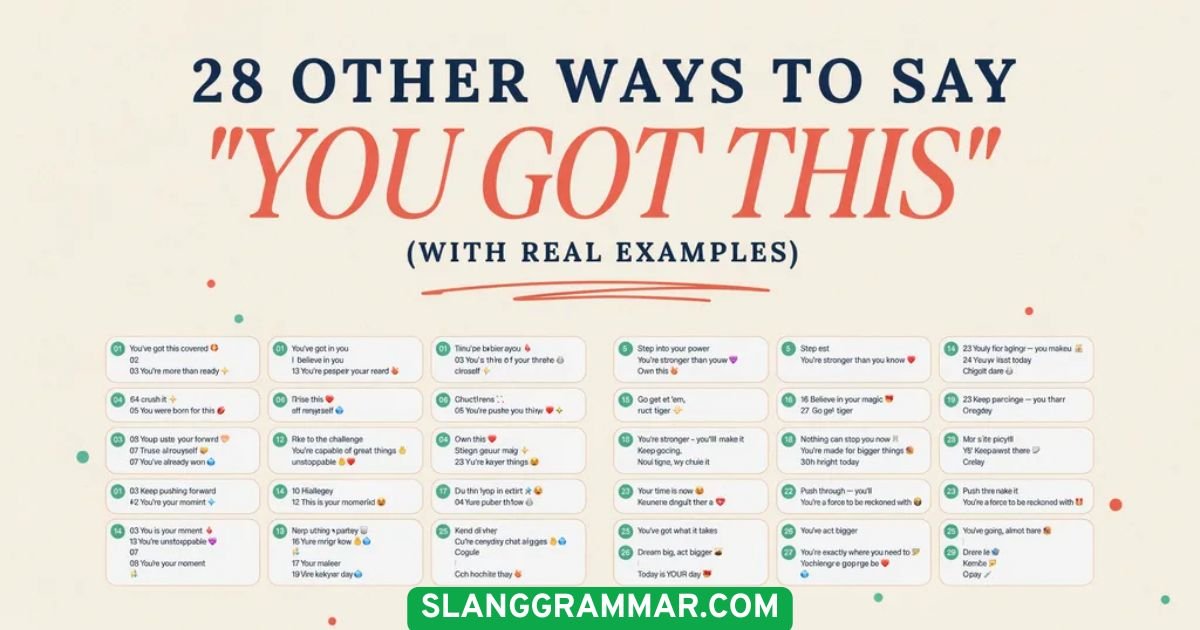
28 Other Ways to Say “You Got This” (With Real Examples)
Sometimes the most powerful thing you can do for someone is offer the right words at the right moment. “You got this” is one of those phrases that seems small but carries a lot of emotional weight — it’s a quick burst of confidence, a way of saying I believe in you without a long speech. But depending on who you’re talking to and what they’re going through, it doesn’t always land the way you intend.
Imagine texting a close friend before their job interview: “you got this” feels natural and warm. Now imagine sending that same message to your manager before their board presentation — suddenly it might feel too casual, even dismissive of how high the stakes are. That’s where having a range of encouraging phrases and motivational words gives you a real advantage. You can match your message to the moment and the person, which makes your support feel far more genuine.
This guide walks you through 28 thoughtful alternatives to “you got this” — covering everything from casual encouragement phrases to professional workplace encouragement, with clear examples and honest guidance on when each one works best.
What Does “You Got This” Mean?
At its core, “you got this” is a confidence-building phrase that tells someone you believe they’re capable of handling whatever challenge is in front of them. It’s short, punchy, and emotionally direct. The phrase became widely popular in everyday American English and has since spread globally through social media, sports culture, and motivational content.
It works because it communicates trust without over-explaining. You’re not saying “here’s how to do it” or “let me help you.” You’re saying: you already have what it takes. That subtle distinction makes it feel empowering rather than instructional.
The phrase is most commonly used just before someone faces a stressful event — a test, a performance, a difficult conversation, a medical procedure, a big life decision. It’s a form of positive reassurance that doesn’t require the speaker to know the details; it’s about the person, not the situation.
When to Use “You Got This”
You got this fits naturally in a handful of common situations, and recognizing them helps you use it — or its alternatives — with more intention.
It works perfectly when someone is visibly nervous but clearly prepared. If your friend has been studying for weeks and is panicking the morning of their exam, “you got this” directly counters that self-doubt. It’s also a great fit for athletic or physical challenges — coaches, teammates, and workout partners use it constantly because it’s energizing without being complicated.
It’s equally effective in creative situations. When a friend is about to hit “publish” on their first blog post or send a creative pitch to a client, the phrase offers a gentle push that acknowledges their anxiety while affirming their ability. It also works well in personal milestone moments — starting a new job, moving to a new city, having a difficult family conversation. These are times when someone needs to hear that the people in their corner believe in them.
The phrase is less effective when someone is genuinely overwhelmed and needs practical help rather than a pep talk. If a colleague is drowning in a project and hasn’t slept in two days, “you got this” might feel tone-deaf. In those cases, emotional support phrases that acknowledge the difficulty — like “I’m here for you” or “let’s figure this out together” — will serve them far better.
Is It Professional or Polite to Say “You Got This”?
Honestly, it depends on your relationship and the setting. “You got this” is inherently casual — it comes from informal speech, and its energy reflects that. In a close-knit team with a relaxed culture, it can be warmly received even in professional contexts. But in more formal environments, or when addressing someone senior to you, it can accidentally sound breezy or undermining.
Here’s a quick comparison to help you decide:
| Situation | Does “You Got This” Work? | Why |
| Texting a close friend before an interview | ✅ Yes | Casual, warm, personal |
| Encouraging a teammate before a presentation | ✅ Yes | Friendly workplace, peer level |
| Messaging your manager before their keynote | ⚠️ Sometimes | Depends on relationship dynamic |
| Emailing a client before their product launch | ❌ Usually not | Too informal for professional email |
| Supporting a child or student before a test | ✅ Yes | Age-appropriate, encouraging |
| Comforting someone during a medical scare | ⚠️ Careful | May feel dismissive if the stakes are high |
The key is knowing your audience. If you’re ever unsure, leaning toward a slightly more formal encouragement phrase like “I have every confidence in you” or “I’m rooting for you” tends to land better across more situations.
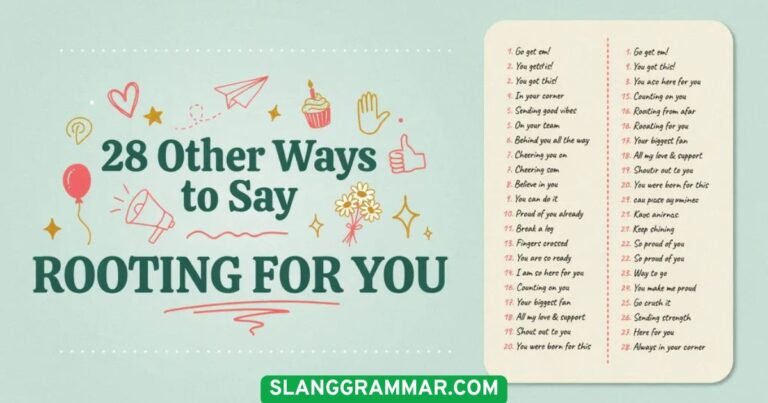
28 Other Ways to Say “You Got This”
1. I Believe in You
The word believe does something that most motivational phrases don’t — it shifts the focus entirely off the task and onto the person. You’re not commenting on the difficulty of the situation or predicting an outcome. You’re making a statement about someone’s character, their worth, their capability as a whole human being. That’s what makes this phrase land so differently from a quick “good luck.” The tone is deeply warm, sincere, and personal, and it carries emotional weight that a casual pep talk simply can’t replicate.
Example: “I know this week has been brutal and you’re exhausted, but I genuinely believe in you — and I’ll be right here when you get out.”
This phrase works beautifully in close, trusted relationships — a parent speaking to a child the night before a big exam, a mentor sending a final message before a client pitch, or a friend who knows the full backstory. It doesn’t work as well in quick, breezy exchanges where something lighter is more appropriate, and it would feel out of place in professional writing where a more measured tone is expected.
2. I Have Full Confidence in You
“Full confidence” is doing a lot of work here. The word full eliminates any room for hedging — it’s not some confidence or cautious optimism. It’s a complete declaration of trust. This makes the phrase feel measured and deliberate in the best way, which is exactly what distinguishes it as the professional-tone alternative to “you got this.” It communicates that you’ve thought about it, you know this person’s ability, and you have no doubts. The tone is composed, sincere, and authoritative without being cold.
Example: “I have full confidence in you to handle the client conversation today — you know this account better than anyone on the team.”
This is an excellent choice for workplace emails, pre-meeting messages from a manager, or any written communication where you want to express genuine encouragement without sacrificing professionalism. It can feel a touch formal for very personal or emotional conversations, so save it for contexts where the composed register is actually a strength.
3. You Can Do This
The subtle difference between “you got this” and “you can do this” is the word can — it shifts the emphasis from a confident statement of fact to a direct affirmation of capability. It’s saying: you have the ability. That makes it particularly useful mid-challenge, when someone is doubting themselves in real time rather than just experiencing pre-event nerves. The phrase is grounded and direct without being aggressive, and its casual, motivating tone makes it accessible in almost any informal setting.
Example: “I know it feels impossible right now, but look at everything you’ve already worked through this week — you can do this.”
This works well in text messages, verbal conversations, coaching contexts, and anywhere a direct injection of belief is needed. It’s not the right pick for formal written communication — you wouldn’t open a professional email with it — but in personal exchanges it’s one of the most reliable phrases on this list.
4. You’re Going to Crush It
The verb crush is doing all the heavy lifting here. It doesn’t suggest modest success — it suggests completely dominating the moment. That energy is infectious when used in the right context, which is why this phrase is such a staple between close friends, teammates, and peers who share an enthusiastic dynamic. The tone is casual, high-energy, and boldly optimistic, and it works best when the person receiving it matches that energy — someone who’s excited, competitive, or needs a spark rather than a steadying hand.
Example: “Three weeks of prep, two full run-throughs, and you know the material cold — you’re going to crush it tomorrow.”
This phrase lands best in pre-event situations: before a job interview at a dream company, before a performance review someone’s been working toward, before an athletic event. It doesn’t work when someone is feeling fragile or anxious — in those moments, the bravado can actually backfire, making the stakes feel higher rather than the person feel steadier. It also doesn’t belong in formal or written professional communication.
5. I’m Rooting for You
The language of rooting comes from sports fandom — you root for your team, your player, your city. When you apply that same word to a person you care about, it communicates genuine emotional investment: your success matters to me. What makes this phrase especially useful is that it doesn’t hinge on a predicted outcome. You can root for someone even when the odds are uncertain, which gives it a quality of unconditional support that pure motivational phrases can’t always offer. The tone is warm, heartfelt, and friendly.
Example: “I know the competition is tough, but I want you to know I’m rooting for you — whatever happens, I’m in your corner.”
This phrase works in casual and semi-formal contexts equally well, making it one of the more versatile options on this list. It fits a handwritten card, a sincere text, or even a brief spoken aside before something important. It’s slightly less suited to high-energy situations where someone needs a shot of adrenaline — in those cases, something more action-oriented tends to land better.
6. I’m Cheering You On
Where “I’m rooting for you” is quiet and sincere, “I’m cheering you on” is more active and energetic — it adds a sense of I’m here, I’m present, I’m loud about this. Cheering implies visible enthusiasm, the kind that comes from actually showing up and calling out someone’s name. The tone is upbeat, encouraging, and warm, and it works particularly well in messages sent during an ongoing challenge, not just at the start. It tells someone that your support isn’t a one-time gesture — it’s continuous.
Example: “I’ve been following every update and I’m cheering you on every step of the way — keep going, you’re doing brilliantly.”
This is a perfect choice for personal texts and notes. It works well when someone is in the middle of a marathon (literal or metaphorical) and needs to feel like someone in their life is genuinely tracking their progress. It’s a touch informal for professional correspondence, but in personal contexts it carries a warmth that more restrained phrases simply can’t match.
7. I’m Behind You All the Way
The phrase all the way is the key detail. It’s not just support for today or for this specific challenge — it signals something longer, deeper, and more committed. “I’m behind you all the way” is less a motivational phrase and more a declaration of loyalty. The tone is steady, warm, and deeply reassuring, and it works best in conversations about bigger life challenges rather than single-event nerves. Think of a friend navigating a career pivot, a sibling pursuing something unconventional, or a partner taking a significant personal risk.
Example: “I know this decision doesn’t come with guarantees, but I want you to know that I’m behind you all the way — whatever happens next, you won’t be going through it alone.”
This phrase earns its depth in moments that genuinely require it. Using it before a routine task or a minor challenge can make it feel overwrought. But when someone is stepping into real uncertainty — the kind that keeps you up at night — hearing all the way from someone you trust is profoundly settling.
8. I’ve Got Your Back
Most encouraging phrases offer support going forward. This one offers something slightly different: coverage. “I’ve got your back” means that if something goes wrong, if you get exposed, if things get complicated — you won’t be facing it alone. That’s a psychologically distinct kind of reassurance, and it works specifically well when someone is about to take a risk, speak up in a difficult situation, or make a bold move where the outcome isn’t guaranteed. The tone is casual, grounded, and loyal.
Example: “Raise the concern in the meeting — I think you’re right, and I’ve got your back if it gets pushback.”
This phrase is most powerful between close friends, tight-knit teammates, or colleagues with real trust. It doesn’t fit formal written communication, and it would feel odd coming from someone you don’t know well — the word back implies a relationship built on mutual protection, so using it without that foundation can actually feel presumptuous rather than supportive.
9. You’ve Got My Full Support
Think of this as “I’ve got your back” translated into language that works outside of casual conversation. The tone is sincere, composed, and semi-formal, making it usable in professional settings, serious personal conversations, and written messages alike. The word full matters here — it removes ambiguity and signals that your support is unconditional and complete, not a polite gesture. This phrase works especially well when someone needs to make a difficult decision and needs to know that the people around them won’t judge the choice.
Example: “Whatever direction you decide to go with this — staying or moving on — you’ve got my full support, and that doesn’t change based on the outcome.”
This is a great fit for workplace conversations, messages from a manager to a team member making a hard call, or personal exchanges where you want to offer something more substantive than encouragement. It works less well if someone needs pure motivation rather than reassurance — in those cases, something more energizing fits better.
Read Also: 28 Other Ways to Say “It Was a Pleasure Meeting You” (Professional & Polite Alternatives)
10. You’re More Than Ready
The phrase more than is doing precise emotional work. Someone who is scared and doubting themselves doesn’t need to hear “you’re ready” — their internal voice will argue back immediately. But more than ready preemptively overcomes that objection. It says: not only have you cleared the bar, you’ve cleared it with room to spare. The tone is affirming, direct, and confidence-building, and it works especially well for people who have genuinely done the work but struggle to trust themselves.
Example: “You’ve rehearsed this more times than I can count and you know every edge case — you’re more than ready. Stop second-guessing and go show them.”
This phrase shines in mentor-to-mentee conversations, coach-to-athlete moments, or any relationship where one person has been watching the other prepare. It works in both casual and semi-formal settings. The one place to be careful: saying it when someone hasn’t actually done the work can make it feel hollow or even condescending — it’s most powerful when it’s genuinely earned.
11. You Were Made for This
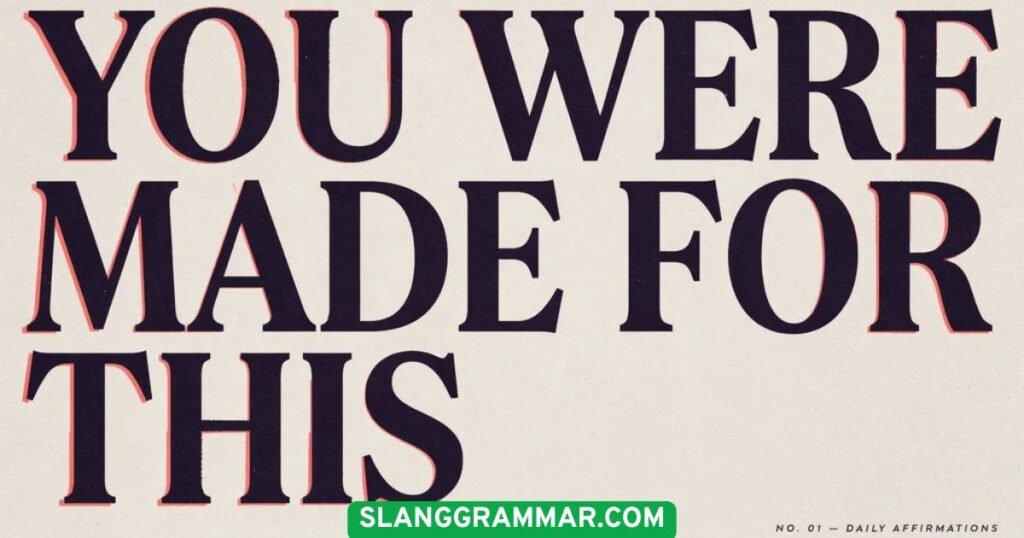
This is one of the most emotionally resonant phrases on the list precisely because it doesn’t speak to the task — it speaks to the person’s entire history. “You were made for this” implies that everything someone has experienced, learned, and worked through has been preparing them for this specific moment. The word made gives it an almost destiny-like quality, which makes it both deeply affirming and very high-impact. The tone is personal, inspiring, and warm, and it shouldn’t be used casually.
Example: “You’ve spent five years building this expertise, this network, and this credibility — you were made for this moment, and everyone in that room is about to see it.”
Save this phrase for genuine milestone moments: a first major leadership role, a breakthrough creative opportunity, a life chapter that truly represents a culmination of someone’s efforts. Using it before something routine would feel absurd and slightly dramatic. But when the moment actually matches the weight of the phrase, it can be genuinely moving and memorable.
12. You’re Going to Do Great
Unlike some of the bolder alternatives, “you’re going to do great” doesn’t overpromise — it doesn’t say perfect or flawless or amazing. It says great, which is honest, warm, and achievable. That measured quality is actually what makes it so versatile. It’s not putting performance pressure on someone; it’s offering a calm, steady prediction rooted in genuine confidence. The tone is warm, optimistic, and gentle, which makes it a reliable choice when someone needs comfort more than hype.
Example: “You know the material, you’ve got a good energy today, and you’re going to do great — I mean that.”
This phrase works naturally in parenting moments (before a school play or a sports match), friendship contexts (before a first date or a difficult conversation), or any situation where you want to be encouraging without adding intensity. It’s most at home in casual, personal exchanges. It wouldn’t carry much weight in a professional email — in that context, something more specific or formal will feel more genuine.
13. Keep Going — You’re Almost There
This phrase is built for a very specific moment: when someone is mid-challenge, energy is running low, and the temptation to stop is real. It works because it gives them something concrete — you’re almost there tells them the effort has an end, and the end is close. That matters enormously when someone is in the kind of exhausted mental state where abstract encouragement bounces off. The tone is active, urgent, and forward-focused, and its power is entirely contextual.
Example: “I know you’re running on empty and this has taken twice as long as it should have — keep going, you’re almost there, and it’s going to be worth it.”
Use this mid-effort — in athletic situations, during long creative or work projects, or in any sustained challenge where stamina is the issue. It would feel tone-deaf before something has even started, and using it when someone actually has a long way to go can backfire badly. The credibility of “almost there” depends entirely on it being true.
14. You’re on the Right Path
Sometimes people aren’t afraid they’ll fail at what they’re doing — they’re afraid they’re doing the wrong thing entirely. That specific self-doubt calls for a specific kind of reassurance, and “you’re on the right path” provides it. It validates direction rather than outcome, which makes it especially powerful in longer personal journeys where results are slow and doubt creeps in between milestones. The tone is calm, reflective, and reassuring, and it’s most effective when the speaker genuinely knows the person’s journey.
Example: “I know it doesn’t feel like it when progress is this slow, but from where I’m standing, you’re on the right path — the work you’re doing now is going to matter.”
This works best in career pivots, long creative pursuits, personal development journeys, or any context where someone needs their choices affirmed more than their performance motivated. It also works well after a difficult decision — when someone has already committed to something and needs to hear that the direction itself is sound. It’s a calm, personal-tone phrase and would feel vague if used before a concrete, task-based challenge.
15. I’m Pulling for You
“Pulling” carries a particular kind of effort — it’s not passive support, it’s active hoping. This phrase communicates that your success genuinely matters to the speaker, that they’re investing emotional energy in wanting things to go well for you. It has a slightly older, more understated quality compared to newer motivational language, which actually works in its favor — it feels sincere rather than scripted. The tone is caring, warm, and quietly earnest, without being dramatic.
Example: “I know the outcome isn’t fully in your hands, but I want you to know that I’m pulling for you — whatever the decision is, you’ve done everything right.”
This phrase fits situations where the outcome is genuinely uncertain and might depend on external factors beyond the person’s control — a job decision made by a hiring committee, a medical result, a competitive application. It works in handwritten cards, sincere verbal exchanges, and some semi-professional contexts where relationship warmth is appropriate. It’s not an energizing phrase, so skip it when someone needs a burst of motivation rather than a steady expression of hope.
16. I Know You Can Handle This
What separates “I know you can handle this” from most other entries is the word know. It’s not I think, I hope, or I believe — it’s a statement of certainty, and that certainty is what makes it so grounding. The phrase is also specific to difficulty rather than performance: it doesn’t say you’ll succeed brilliantly, it says you have the capacity to handle what’s coming. That’s a different and often more useful kind of reassurance, especially when someone is scared of the process, not just the outcome. The tone is calm, grounded, and steady.
Example: “This is genuinely a tough situation, and I’m not going to pretend otherwise — but I know you can handle this, because I’ve watched you navigate things just as hard before.”
This phrase works especially well when the challenge is difficult and the speaker acknowledges it openly rather than glossing over it. That honesty makes the reassurance feel more credible. It fits both personal and professional contexts — a manager supporting a team member through a hard week, a friend acknowledging real difficulty while still expressing confidence.
17. Go for It
This phrase isn’t really about capability at all — it’s about permission. “Go for it” speaks to the person who already knows they can do something but is hesitating to commit, overthinking the risk, or waiting for a signal that it’s okay to act. The word go adds forward momentum; there’s nothing passive about it. The tone is energetic, casual, and direct, and it has a sort of liberating quality — it cuts through hesitation without overcomplicating anything.
Example: “You’ve analyzed this from every angle and you keep coming back to the same answer — just go for it. You’ll regret it more if you don’t try.”
This phrase is perfect for the hesitator, the overthinker, the person stuck in the loop of “but what if.” It’s not the right fit for someone who is genuinely terrified or who hasn’t thought things through — in those cases it can feel flippant. But for someone who is ready and just needs a final nudge, two words is exactly enough.
18. Wishing You the Best
This is one of the few phrases on this list that belongs comfortably in formal written communication. It carries goodwill without crossing into casual territory, which makes it ideal for professional emails, cards, or messages where you want to express genuine warmth while maintaining an appropriate register. The word wishing adds a personal touch — it implies that the speaker is actively thinking of the person, not just offering a routine send-off. The tone is warm, composed, and polished.
Example: “I’ve watched the care and precision you’ve put into this project from the beginning — wishing you the best as you take it into the final stage.”
This phrase works beautifully when acknowledging someone before a major work milestone, when sending a professional note of encouragement to a colleague, or in any context where you want your good intentions to come through without any informality. It’s not a phrase for high-energy moments — it won’t give anyone a surge of adrenaline — but as an expression of sincere goodwill in a composed tone, it’s one of the strongest options available.
19. You’re Doing Amazing
Most encouragement phrases are forward-looking — they talk about what’s about to happen. This one is present-tense, and that’s what makes it special. “You’re doing amazing” is for the person who is currently in the middle of something and needs to hear that the effort they’re putting in right now is visible, valued, and impressive. The word amazing is deliberately enthusiastic — it doesn’t hedge, and that lack of hedging is exactly what someone running on fumes often needs. The tone is warm, affirming, and enthusiastic.
Example: “I want you to know — watching how you’ve handled all of this over the past month, the long hours, the setbacks, the pivots — you’re doing amazing, and it genuinely shows.”
Use this during extended challenges where someone needs their ongoing effort acknowledged, not just their eventual outcome celebrated. It works in casual and friendly settings and fits personal texts, team messages, and supportive conversations equally well. It risks sounding hollow if used generically — its power comes from the fact that you’ve actually been watching and can say it with real conviction.
20. I’m Here for You
This phrase makes a fundamentally different kind of offer than every other alternative on this list. Most motivational words say something about what the person is capable of. “I’m here for you” says something about what you will do — it promises presence, availability, and emotional support regardless of outcome. That shift changes everything about how it lands. The tone is empathetic, warm, and grounding, and it speaks directly to the fear of going through something alone.
Example: “Whatever happens in that room today, I want you to know I’m here for you — call me the moment you’re out, no matter what.”
This works best when someone is genuinely scared, facing something emotionally heavy, or going through a challenge where the outcome is uncertain and the stakes are personal. It doesn’t fuel energy so much as it removes the weight of isolation. For best results, pair it with something more capability-focused if you also want to express belief in their ability — together, the two phrases cover both emotional and motivational ground.
21. You’re Not Alone in This
Isolation is one of the most corrosive feelings someone can experience during a hard stretch — the sense that everyone else has it figured out and you’re the only one struggling. “You’re not alone in this” addresses that directly. It doesn’t minimize the difficulty, doesn’t promise a good outcome, and doesn’t rush to fix anything. It simply says: you have company in this experience. The tone is compassionate, connecting, and deeply human, and it resonates most in situations with genuine emotional weight.
Example: “I know this has been an incredibly isolating few months, and I want to say clearly — you’re not alone in this. We’re going to work through it together.”
This phrase is best saved for real difficulty: prolonged struggles, health challenges, grief, professional crises, or any situation where someone has been carrying something heavy without much support. In lighter contexts it can feel overly heavy, so match the weight of the phrase to the weight of the situation. Pair it with a specific offer of practical help if you want to make the support feel tangible rather than just verbal.
22. Keep Pushing Forward
The word forward matters here — it points direction. This isn’t just a phrase about endurance; it’s about endurance with momentum, about continuing to move even when it’s hard. That distinction gives “keep pushing forward” a slightly more purposeful feel than simply “keep going,” and it works particularly well in contexts where someone is tempted not just to stop, but to retreat or give up entirely. The tone is direct, energizing, and coaching-style, which fits mentors, managers, and close friends equally well.
Example: “I know this is harder than you expected and the timeline has slipped — keep pushing forward anyway. The work you’re putting in is building something real.”
This phrase works best mid-challenge, when someone is tired and questioning whether it’s worth continuing. It conveys confidence in their strength without sugarcoating the difficulty, which makes it feel more credible than purely cheerful encouragement. It fits casual and semi-formal settings — spoken conversations, text messages, coaching calls — and would feel slightly out of place in formal written professional communication.
Read Also: 26 Other Ways to Say Okay (Formal, Casual & Professional)
23. You’ve Got What It Takes
The phrase what it takes has a specific meaning — it’s not just about skill or knowledge, it’s about the full package: the grit, the character, the resilience, the judgment. Saying “you’ve got what it takes” implies that you’ve assessed the whole person and found them capable in the broadest sense. That’s a powerful thing to hear from someone whose opinion you trust. The tone is assured, empowering, and sincere, and it carries particular weight when coming from a mentor, coach, or experienced peer who has seen the person in action.
Example: “I’ve watched how you handle pressure, how you treat people when things get hard, how you keep going when most would have quit — you’ve got what it takes for this next step.”
This phrase works especially well when someone is doubting their readiness for a promotion, a new level of responsibility, or a significant leap. It implicitly says “I have evidence for this belief,” which makes it feel earned rather than generic. It fits personal and semi-professional contexts and is particularly strong in mentorship or coaching relationships where the endorsement carries genuine credibility.
24. You’ve Prepared So Hard for This
Generic encouragement is easy to dismiss. Specific encouragement — the kind that acknowledges what someone has actually done — is much harder to argue with internally. “You’ve prepared so hard for this” works because it grounds your support in real, observable effort. The person can’t say “but you don’t know what you’re talking about” because you’re not making a prediction — you’re acknowledging what you’ve witnessed. The tone is warm, specific, and validating, and its effectiveness is directly tied to how true it is.
Example: “You’ve been up at 6am every single day this month, you’ve done every mock session, you’ve rewritten those slides three times — you’ve prepared so hard for this. Trust the work.”
Use this phrase when you’ve genuinely watched someone put in extraordinary effort. It works beautifully right before a high-stakes moment — a final exam, a major pitch, a performance that took months to prepare for. It loses its impact if said generically or without the specific context that makes it ring true, so don’t use it unless you can back it up with real knowledge of what they’ve done.
25. Trust Yourself
Every other phrase on this list comes from the outside — it’s one person offering confidence to another. “Trust yourself” is different: it redirects a person’s attention inward, back to their own instincts, their own knowledge, their own capability. The word trust implies that the tools are already there — you just need to stop second-guessing them. It’s a subtle but powerful reframe, and it works particularly well for people who are technically prepared but are getting in their own way. The tone is calm, direct, and empowering.
Example: “You know this material better than you’re giving yourself credit for — stop looking for reassurance from everyone else and trust yourself.”
This phrase is most effective with overthinking, intellectually confident people who have a habit of undermining their own judgment. It’s short, memorable, and works across casual and semi-formal contexts. It’s particularly strong when paired with a brief specific observation — “you’ve done this before” or “your instincts on this are usually right” — which gives the instruction a concrete foundation rather than leaving it as an abstract command.
26. I’m Confident You’ll Nail It
“Nail it” is an interesting word choice — it suggests precision and completion, hitting something exactly right. Pairing that with I’m confident creates a phrase that balances personal conviction with energetic outcome language, sitting neatly in the middle ground between purely professional encouragement and casual high-energy pep talk. The tone is upbeat, friendly, and semi-formal, which makes it one of the more flexible options — comfortable in a team Slack message, a quick chat before a presentation, or a text to a friend.
Example: “You know this client’s business inside out and you’ve got a genuinely strong proposal — I’m confident you’ll nail it.”
This phrase works well between peers, from a manager to a team member, or in any personal context where you want enthusiasm tempered with genuine conviction. “Nail it” does carry a slight casualness that might feel off in very formal written communication — a board-level memo or a formal letter — so read the room before using it in writing. In spoken conversation or informal professional channels, it lands with exactly the right combination of confidence and energy.
27. You’re Stronger Than You Think
There’s a well-documented psychological phenomenon where people consistently underestimate their own resilience — they predict they’ll be more devastated by setbacks than they actually end up being. “You’re stronger than you think” speaks directly to that gap. It’s not just encouragement; it’s a gentle correction of someone’s self-assessment. The tone is compassionate, empowering, and personal, and it works particularly well when someone is facing something that tests character and endurance more than skill or knowledge.
Example: “I know you’re terrified that you won’t be able to handle it if things go wrong — but you’ve come through things that would have stopped most people. You’re stronger than you think.”
This phrase is most powerful in personal and emotional contexts: facing a health challenge, going through a painful transition, navigating grief, or attempting something with a real risk of failure. It doesn’t work as well in purely performance-based situations where the issue is skill rather than resilience — in those cases, something capability-focused is more relevant. But in the moments where someone genuinely doubts their own ability to cope, this phrase can be quietly transformative.
28. You’re Ready — Go Show Them What You’ve Got
This is a send-off phrase — a complete, two-part final word before someone walks into the moment. The first part, you’re ready, closes the door on doubt. The second part, go show them what you’ve got, opens the door to action and throws them forward with purpose. The phrase carries a slightly competitive edge — show them implies an audience, a performance, something to prove — which is exactly what certain high-stakes moments call for. The tone is enthusiastic, confident, and high-energy.
Example: “We’ve done everything we can to prepare you for this — you know the material, you know the room, and you’ve earned your place at that table. You’re ready. Go show them what you’ve got.”
This phrase works best as a literal send-off right before someone walks into something significant: a competition, a big presentation, an important interview, a performance they’ve been building toward. The competitive edge makes it perfect for achievement-oriented moments and less suited to emotionally sensitive situations where someone needs comfort rather than a battle cry. Timing is everything — used at exactly the right moment, it’s one of the most energizing phrases you can offer.
Quick Reference Table
Here’s a side-by-side comparison of all 28 alternatives so you can find the right phrase for any situation at a glance.
| Alternative Phrase | Best Use Case | Tone |
| I believe in you | Personal, emotional moments | Warm, sincere |
| I have full confidence in you | Professional, formal settings | Professional, composed |
| You can do this | Everyday encouragement | Direct, motivating |
| You’re going to crush it | High-energy, pre-event | Casual, enthusiastic |
| I’m rooting for you | Uncertain outcomes, personal support | Friendly, heartfelt |
| I’m cheering you on | Ongoing challenges | Upbeat, warm |
| I’m behind you all the way | Long-term journeys | Loyal, deep |
| I’ve got your back | Situations of risk or vulnerability | Casual, protective |
| You’ve got my full support | Decisions, transitions | Semi-formal, sincere |
| You’re more than ready | Pre-event self-doubt | Affirming, direct |
| You were made for this | Milestone moments | Personal, inspiring |
| You’re going to do great | Pre-event nerves | Calm, optimistic |
| Keep going — you’re almost there | Mid-challenge fatigue | Active, urgent |
| You’re on the right path | Long-term direction doubt | Calm, reassuring |
| I’m pulling for you | Uncertain outcomes | Caring, understated |
| I know you can handle this | High-pressure difficulties | Grounded, steady |
| Go for it | Hesitation and overthinking | Energetic, brief |
| Wishing you the best | Formal written communication | Warm, composed |
| You’re doing amazing | Ongoing effort recognition | Enthusiastic, affirming |
| I’m here for you | Emotional or personal challenges | Empathetic, warm |
| You’re not alone in this | Isolation, overwhelm | Compassionate, connecting |
| Keep pushing forward | Endurance, mid-effort slump | Direct, energizing |
| You’ve got what it takes | Doubting readiness or qualifications | Assured, sincere |
| You’ve prepared so hard for this | After visible effort and dedication | Warm, specific |
| Trust yourself | Overthinking, mental block | Calm, empowering |
| I’m confident you’ll nail it | Peer support, semi-professional | Upbeat, friendly |
| You’re stronger than you think | Personal, emotional resilience | Compassionate, empowering |
| You’re ready — go show them what you’ve got | High-energy send-off moments | Confident, enthusiastic |
FAQ’s
What Does “You Got This” Mean?
“You got this” means you can do it or handle the situation. It is a friendly way to encourage someone.
Is “You Got This” Grammatically Correct?
Yes, it is correct in casual English. In formal English, say “You can do this” or “You can handle this.”
What to Say Instead of “You Got This”?
You can say “You can do it,” “I believe in you,” or “You can handle this.” These sound supportive and natural.
How to Answer “You Got This”?
You can reply, “Thank you, I’ll do my best.” You can also say, “Thanks, I needed that.”
How to Reply “You Got It”?
You can reply, “Great, thank you” or “Sure, I understand.” It depends on the situation.
How to Choose the Right Phrase
The phrase you choose matters less than how well it fits the person, the moment, and the relationship. “You got this” is a genuinely good phrase — it’s clear, energetic, and hard to misread. But having 28 alternatives means you can tailor your support with real precision.
When you’re in doubt, ask yourself three quick questions: How well do I know this person? How serious is the situation? Am I trying to energize them or comfort them? A casual, high-energy phrase like “you’re going to crush it” is perfect for the first scenario; a warm, steady phrase like “I’m here for you” fits the third. Professional encouragement calls for composed, sincere language like “I have full confidence in you,” while personal milestones invite the deeper warmth of “I believe in you” or “you were made for this.”
The right words of encouragement don’t just communicate a message — they communicate that you actually paid attention to the person receiving them. That’s what transforms a generic pep talk into something someone will carry with them long after the moment has passed.
Related Guides:
1: 28 Professional Ways to Say “I Am Interested in This Position”
2: 25 Other Ways to Say “Sorry I Missed Your Call” (Professional & Polite Alternatives)
3: 25 Other Ways to Say “I Appreciate Your Help” (With Real Examples)
4: How to Say Thank You for Your Partnership Without Sounding Like a Broken Record
5: 25+ Polite Ways to Say “Sorry for the Short Notice” (Informal & Professional Alternatives 2026 updated)