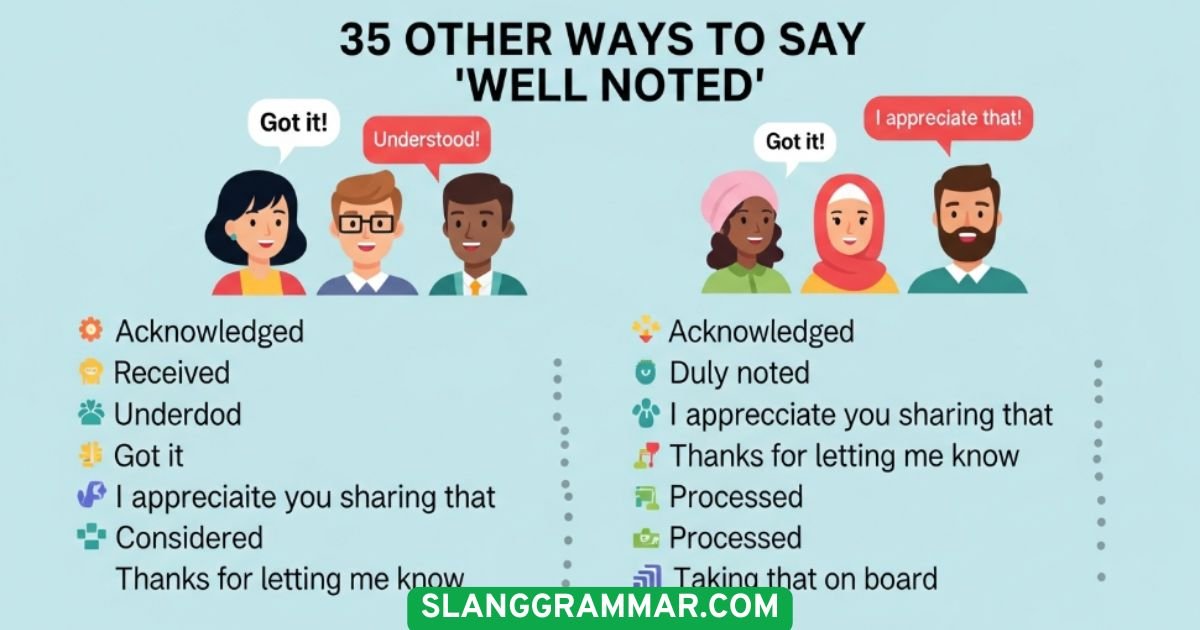
Friendly Guide to 35 Other Ways to Say “Well Noted”
Well Noted means you have received and understood a message. People use it to show that they have paid attention. It is common in emails, work replies, and formal messages.
Sometimes Well Noted can sound too short or serious. You may need better words to sound polite and clear. That is why learning other phrases can improve your replies.
Well Noted is useful when someone gives an update or instruction. It helps you confirm the message in a simple way. You can also use softer alternatives in professional emails.
What Does Well Noted Mean?
The well noted meaning is simple: it means “I have received this information and understood it.” When someone says well noted, they usually want to acknowledge receipt, confirm understanding, and show that the message will be remembered or considered.
In business settings, well noted is often used after someone gives instructions, shares updates, sends reminders, or provides feedback. For example, if a manager says, “Please send the report by Friday,” you might reply, “Well noted, I’ll send it by Friday.” This tells the person that you have read the instruction and know what to do next.
The phrase comes from formal written communication, where people often use short acknowledgments to confirm a message. However, in American business email style, well noted can sometimes sound slightly unnatural or too direct. It is not wrong, but phrases like noted with thanks, received and understood, or thank you for the update often sound more polished.
When to Use Well Noted
You can use well noted when you need to give a quick email confirmation. It works best when the message is clear, the situation is professional, and you do not need to add much detail. For example, if a coworker sends a meeting time change, replying with well noted can be enough.
It also fits when you receive instructions from a manager or client. In this case, the phrase shows that you understand the task and will follow it. Still, it is usually better to add a short action sentence after it, such as “Well noted, I’ll update the file before the end of the day.” That makes your professional tone clearer and more helpful.
You can also use it when someone shares feedback. If the feedback is serious or detailed, a warmer phrase may be better. Saying I’ll take this into account or I appreciate the information can feel more thoughtful than simply saying well noted.
In short, use well noted when you want to confirm that you received a message, but choose a stronger alternative when you want to sound more natural, polite, or action-focused.
Is It Professional or Polite to Say Well Noted?
Yes, well noted can be professional and polite, but it depends on the situation. In some workplaces, it sounds normal. In others, especially in the USA, it may sound a little stiff or non-native compared with common business email phrases like received thank you, understood, or thank you for the update.
Here is a simple comparison to help you decide when the phrase works well.
| Point | Why It Works | Possible Issue |
| Professional use | It gives a clear formal acknowledgment | It may sound stiff in casual emails |
| Polite use | It shows you received the message | It can feel cold if used alone |
| Email use | It works in short work email replies | It may need a follow-up sentence |
| Best tone | Neutral and direct | Not always warm or friendly |
A good rule is simple: use well noted only when the message does not need warmth or extra explanation. For sensitive feedback, customer messages, or client concerns, choose a more thoughtful polite response.
When Should You Use These Alternatives?
You should use well noted alternatives when you want your reply to match the tone of the message. A short phrase like noted works for quick internal updates, but a phrase like thank you for the update is better when you want to sound warm and polite.
These alternatives are also useful when you need to show action. For example, I’ll proceed accordingly tells the reader that you understand the message and know the next step. That is stronger than only saying well noted.
You should also use these phrases when replying to clients, managers, teachers, HR teams, or support requests. The right professional ways to say noted can make your clear communication sound more respectful and confident.
35 Other Ways to Say “Well Noted”
Below are practical alternatives to well noted that you can use in emails, messages, and workplace replies. Each phrase has a slightly different tone, so choose the one that best matches your situation.
1. “Noted.”
Noted is the shortest and simplest noted synonym. It means you received the message and understand it. The tone is neutral and direct, so it works well for quick internal messages.
Example: “Noted. I’ll update the document before the meeting.”
This phrase is best for fast workplace communication where the relationship is already clear. It does not fit well when someone shares emotional feedback, a complaint, or a sensitive concern because it can sound too cold.
2. “Duly noted.”
The duly noted meaning is that something has been properly noticed or officially recorded. It sounds more formal than plain “noted,” so it works best in serious or professional settings.
Example: “Duly noted. I’ll make sure the new policy is followed.”
Use this in formal emails, official responses, or structured business email communication. Avoid it in warm or friendly conversations because it can sound too strict.
3. “Acknowledged.”
Acknowledged means you have received and recognized the message. It carries a professional tone and is common in workplaces where people need quick confirmations.
Example: “Acknowledged. I’ll move forward with the revised timeline.”
This phrase is useful for task updates, project instructions, and team messages. It may not fit casual conversations because it can feel mechanical if used with friends or close coworkers.
4. “Understood.”
Understood means you clearly understand the message or instruction. It is direct, clean, and useful in professional emails when you want to confirm understanding.
Example: “Understood. I’ll prepare the slides before tomorrow’s call.”
This phrase works best when someone gives a clear instruction. It may not be enough when you need to show appreciation, so add “thank you” if the situation needs warmth.
5. “Thank you for the update.”
Thank you for the update is one of the most natural well noted alternatives. It confirms the message while sounding warm and polite.
Example: “Thank you for the update. I’ll adjust the schedule based on the new timing.”
This phrase is great for client emails, team updates, and professional notices. It may not fit when you need to confirm a legal document or formal receipt because it is more conversational than official.
6. “I’ve noted this.”
I’ve noted this means you have taken notice of the information and will remember it. The tone is semi-formal and useful for regular email etiquette.
Example: “I’ve noted this and will include the changes in the final draft.”
Use this when someone gives feedback, instructions, or a correction. It may not fit if you need to sound very warm, because it focuses more on confirmation than appreciation.
7. “This is noted.”
This is noted is a more formal way to say the information has been recorded. It sounds professional, but it can feel distant.
Example: “This is noted. We’ll review the request during the next planning meeting.”
This works best in official formal email response situations. It does not fit casual or friendly messages because it may sound too rigid.
8. “Received, thank you.”
Received thank you is a clear and polite way to acknowledge receipt. It confirms that you got the message and adds a small touch of appreciation.
Example: “Received, thank you. I’ll review the attachment this afternoon.”
This is excellent for documents, files, forms, and quick email replies. It may not be enough when the sender expects a detailed response or decision.
9. “I understand your point.”
I understand your point shows that you recognize someone’s opinion, feedback, or concern. The tone is respectful and thoughtful.
Example: “I understand your point, and I’ll consider it while revising the proposal.”
This phrase works well when someone shares feedback or disagrees with you. It does not fit simple file confirmations because it is more about ideas and opinions.
10. “Thanks for letting me know.”
Thanks for letting me know is friendly, natural, and common in American English. It is a great polite email phrase for everyday updates.
Example: “Thanks for letting me know. I’ll update my notes before the meeting.”
Use this for schedule changes, small updates, or helpful information. It may be too casual for legal, official, or highly formal communication.
Read Also: Better Ways to Say Have a Good Rest of Your Day in Everyday and Professional Conversations
11. “I’ve taken note of this.”
I’ve taken note of this sounds careful and professional. It means you have actively recorded or remembered the information.
Example: “I’ve taken note of this and will apply it to the next version.”
This phrase works well for feedback, instructions, and project details. It may not fit very casual chats because it sounds slightly formal.
12. “Point taken.”
Point taken means you understand and accept someone’s point, often after feedback or correction. The tone can be casual, direct, and sometimes slightly defensive if not used carefully.
Example: “Point taken. I’ll make the explanation clearer in the next draft.”
This phrase works best when someone gives a suggestion or correction. Avoid using it with upset clients because it can sound dismissive if the message needs more care.
13. “Message received.”
Message received means the information has reached you and you understand it. It has a short, clear, and neutral tone.
Example: “Message received. I’ll contact the vendor today.”
This phrase is useful for quick team messages or direct instructions. It may sound too casual or radio-like in formal emails.
14. “I’ll keep this in mind.”
I’ll keep this in mind means you will remember the information for later. It sounds thoughtful and friendly.
Example: “I’ll keep this in mind when planning the next campaign.”
This is best for advice, reminders, or suggestions. It does not fit when someone gives a direct instruction that requires immediate action, because it sounds less committed.
15. “Thanks, noted.”
Thanks, noted is short but still polite. It combines quick confirmation with appreciation, making it useful in work email replies.
Example: “Thanks, noted. I’ll send the updated file shortly.”
Use this when you want to reply quickly without sounding cold. Avoid it in serious customer complaints or sensitive feedback because it may feel too brief.
16. “I’ve received and understood.”
I’ve received and understood clearly confirms both receipt and understanding. It is a strong formal acknowledgment.
Example: “I’ve received and understood the updated instructions.”
This phrase works well for policies, rules, procedures, and important tasks. It may sound too formal for everyday team chats.
17. “Your message is noted.”
Your message is noted is a formal way to say the message has been received. It sounds professional and controlled.
Example: “Your message is noted, and we’ll review the request with the team.”
This phrase fits customer support, HR replies, or official responses. It may not fit friendly workplace conversations because it can sound distant.
18. “I appreciate the information.”
I appreciate the information adds warmth while still confirming the message. It sounds polite, professional, and respectful.
Example: “I appreciate the information. It will help me prepare for the meeting.”
This is a good choice when someone shares useful details. It may not be the best fit for urgent instructions where you need to show immediate action.
19. “I’ll take this into account.”
I’ll take this into account means you will consider the information before making a decision or taking action. It sounds thoughtful and professional.
Example: “I’ll take this into account before finalizing the report.”
This works well for feedback, suggestions, and planning. It does not fit simple receipt confirmations because it suggests deeper consideration.
20. “Noted with thanks.”
Noted with thanks is a common formal email response. It means you received the message and appreciate it.
Example: “Noted with thanks. I’ll update the spreadsheet today.”
This phrase is useful in business emails and polite professional replies. In very casual communication, it may sound a little stiff.
21. “This has been noted.”
This has been noted sounds formal and official. It tells the sender that the information has been recorded.
Example: “This has been noted for our next review meeting.”
Use this for official notices, meeting records, and administrative replies. Avoid it when you want to sound warm or conversational.
22. “I confirm receipt.”
I confirm receipt is one of the clearest ways to confirm that you received something. It is very formal and common in document-related emails.
Example: “I confirm receipt of the signed agreement.”
This phrase is best for contracts, invoices, applications, forms, and official documents. It is too formal for casual updates or friendly messages.
23. “Thank you, understood.”
Thank you, understood combines appreciation with confirmation. It sounds polite, clear, and useful in professional settings.
Example: “Thank you, understood. I’ll complete the task by Friday.”
This phrase works well when replying to a manager, teacher, or client. It may not fit if you need to discuss details further because it sounds like the matter is settled.
24. “I’ve made a note of this.”
I’ve made a note of this means you have written down or remembered the information. It feels practical and helpful.
Example: “I’ve made a note of this and will follow up next week.”
This works well for reminders, deadlines, and small details. It does not fit urgent instructions unless you also explain your next action.
25. “Your instructions are clear.”
Your instructions are clear tells the sender that you fully understand what they want. It is a useful phrase when someone gives specific directions.
Example: “Your instructions are clear. I’ll start working on the update now.”
This phrase is best for task-based communication. It may not fit general updates because it only makes sense when instructions are involved.
26. “Understood and noted.”
Understood and noted is a strong alternative to well noted because it confirms both understanding and acknowledgment. It has a clean professional tone.
Example: “Understood and noted. I’ll follow the new process from now on.”
Use this in professional emails, manager replies, and project updates. It may sound too formal in casual chats with close coworkers.
Bonus Section: Polite and Professional Variations
27. “Thank you for the clarification.”
Thank you for the clarification is useful when someone explains something that was unclear before. It sounds warm, polite, and professional.
Example: “Thank you for the clarification. I understand the requirement now.”
This phrase works best after someone answers a question or explains a detail. It does not fit when no clarification was given.
28. “I’ll proceed accordingly.”
I’ll proceed accordingly means you understand the message and will take action based on it. The tone is formal and action-focused.
Example: “I’ll proceed accordingly and send the revised version by noon.”
This is a good phrase for client instructions, manager requests, or process updates. It may sound too serious for simple friendly messages.
Read Also: 30 Other Ways to Say “In the Text It States” Clearly and Professionally
29. “I’ll follow your instructions.”
I’ll follow your instructions clearly shows that you understand what the sender wants and will do it. It has a respectful and practical tone.
Example: “I’ll follow your instructions and update the product page today.”
This phrase works well when replying to a boss, client, or teacher. It does not fit situations where you disagree or still need more details.
30. “I’ve recorded this for reference.”
I’ve recorded this for reference means you have saved the information so you can use it later. It sounds organized and professional.
Example: “I’ve recorded this for reference during the next audit.”
Use this for meeting notes, policy details, instructions, and records. It may not fit quick casual messages because it sounds more administrative.
31. “I’ll make sure this is considered.”
I’ll make sure this is considered means the information will be included in future thinking or decision-making. It sounds careful and respectful.
Example: “I’ll make sure this is considered before we finalize the plan.”
This phrase is useful for feedback, suggestions, and client concerns. It does not fit direct instructions where immediate action is expected.
32. “I’ve got it.”
I’ve got it is casual and friendly. It means you understand the message and know what to do.
Example: “I’ve got it. I’ll send the file before lunch.”
This phrase works well with teammates or people you know well. Avoid it in formal emails, legal messages, or official communication.
33. “Copy that.”
Copy that means the message is received and understood. It is casual, direct, and sometimes used in fast team communication.
Example: “Copy that. I’ll join the call at 3 p.m.”
This works in quick chats or informal workplace messages. It does not fit formal business emails because it can sound too casual.
34. “Acknowledged with thanks.”
Acknowledged with thanks is a polished version of acknowledged with thanks style communication. It confirms the message and shows appreciation.
Example: “Acknowledged with thanks. I’ll review the details and respond shortly.”
This phrase works well in professional emails, especially when you need a respectful reply. It may be too formal for everyday texts or casual team chats.
35. “I’ll keep track of this.”
I’ll keep track of this means you will monitor or remember the information over time. It sounds practical and helpful.
Example: “I’ll keep track of this and update you if anything changes.”
This phrase is best for ongoing tasks, deadlines, updates, or project details. It does not fit one-time document receipt where I confirm receipt would be clearer.
Quick Reference Table
This table gives you a fast way to compare the best professional ways to say noted based on tone and situation.
| Alternative Phrase | Best Use Case | Tone |
| Noted. | Quick internal reply | Neutral |
| Duly noted. | Formal or official message | Formal |
| Acknowledged. | Task or team confirmation | Professional |
| Understood. | Clear instruction | Neutral |
| Thank you for the update. | General email update | Warm |
| I’ve noted this. | Feedback or instruction | Semi-formal |
| This is noted. | Official written reply | Formal |
| Received, thank you. | File or document receipt | Polite |
| I understand your point. | Feedback or disagreement | Respectful |
| Thanks for letting me know. | Friendly update | Friendly |
| I’ve taken note of this. | Detailed feedback | Professional |
| Point taken. | Correction or suggestion | Direct |
| Message received. | Short confirmation | Neutral |
| I’ll keep this in mind. | Advice or reminder | Thoughtful |
| Thanks, noted. | Quick polite reply | Semi-formal |
| I’ve received and understood. | Important instruction | Formal |
| Your message is noted. | Customer or HR reply | Professional |
| I appreciate the information. | Helpful update | Warm |
| I’ll take this into account. | Feedback or planning | Professional |
| Noted with thanks. | Business email | Polite |
| This has been noted. | Record or official note | Formal |
| I confirm receipt. | Documents or forms | Formal |
| Thank you, understood. | Manager or client reply | Polite |
| I’ve made a note of this. | Reminder or detail | Helpful |
| Your instructions are clear. | Task directions | Professional |
| Understood and noted. | Work instruction | Professional |
| Thank you for the clarification. | Explanation received | Warm |
| I’ll proceed accordingly. | Action-based reply | Formal |
| I’ll follow your instructions. | Direct task request | Respectful |
| I’ve recorded this for reference. | Records or notes | Organized |
| I’ll make sure this is considered. | Feedback or concern | Respectful |
| I’ve got it. | Casual workplace chat | Friendly |
| Copy that. | Fast informal reply | Casual |
| Acknowledged with thanks. | Polite business reply | Professional |
| I’ll keep track of this. | Ongoing task | Helpful |
How to Say Well Noted Professionally in Email
If you are wondering how to say well noted professionally, the safest choice is to combine acknowledgment with a next step. Instead of only writing well noted, you can say, “Thank you for the update. I’ll revise the file and send it back by 4 p.m.” This sounds more useful because it confirms both the message and the action.
For well noted in email, your reply should match the sender’s tone. If the email is formal, use I confirm receipt, acknowledged with thanks, or understood and noted. If the email is friendly, use thanks for letting me know or received, thank you. If the email includes instructions, use your instructions are clear or I’ll proceed accordingly.
Good email etiquette is not about using fancy words. It is about making the other person feel heard and giving them confidence that the message was understood.
Common Mistakes to Avoid When Replacing Well Noted
One common mistake is using noted by itself in every situation. Although it is correct, it can sound cold if someone shares important feedback or a serious concern. In those cases, a warmer phrase like I appreciate the information or I understand your point is better.
Another mistake is using overly formal phrases in casual situations. For example, I confirm receipt is perfect for a signed document, but it sounds strange if a coworker simply tells you lunch has been moved to 1 p.m. A simple thanks for letting me know would feel more natural.
Also, avoid using phrases that sound like you are closing the conversation when more discussion is needed. If you still have questions, do not say understood and noted too quickly. Instead, say something like, “Thank you for the update. I have one quick question before I proceed.”
FAQ Section
Is it correct to say “well noted”?
Yes, it is correct to say “well noted” in emails and formal replies. It means you received and understood the message.
What does well noted mean?
Well noted means the information has been received, understood, and remembered. People use it to confirm updates, instructions, or feedback.
What is another way to say well noted?
You can say “Noted,” “Understood,” “Received, thank you,” or “Thank you for the update.” These phrases sound clear and professional.
Is well-noted okay?
Yes, well-noted is okay, but well noted is more common in replies. Use it when you want to sound polite and formal.
Can I say noted instead of OK?
Yes, you can say “noted” instead of “OK” in work messages. It sounds more professional, but it can feel short if used alone.
Conclusion
Well Noted is a useful phrase in emails and work messages. It shows that you received a message and understood it clearly. You can use it when someone gives you an update, instruction, or important detail. This phrase sounds simple and professional, but sometimes it can feel too short. Better phrases can help you sound more polite, warm, and clear.
Choosing the right words helps you write better replies. You can say Noted, Thank you for the update, Understood, or Received, thank you in different situations. Each phrase has its own tone and use. A good reply shows respect and understanding. Use Well Noted and its alternatives carefully to make your message helpful and professional.
Related Guides:
1: 30 Other Ways to Say “Token of Appreciation”
2: 30 Other Ways to Say “I Enjoyed Your Company” Naturally
3: 30 Professional Ways to Say “Thank You for the Update” in Emails and Workplace Messages
4: 30 Other Ways to Say Have a Great Weekend With Examples
5: You Are Most Welcome: Meaning, Usage, and 30 Better Ways to Say It