Better Ways to Say Received With Thanks in Emails, Gifts, and Daily Messages
“Received with thanks” means you got something and you are thankful for it. People use it after getting an email, document, gift, message, or file. It is a polite way to confirm receipt and show appreciation.
Sometimes, “received with thanks” can sound too short or formal. You may need warmer, clearer, or more natural words in some situations. The right phrase can make your reply sound more kind and professional.
“Received with thanks” is common in emails and office messages. It works well for documents, updates, payments, and business replies. You can also use better alternatives to match the tone and situation.
What Does Received With Thanks Mean?
Received with thanks means that you have successfully received something and you are thankful for it. In simple words, it is a short way to say, “I have received it, thank you.” People often use it when replying to emails, documents, files, payments, reports, forms, or messages.
The phrase is most common in professional communication. You may see it in an official email response, especially when someone sends an attachment, invoice, report, or confirmation. It tells the sender two things at once: the item was received successfully, and you appreciate the action.
A similar phrase, received with thank, is sometimes typed by mistake, but the correct and natural phrase is received with thanks. The word “thanks” works as a noun here, meaning appreciation or gratitude.
When to Use Received With Thanks
You can use received with thanks when someone sends you something important and you want to confirm it politely. It is especially useful when the sender needs a quick receipt confirmation.
For example, if a coworker sends a report, you can reply, “The report has been received with thanks.” If a client sends signed paperwork, you can say, “Your documents have been received, thank you.” This kind of polite response is useful because it avoids confusion and keeps the conversation moving.
It also works in formal email situations, such as HR communication, client updates, school administration, business records, or finance-related messages. However, for close friends, family, gifts, or emotional notes, warmer wording often sounds better.
Is It Professional or Polite to Say Received With Thanks?
Yes, received with thanks is both polite and professional. It is widely understood in business correspondence and works well as a short formal reply. Still, it is not always the best choice. In American English, some people may find it a little old-fashioned or overly brief.
Here is a simple comparison to help you decide when it works.
| Point | Why It Works | Possible Problem |
| Professional tone | It sounds respectful in business emails | It may feel too stiff in casual messages |
| Clear confirmation | It helps you acknowledge receipt quickly | It may not explain the next step |
| Short reply | Good for fast office use | It can sound robotic if repeated often |
| Polite wording | Shows gratitude and confirmation | It may feel too cold for gifts or personal thanks |
The best approach is to use it when you need a quick, respectful reply. Use warmer alternatives when you want to sound more personal, friendly, or appreciative.
Polite Alternatives to “Received With Thanks”
There are many polite alternatives that sound clearer, warmer, or more natural than the original phrase. The right choice depends on the situation. A workplace reply needs a professional tone, while a gift message needs warmth and emotion.
Below are 30 useful alternatives, with examples and simple guidance.
30 Other Ways to Say Received With Thanks
1. I Have Received It, Thank You
I have received it, thank you is one of the clearest alternatives. It means you got the item or message and you are politely thanking the sender. The tone is neutral, clear, and suitable for both semi-formal and professional communication.
Example: “Hi Mark, I have received it, thank you. I will review it this afternoon.”
This phrase works well for files, emails, forms, and simple confirmations. It may not feel warm enough for a personal gift or emotional message.
2. Thank You for Sharing
Thank you for sharing is a friendly and professional phrase. It shows appreciation for information, updates, documents, or ideas. It carries a warm but still respectful tone, which makes it useful in business emails and team conversations.
Example: “Thank you for sharing the updated presentation. I will go through it before the meeting.”
Use this when someone sends helpful information. Avoid it when you need to clearly confirm that a legal or official document was received.
3. Acknowledged With Thanks
Acknowledged with thanks is a strong formal acknowledgment. It means you have seen, accepted, or noted the message. This phrase sounds very professional and is common in office settings.
Example: “Your request has been acknowledged with thanks.”
It works well for workplace updates, admin emails, and official notices. It may sound too formal in a text to a friend.
4. Noted With Thanks
Noted with thanks means you have understood or recorded the message. It is short, polite, and often used in business correspondence. The tone is professional but slightly less warm than some other options.
Example: “Your instructions are noted with thanks.”
This is useful when someone gives directions, updates, or reminders. Do not use it when you need to show deep appreciation, such as after receiving a thoughtful gift.
5. Received and Appreciated
Received and appreciated is a warmer alternative. It confirms receipt while adding a stronger sense of gratitude. The tone is professional, friendly, and thoughtful.
Example: “Your feedback has been received and appreciated.”
This phrase is good for feedback, support, advice, or helpful documents. It may not be the best choice for very formal legal or finance communication where simpler wording is better.
6. Much Appreciated
Much appreciated is short, warm, and natural. It does not directly say “received,” but it works when the context already makes that clear. The tone is friendly and semi-formal.
Example: “I got the file. Much appreciated.”
Use it when you want to sound natural and grateful. Avoid it when the sender needs a very clear confirm receipt message.
7. I Confirm Receipt of Your Email
I confirm receipt of your email is a direct and formal phrase. It is ideal when you need a clear receipt confirmation. The tone is professional and official.
Example: “Dear Ms. Carter, I confirm receipt of your email and will respond shortly.”
Use this in formal workplace communication, legal matters, HR replies, or client emails. It may sound too cold in casual conversations.
8. Your Message Has Been Received
Your message has been received is clear and professional. It confirms that the communication arrived, but it sounds more neutral than warm.
Example: “Your message has been received. Thank you for the update.”
This works well for support replies, admin emails, and customer service. It may feel impersonal if you are replying to someone you know well.
9. Thank You for the Update
Thank you for the update is a natural phrase for workplace communication. It shows appreciation without sounding stiff. The tone is friendly and professional.
Example: “Thank you for the update. I will adjust the schedule accordingly.”
Use it when someone shares progress, news, or a change in plans. It would not fit if someone sends a physical item or gift.
10. I Appreciate the Information
I appreciate the information is polite and useful when someone gives details, instructions, or helpful context. It has a warm professional tone.
Example: “I appreciate the information you shared about the new policy.”
This phrase is great for business emails, school communication, and client replies. It does not work as well when you need a simple document confirmation.
11. Thanks for Confirming
Thanks for confirming is friendly and efficient. It works when someone has verified a date, detail, payment, appointment, or decision. The tone is semi-formal and natural.
Example: “Thanks for confirming the meeting time. I’ll see you at 10 a.m.”
This phrase works well in everyday workplace messages. It is not suitable if the person did not confirm anything.
12. Well Received
Well received means the message, file, or idea was received positively. It sounds professional and slightly polished.
Example: “Your proposal was well received by the team.”
This is best when feedback or a proposal was accepted positively. Do not use it for simple attachments unless you want to sound more formal than necessary.
Read Also: 28 Powerful Ways to Say Good To Know in Everyday and Professional Conversations
13. The Document Has Been Received
The document has been received is a clear phrase for document received situations. It is formal, direct, and useful when you need to acknowledge documents.
Example: “The document has been received and will be reviewed by our team.”
Use it for contracts, forms, records, applications, and reports. It may sound too official for a friendly message.
14. I Have Received the Document, Thank You
I have received the document, thank you is clear, polite, and complete. It confirms the item and adds appreciation.
Example: “Hi Sarah, I have received the document, thank you. I will check it today.”
This is one of the best choices for document acknowledgment in normal office communication. It may feel too plain for a personal note.
15. Thank You for Sending This Over
Thank you for sending this over is friendly and professional. It is common in American workplace emails and sounds more natural than received with thanks.
Example: “Thank you for sending this over. I’ll review it before our call.”
Use it with coworkers, clients, and team members. Avoid it in very formal legal or official letters.
16. I Appreciate You Sending This
I appreciate you sending this is warm and polite. It feels more personal than a standard confirmation.
Example: “I appreciate you sending this so quickly.”
This works well when someone helps you by sending a file, link, or detail. It may not be strong enough for official record-keeping.
17. Thank You, I Got It
Thank you, I got it is casual and easy to understand. It confirms receipt in a friendly way.
Example: “Thank you, I got it. I’ll take a look soon.”
Use this with coworkers you know well, classmates, friends, or casual business chats. Avoid it in formal emails to clients or senior managers.
18. Got It, Thanks
Got it, thanks is very short and casual. It means you understood or received the message.
Example: “Got it, thanks. I’ll be there by noon.”
This is best for quick messages, chats, or texts. It is too casual for serious formal email communication.
19. Your Email Is Received With Thanks
Your email is received with thanks is close to the original phrase but slightly more specific. It confirms the email directly.
Example: “Your email is received with thanks, and I will reply soon.”
This works in formal or semi-formal office communication. It can sound a bit unnatural if overused.
20. Thank You for Your Message
Thank you for your message is polite, simple, and professional. It works well in customer service, business replies, and general communication.
Example: “Thank you for your message. I will get back to you shortly.”
Use this when replying to an email, inquiry, or request. It may not confirm an attachment unless you add more detail.
21. I Appreciate Your Prompt Response
I appreciate your prompt response shows gratitude for a quick reply. It has a polished professional tone.
Example: “I appreciate your prompt response and have received the updated file.”
Use it when someone responds quickly or helps you meet a deadline. Do not use it if the person replied late.
22. Thank You for the Confirmation
Thank you for the confirmation is clear and practical. It works when someone confirms an appointment, order, payment, or detail.
Example: “Thank you for the confirmation. I have noted the new delivery date.”
Use it in scheduling, client work, and admin tasks. Avoid it when no confirmation was given.
23. Confirmed, Thank You
Confirmed, thank you is short, clear, and professional. It tells the sender that the matter is confirmed.
Example: “Confirmed, thank you. I’ll proceed with the booking.”
This works well for quick workplace replies. It may feel too brief if the message needs warmth or detail.
24. Received Successfully
Received successfully confirms that something arrived without a problem. It is useful for files, forms, uploads, payments, and submissions.
Example: “Your application was received successfully.”
This phrase works well in automated replies or admin communication. It may sound too technical for personal messages.
25. I Will Review It Shortly
I will review it shortly does not directly say thank you, but it is a helpful next-step phrase. It works best when added after a receipt confirmation.
Example: “Thank you for sending the report. I will review it shortly.”
Use this when you want to confirm receipt and explain what happens next. Do not use it if you do not actually plan to review the item soon.
26. Thank You for Forwarding This
Thank you for forwarding this is specific and useful when someone sends an email, file, or message from another person.
Example: “Thank you for forwarding this. I’ll follow up with the vendor.”
Use it in business correspondence when someone passes along information. Avoid it if the person created the message themselves.
27. I Appreciate Your Help
I appreciate your help is warm and personal. It focuses more on the effort than the item received.
Example: “I received the form. I appreciate your help with this.”
Use it when someone supports you, explains something, or sends something useful. It may be too broad for official records.
28. Thank You for the Details
Thank you for the details works when someone sends information, instructions, numbers, or explanations.
Example: “Thank you for the details. I have received the full list.”
This is good for workplace and client communication. It does not fit when receiving a gift, payment, or physical item.
29. I Have Noted This, Thank You
I have noted this, thank you means you have received and recorded the information. It sounds polite and professional.
Example: “I have noted this, thank you. I’ll update the file accordingly.”
Use it for instructions, reminders, dates, and changes. Avoid it for emotional replies because it can sound distant.
30. Thank You, This Is Helpful
Thank you, this is helpful is friendly and appreciative. It confirms that the message or document is useful, not just received.
Example: “Thank you, this is helpful. I’ll use it to complete the report.”
Use it when someone sends advice, instructions, or useful resources. It would not fit if the item is only a basic receipt or form.
Quick Reference Table
This table gives you a fast way to choose the right phrase based on tone and situation.
| Alternative Phrase | Best Use Case | Tone |
| I have received it, thank you | Formal / semi-formal email | Neutral |
| Thank you for sharing | Updates, ideas, documents | Friendly |
| Acknowledged with thanks | Office or admin replies | Professional |
| Noted with thanks | Instructions or reminders | Professional |
| Received and appreciated | Feedback or support | Warm |
| Much appreciated | Quick friendly replies | Friendly |
| I confirm receipt of your email | Official email response | Formal |
| Your message has been received | Customer service or admin | Neutral |
| Thank you for the update | Workplace updates | Friendly |
| I appreciate the information | Helpful details | Professional |
| Thanks for confirming | Appointments or details | Friendly |
| Well received | Accepted ideas or proposals | Professional |
| The document has been received | Document records | Formal |
| I have received the document, thank you | Office documents | Neutral |
| Thank you for sending this over | Coworker or client emails | Friendly |
| I appreciate you sending this | Helpful files or links | Warm |
| Thank you, I got it | Casual work chats | Friendly |
| Got it, thanks | Texts or quick replies | Casual |
| Your email is received with thanks | Formal email reply | Professional |
| Thank you for your message | General replies | Polite |
| I appreciate your prompt response | Fast replies | Professional |
| Thank you for the confirmation | Confirmed details | Neutral |
| Confirmed, thank you | Quick confirmation | Professional |
| Received successfully | Files, forms, uploads | Neutral |
| I will review it shortly | Next-step replies | Professional |
| Thank you for forwarding this | Forwarded emails | Friendly |
| I appreciate your help | Support or assistance | Warm |
| Thank you for the details | Information or instructions | Professional |
| I have noted this, thank you | Changes or reminders | Professional |
| Thank you, this is helpful | Useful advice or resources | Warm |
Received With Thanks in Business Emails
In business emails, the main goal is to be clear and respectful. A reply like received with thanks tells the sender that their message arrived, but sometimes it does not tell them what happens next. That is why adding a next step can make your reply much stronger.
For example, instead of only saying “received with thanks,” you can write, “I have received the document, thank you. I will review it and respond by Friday.” This sounds more helpful because it gives confirmation, appreciation, and a clear timeline.
Good email etiquette is not about using big words. It is about making communication easy. A strong formal reply should answer the sender’s main concern: Did you receive it? Do you understand it? What will you do next?
Read Also: Professional Ways to Say “Thank You for Your Assistance in This Matter”
Received With Thanks Email Examples for Office Use
For normal office use, keep your reply short but complete. If a coworker sends a report, you can say, “Thank you for sending this over. I have received it and will review it shortly.” This sounds natural and professional.
If your manager sends instructions, you can reply, “Noted with thanks. I will proceed as discussed.” If a client sends a file, you can say, “I confirm receipt of the file with thanks. I will check it and follow up if needed.”
These professional email examples work because they do not sound robotic. They confirm the message and show respect for the sender’s time.
How to Acknowledge Documents Received With Thanks
When you acknowledge documents, be specific. Mention the document, confirm that it arrived, and explain the next step if needed. This helps avoid confusion, especially in legal, school, HR, finance, or client communication.
A good document acknowledgment might say, “I have received the signed agreement, thank you. I will forward it to the accounts team for processing.” This is better than a one-line reply because it gives the sender confidence.
For formal situations, use phrases like “I confirm receipt of the document” or “The document has been received.” For warmer office communication, use “Thank you for sending the document” or “I appreciate you sending this over.”
Received With Thanks Meaning and Usage Explained
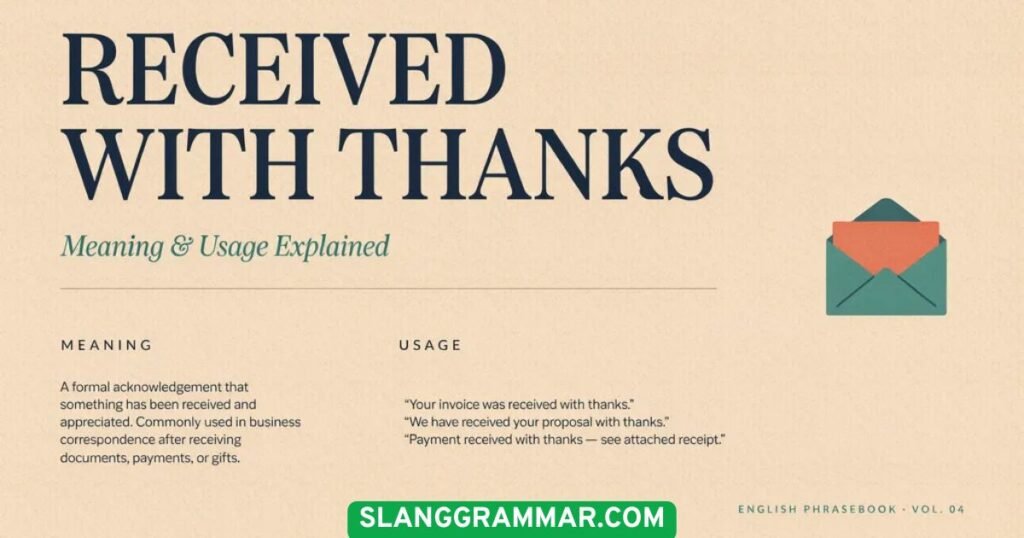
The phrase received with thanks belongs to practical communication. It is not usually emotional or creative. It simply confirms that something has arrived and adds a polite thank-you.
This is why it fits emails, reports, invoices, attachments, order confirmations, and business records. It may also appear on receipts, especially when money or donations are involved. In that setting, it works as a short record of acknowledge receipt.
Still, the phrase is not perfect for every situation. If someone sends you a heartfelt gift, a personal note, or a kind favor, a warmer gratitude expression will usually sound better.
Received With Thanks From Meaning in Professional Context
The phrase “received with thanks from” is usually used in receipts or written records. It means that something was received from a specific person or organization.
For example, “Received with thanks from John Miller the amount of $500” means the money came from John Miller and was accepted with appreciation. This phrase is more common in payment records, donation receipts, and official acknowledgments than in everyday emails.
In a modern workplace, you may use simpler wording instead. For example, “We have received your payment, thank you” sounds clearer and more natural for most readers.
Thanks for Gift Quotes
When someone gives you a gift, received with thanks may sound too cold. A gift usually deserves a warmer message because it reflects care, thought, or love.
You can say, “Thank you for the beautiful gift. I truly appreciate your kindness.” This sounds more personal than a basic receipt confirmation. Good gift thank you quotes should mention the gift, the feeling, and the person’s thoughtfulness.
For example, “Your gift made my day brighter, and I am so thankful for it” is simple, warm, and easy to use.
Gift Captions for Instagram
Gift captions for Instagram should feel natural and emotional. You do not need to sound formal. The best captions are short, clear, and warm.
You might write, “Feeling grateful for this beautiful surprise,” or “A thoughtful gift that made my heart happy.” These captions work because they show appreciation without sounding forced.
If you want a simple caption, try “Received with love and gratitude.” It keeps the idea of received with thanks but makes it softer for social media.
Thank You Captions for Instagram
Thank you captions are useful when you want to publicly appreciate someone. They can be used for gifts, support, birthday wishes, celebrations, or kind gestures.
A simple caption like “Thank you for all the love and kindness” works well for most posts. You can also write, “Grateful for the people who make life brighter.” These captions feel friendly and easy to understand.
For a more polished style, use “Sincerely thankful for your support and kindness.” It sounds warm but still respectful.
Receiving Gift Captions for Instagram
Receiving gift captions for Instagram should focus on the feeling behind the gift. Instead of only saying you received something, show how it made you feel.
You can write, “This thoughtful gift means so much to me,” or “I received more than a gift; I received love and kindness.” These lines work well because they feel personal.
For a shorter caption, try “Grateful to receive such a lovely surprise.” It is simple, kind, and easy to use.
Unexpected Gift Thank You Quotes
An unexpected gift often feels extra special because you were not waiting for it. That is why unexpected gift thanks should sound sincere and warm.
You can say, “Thank you for the unexpected gift. It truly made my day.” Another good option is, “Your surprise came at the perfect time, and I appreciate it so much.”
Avoid using received with thanks alone for surprise gifts. It may confirm the gift, but it does not fully express the emotion behind your appreciation.
Thanks to Husband for a Surprise Gift
When thanking your husband for a surprise gift, use words that feel loving and personal. A simple message can mean a lot when it comes from the heart.
You might say, “Thank you, my love, for the beautiful surprise gift. You always know how to make me smile.” This message is warm, direct, and natural.
Another option is, “Your gift reminded me how thoughtful and caring you are. I feel truly loved.” This sounds much better than a formal phrase because the relationship is personal.
Thank You God for Everything Quotes
Some thank-you messages are about faith and daily blessings. Thank You God for everything quotes help express spiritual gratitude in a simple way.
You can say, “Thank You, God, for every blessing, every lesson, and every new day.” This kind of message works well for personal reflection, captions, journals, or prayer notes.
The goal is not to sound perfect. The goal is to express honest gratitude for life, protection, peace, family, and daily blessings.
Words to Say Thank You and Appreciation
Good words of appreciation can make any message feel more thoughtful. Instead of using the same phrase every time, you can choose words that match the situation.
For professional settings, phrases like “I appreciate your support,” “Thank you for your assistance,” and “Your help is greatly appreciated” work well. For personal situations, warmer phrases like “Your kindness means a lot” or “I am truly grateful” sound better.
The right appreciation words depend on the relationship, the setting, and the reason for your thanks.
Thank You Quotes for Expressing Gratitude
Thank you quotes for expressing gratitude are helpful when you want your message to feel more meaningful. They can be used in cards, captions, emails, or personal notes.
A simple quote like “Your kindness means more than words can say” works because it feels warm and easy to understand. Another good option is, “A thankful heart remembers every kind gesture.”
These messages are best for personal appreciation, not official communication. For business replies, keep the wording clearer and more direct.
Thankful Blessing Quotes for Daily Gratitude
Thankful blessing quotes are useful for people who want to express daily positivity and faith. They can be used in morning posts, journals, captions, or personal messages.
You can write, “I am thankful for today’s blessings and the peace they bring.” Another simple option is, “Every day gives me a new reason to be grateful.”
These phrases work well when your goal is reflection, encouragement, or spiritual appreciation.
FAQ
Is it correct to say received with thanks?
Yes, received with thanks is correct and polite. It is often used in emails to confirm that something was received.
How do you say email received with thanks?
You can say, “I have received your email, thank you.” You can also write, “Your email has been received with thanks.”
How do you say thank you after receiving?
You can say, “Thank you, I have received it.” For a warmer reply, say, “I truly appreciate it.”
What does “received with thanks” mean?
Received with thanks means you got the message, file, gift, or document and feel thankful for it.
Can I say well received with thanks?
Yes, you can say well received with thanks, but it sounds a little formal. A more natural option is “It was well received, thank you.”
Conclusion
“Received with thanks” is a polite and useful phrase for formal messages, office emails, documents, and gift replies. It tells the sender that you got the message, file, payment, or item and you also feel thankful for it. This phrase helps you reply in a clear and respectful way. It works well when you need to confirm something quickly without writing a long message.
You can use “received with thanks” in business emails, school messages, and professional communication. You can also use other simple words when you want your reply to sound warmer or more natural. A good reply should always show respect, appreciation, and clear meaning. This helps the sender feel valued and makes your message easy to understand.
Related Guides:
1: 30 Other Ways to Ask “How Are You Holding Up?” With Care and Support
2: 25 Other Ways to Say “Thank You Both” in Emails, Messages, and Everyday Conversations
3: 30 Other Ways to Say “I Hope Everything Is Going Well” That Sound Genuine and Fresh
4: 30 Better Ways to Say “Please Accept My Apologies”
5: 30 Ways to Say “By Way of Introduction” (Friendly Email Phrases That Actually Work)