30 Ways to Say “By Way of Introduction” (Friendly Email Phrases That Actually Work)
“By way of introduction” is a polite phrase you use when you meet someone for the first time in an email. It simply means “I am using this message to say hello and tell you who I am.” Think of it as a friendly handshake before you get to the main point of your email.
Have you ever stared at a blank email, unsure how to start without sounding too stiff or too casual? You are not alone. Most professionals struggle with the very first line of an important message. The good news is that changing just a few words can make you sound more confident and approachable right away.
This phrase works best when you are emailing a stranger or joining a new team. However, using it too often can make your writing feel old-fashioned and distant. That is why learning a few fresh alternatives will help you connect better with busy American readers.
What Does “By Way of Introduction” Mean?
When someone says by way of introduction in an email, they are essentially saying “I am using this message as my formal hello.” The phrase signals that the main purpose of the email is to present yourself or another person to the reader. It is a polite, slightly old-fashioned way of saying “here is who I am” or “here is who I want you to meet.”
Think of it as a verbal handshake. You are not jumping straight into a request or a sales pitch. Instead, you are taking a moment to establish who you are before moving on to anything else. In person, you might say “Hi, I do not think we have met yet.” In an email, by way of introduction serves that same function but with a more formal wrapper around it.
The phrase works best when you are contacting someone who does not know you at all. For example, if you are a new account manager emailing a long-time client for the first time, you might write “By way of introduction, I am taking over your account starting next month.” It sets the stage clearly and politely.
However, because the phrase sounds a bit old-school, many modern professionals find it unnecessary. Why use five words when two or three will do? That is exactly why having alternatives to by way of introduction in your back pocket makes you a more versatile and approachable email writer.
When Should You Use Introduction Alternatives in Emails?
You do not need to overthink this. Most of the time, you can skip by way of introduction entirely and use something shorter or warmer. But there are specific moments when switching to an alternative makes a real difference in how your message lands.
The first situation is cold outreach. When you email someone for the first time without any prior connection, leading with by way of introduction can feel distant. Instead, using a phrase like “I am reaching out to introduce myself” sounds more active and engaged. You are not just announcing your existence. You are expressing intention.
Another common scenario is introducing two people who would benefit from knowing each other. If you say “By way of introduction, meet Sarah and Tom,” that works but feels clunky. A smoother option like “I would like to introduce you to Sarah” feels more like you are doing someone a favor, not just checking a box.
You also want alternatives when you join an existing team or company. Sending a first email to your new coworkers with by way of introduction as the opener might come across as overly formal, especially in a relaxed workplace culture. Phrases like “I wanted to take a moment to introduce myself” strike a better balance between professional and friendly.
Finally, use alternatives when you are writing a networking email after meeting someone at an event or through a referral. The original phrase can make you sound like you are drafting a legal document rather than building a relationship. Warmer options help you come across as someone people actually want to talk to.
Is “By Way of Introduction” Still Professional?
Here is the honest answer. Yes, by way of introduction in an email is still professional. You will not offend anyone by using it. But that does not mean it is your best choice. The phrase is grammatically correct, polite, and widely understood. However, it carries a slightly dated, overly formal tone that does not match how most Americans write business emails today.
Think about the emails you actually enjoy reading. They probably sound like a real person wrote them, not a textbook. By way of introduction leans toward the textbook end of the spectrum. It is not wrong, but it is rarely the most effective option.
To help you see the differences clearly, here is a quick comparison of how the same message might sound with different levels of formality.
| Phrase | Tone | Best Use Case |
| By way of introduction, I am the new regional director. | Formal, distant | Very traditional industries (law, banking, government) |
| I would like to introduce myself as the new regional director. | Professional, neutral | Corporate emails where you want respect without stiffness |
| I am reaching out to introduce myself as your new regional director. | Friendly, active | Modern workplaces, remote teams, creative fields |
| Hi everyone, let me introduce myself. I am your new regional director. | Casual, warm | Internal team emails, startups, Slack messages |
As you can see, by way of introduction is not bad. It just occupies the most formal end of the spectrum. If you work in a traditional field like law, finance, or academia, you might still use it regularly. But if you want to sound approachable, confident, and current, you have many better professional email phrases to choose from.
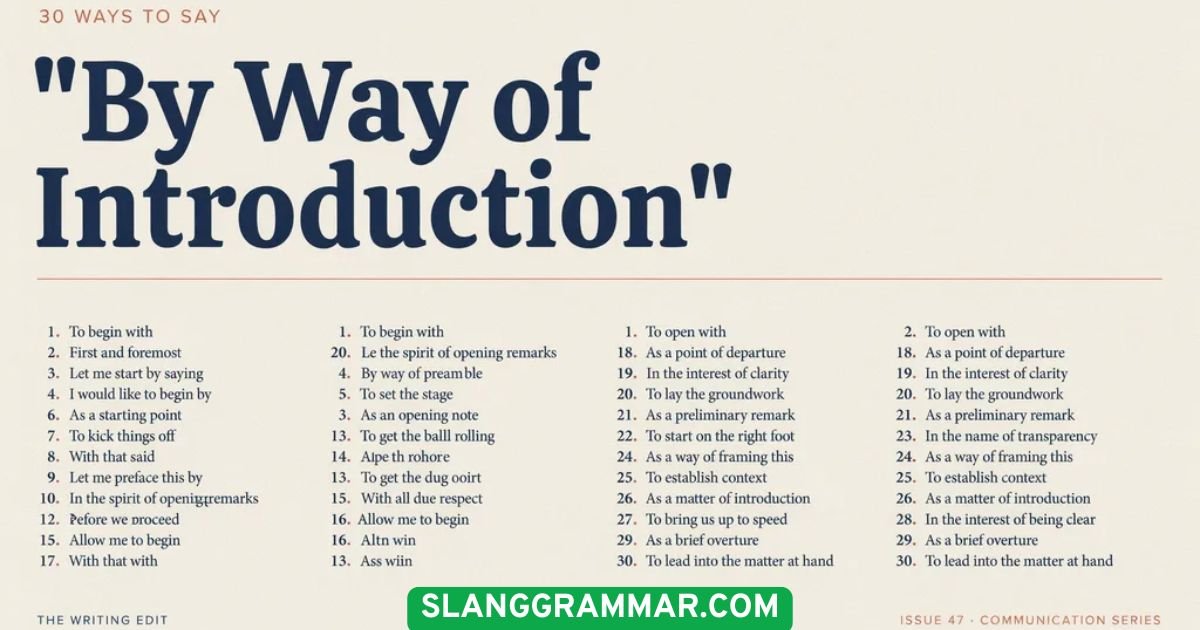
30 Ways to Say “By Way of Introduction” in a Business Email
Now we get to the good part. Below are thirty different ways to open an introductory email. Each one comes with a clear explanation, a realistic example, and guidance on when to use it or avoid it. Read through them, bookmark your favorites, and start testing them in your own emails.
1. I would like to introduce myself
This phrase is a classic for a reason. It is polite, clear, and gets straight to the point. You are telling the reader exactly what you are doing without any extra fluff. The tone lands right in the middle of formal and neutral, making it safe for almost any professional situation.
Example: “I would like to introduce myself. My name is Marcus Chen, and I will be your new point of contact for all technical support questions going forward.”
Use this when you are writing to someone in a traditional corporate environment or when you do not know the reader’s preferred communication style. It is hard to go wrong here. Avoid it only when you need to sound warm or when you are writing to a team that values extreme casualness, like a startup where everyone uses first names and emojis.
2. Allow me to introduce myself
This one sounds slightly more old-fashioned than the first option, but it carries a sense of confidence and respect. You are asking for permission to introduce yourself, which feels courteous without being weak. The tone is formal but polished.
Example: “Allow me to introduce myself. I am Dr. Elena Vasquez from the research compliance office, and I will be reviewing your upcoming grant application.”
Use this in highly formal settings like academic institutions, government agencies, or when writing to senior executives you have never met. Avoid it in casual internal emails or when you want to sound like a peer rather than a subordinate.
3. I am writing to introduce myself
This is one of the most direct and functional options. You are stating your action clearly, which American readers tend to appreciate. The tone is professional and purpose-driven without being overly warm or cold.
Example: “I am writing to introduce myself as the new logistics coordinator for your Midwest distribution routes. I wanted to say hello before our scheduled call next Tuesday.”
Use this when you need to be efficient with your reader’s time. It works well for cold emails, follow-ups after a referral, or any situation where the recipient is busy and wants to know immediately why you are emailing. Avoid it when you are introducing two people in a more social or networking context, as it can feel a bit transactional.
4. I wanted to take a moment to introduce myself
This phrase adds a small but meaningful layer of consideration. By saying you “wanted to take a moment,” you are acknowledging that the reader is busy and that you appreciate their attention. The tone is courteous and respectful without being submissive.
Example: “I wanted to take a moment to introduce myself before we dive into any project details. I am Jamie Lin, and I will be leading the user research side of our collaboration.”
Use this when you are writing to someone whose time you genuinely respect, such as a busy executive, a client, or a colleague in a different department. Avoid it in very short emails or when you have already established a casual relationship with the reader.
5. I would like to briefly introduce myself
Adding the word “briefly” does two good things. It signals that you will not waste the reader’s time, and it sets an expectation that the introduction will be short. The tone is efficient and professional with a hint of humility.
Example: “I would like to briefly introduce myself. I am Samira Khan, and I am the new editor joining your content team. I am excited to learn from all of you.”
Use this when you are introducing yourself to a group, such as a large team or a department. It reassures everyone that you will not send a novel-length email. Avoid it when you actually need to share a longer introduction, like when you are explaining a complex background or multiple roles.
6. Please allow me to introduce
This is a more formal way to introduce someone else rather than yourself. The “please allow me” part softens the statement and makes it feel like a polite request rather than a command. The tone is formal and deferential.
Example: “Please allow me to introduce our new head of security, David Okonkwo. David brings over fifteen years of experience from the private sector.”
Use this when you are introducing a senior person to other senior people, especially in conservative industries like banking or law. Avoid it in everyday team emails or when introducing peers to each other, as it can sound like you are giving a speech at a formal dinner.
7. I am pleased to introduce
This phrase adds genuine positive emotion to the introduction. You are not just stating a fact. You are expressing happiness about the introduction. The tone is warm and professional, making it great for good news.
Example: “I am pleased to introduce our newest account director, Priya Mehta. Priya comes to us from our London office, and we are thrilled to have her on the US team.”
Use this when you are announcing a new hire, a promotion, or introducing someone impressive to a group. The positivity is contagious. Avoid it when the introduction is routine or when the news is neutral, as the enthusiasm might feel forced.
8. I am reaching out to introduce myself
This is a very common option in modern American business emails, especially in sales, marketing, and tech. The phrase “reaching out” feels active and friendly. You are not just writing. You are extending a hand. The tone is professional with a friendly leaning.
Example: “I am reaching out to introduce myself. I am Jordan Ellis from the partnerships team, and I saw that you recently spoke at the Austin tech conference.”
Use this in cold outreach, networking emails, or any situation where you want to sound approachable and proactive. Avoid it in very formal legal or financial correspondence, where “reaching out” might feel too casual.
Read Also: Clear Guide to 25 Other Ways to Say “Positive Impact”
9. I would like to introduce you to
This is your go-to phrase for connecting two people. The structure is clear and helpful. You are telling Person A that you are about to introduce Person B. The tone is professional and service-oriented.
Example: “I would like to introduce you to Aisha Johnson from our procurement team. Aisha handles all vendor contracts, and she wanted to connect with you about the upcoming renewal.”
Use this whenever you are the bridge between two colleagues, clients, or partners. It positions you as a helpful connector. Avoid it when you are introducing yourself, because that would be grammatically incorrect and confusing.
10. I am happy to introduce
Similar to “I am pleased to introduce,” this phrase adds a sense of joy and willingness. It sounds slightly more casual and accessible than “pleased,” making it a great fit for friendly workplace cultures. The tone is warm and enthusiastic.
Example: “I am happy to introduce our new creative director, Taylor Wong. Taylor has already brought some fantastic ideas to the team, and I cannot wait for you all to work together.”
Use this in internal announcements, team emails, or when introducing someone you genuinely admire. Avoid it in formal external correspondence with clients you do not know well, as the happiness might seem out of place.
11. This email is to introduce
This is the most direct and no-nonsense option on the list. You are stating the email’s purpose in the clearest possible terms. The tone is neutral and functional, almost like a subject line that grew into a full sentence.
Example: “This email is to introduce our new summer intern, Chris Park. Chris will be shadowing the customer support team for the next eight weeks.”
Use this for purely informational introductions where the reader just needs the facts. It works well for internal distribution lists or announcement emails. Avoid it when you want to build a relationship or sound warm, as this phrase has zero emotional temperature.
12. I wanted to formally introduce myself
Adding “formally” changes the stakes. You are signaling that this introduction carries weight, perhaps because you are taking on a new role or because the relationship matters. The tone is formal and respectful.
Example: “I wanted to formally introduce myself as the new compliance officer for your region. I will be reaching out quarterly to review your team’s documentation.”
Use this when you are stepping into a role that has authority or responsibility over the reader, such as a manager, auditor, or regulator. Avoid it when you are joining a peer-level team, as the formality might create unnecessary distance.
13. I would like to take this opportunity to introduce
This phrase works well when the introduction is part of a larger message or event. By saying “take this opportunity,” you are acknowledging that the moment matters. The tone is professional and slightly ceremonious.
Example: “I would like to take this opportunity to introduce our new board member, Robert Chen. Robert joins us after twenty years in nonprofit leadership, and we are grateful to have his guidance.”
Use this in newsletters, annual reports, or any message where the introduction is a special moment rather than a routine update. Avoid it in day-to-day emails where the introduction is not particularly notable.
14. I am writing to connect and introduce myself

This phrase combines two actions. You want to connect, which implies building a relationship, and you want to introduce yourself. The tone is friendly and relationship-focused.
Example: “I am writing to connect and introduce myself. I am Morgan Lee from the alumni relations office, and I noticed you recently moved back to the Chicago area.”
Use this when networking, reaching out to a fellow alumni, or emailing someone with whom you share a common connection. The word “connect” softens the ask and makes the email feel more social. Avoid it in purely transactional emails where you just need to share information.
15. I would like to introduce our team
Sometimes you are not introducing just yourself. You are introducing a whole group. This phrase handles that situation smoothly. The tone is collaborative and professional.
Example: “I would like to introduce our team. You will be working primarily with me, but here is everyone who supports your account: Marcus on tech, Jenna on onboarding, and Priya on billing.”
Use this when you are handing off a client to a new team, announcing a restructure, or welcoming a new partner. Avoid it when you are the only person the reader needs to know.
16. I am reaching out by way of a brief introduction
This phrase is interesting because it includes the original keyword “by way of” but adds “brief” to soften it. You are essentially saying “I am using this message as a short hello.” The tone is professional but self-aware.
Example: “I am reaching out by way of a brief introduction. I am Casey Rivers, and I will be filling in for your usual rep while she is on leave.”
Use this when you want to acknowledge that the phrase is a bit formal but you are keeping things short anyway. It works as a transition phrase when you are not sure about the reader’s preferences. Avoid it when you have already established a relationship, as it will feel unnecessarily wordy.
17. I am contacting you to introduce myself
This is another direct, purpose-driven option. The word “contacting” is slightly more formal than “reaching out,” but still feels modern. The tone is professional and clear.
Example: “I am contacting you to introduce myself. I am Dr. Simone West from the health services department, and I will be your point of contact for the upcoming wellness initiative.”
Use this in healthcare, education, or government settings where “contacting” is standard language. Avoid it in very casual startup environments where “reaching out” or just “hey” would work better.
18. I would like to start by introducing myself
This phrase works well when your email has multiple parts. You are signaling that the introduction is just the beginning, and more information will follow. The tone is structured and professional.
Example: “I would like to start by introducing myself. I am Alex Rivera, your new project manager. After that, I will share a few updates about our timeline and next steps.”
Use this in longer emails or when you are setting expectations for a series of topics. It helps the reader follow your structure. Avoid it in very short emails where the introduction is the only thing you need to say.
19. I wanted to introduce you to
This is a simple, friendly way to connect two people. The phrase “I wanted to” adds a sense of intention and care. You are not just introducing. You are making an effort. The tone is warm and helpful.
Example: “I wanted to introduce you to Sofia Ramirez from our legal team. Sofia is handling the trademark filing, and she had a quick question about your prior artwork.”
Use this in everyday colleague introductions, especially when the introduction is a small favor or a kind gesture. Avoid it in extremely formal situations where “I would like to introduce you to” might be more appropriate.
20. I am pleased to connect and introduce myself
This phrase bundles connection and introduction into one friendly package. You are pleased, which adds positivity, and you want to connect, which adds relationship intent. The tone is warm and professional.
Example: “I am pleased to connect and introduce myself. I am Jordan Taylor from the community outreach team, and I have heard wonderful things about the work you are doing downtown.”
Use this in networking emails, follow-ups after a referral, or any situation where you want to start a relationship on a positive note. Avoid it when the introduction is purely informational or when you do not actually feel pleased (like a required introduction).
21. This message serves as an introduction
This is a very formal, almost legalistic way to introduce someone or something. It works best in documentation, official notices, or when you need to establish a record. The tone is formal and impersonal.
Example: “This message serves as an introduction to our new vendor management system. The system will go live on March 1st, and your team will receive training credentials next week.”
Use this in official company announcements, policy updates, or any message where you need to be precise and leave a paper trail. Avoid it in friendly or relationship-driven emails, as it feels cold.
22. I am glad to make this introduction
This phrase expresses genuine happiness about connecting two people. It is warmer than “pleased” and more specific than “happy.” The tone is friendly and enthusiastic.
Example: “I am glad to make this introduction. I think you two will really enjoy working together, and I am excited to see what you create.”
Use this when you are introducing people who share clear common ground or when the introduction is likely to lead to something positive. Avoid it when you are just doing a routine intro or when you do not know the people well enough to feel glad.
Read Also: 26+ Other Ways to Say “Please Discard My Previous Email” (Without Sounding Like a Robot)
23. I am writing to formally introduce
Adding “formally” changes the stakes significantly. You are telling the reader to pay attention because this introduction matters in an official capacity. The tone is formal and authoritative.
Example: “I am writing to formally introduce our new chief financial officer, Lisa Park. Lisa joins us from a Fortune 500 company and will oversee all financial strategy going forward.”
Use this for executive announcements, external partner introductions, or any situation where the person being introduced holds significant authority. Avoid it for peer-level or junior introductions, as the formality will feel mismatched.
24. I would like to introduce myself and my role
This phrase adds specificity by mentioning your role. It is useful when your job title or function matters to the reader. The tone is professional and transparent.
Example: “I would like to introduce myself and my role. I am Darnell Washington, and I am the accessibility coordinator. I will be reviewing all public-facing materials for compliance.”
Use this when your position gives you authority or responsibility over the reader’s work, or when the reader needs to know exactly who you are for future reference. Avoid it when your role is obvious from your email signature or when the introduction is very casual.
25. I am reaching out to make an introduction
This phrase works perfectly when you are connecting two other people. You are the bridge. The action is clear and helpful. The tone is professional and service-oriented.
Example: “I am reaching out to make an introduction between you and my colleague, Dr. Amira Singh. Amira is leading our research on supply chain transparency, and she would love to hear your perspective.”
Use this in networking, partnership development, or any situation where you are adding value by connecting people. Avoid it when you are introducing yourself, as that would be grammatically incorrect.
26. I am pleased to introduce myself as
This is a confident, clear way to state who you are, especially when your title or identity matters. The phrase “as” connects your name to your role directly. The tone is professional and self-assured.
Example: “I am pleased to introduce myself as the new ombudsperson for the western region. My door is always open if you have concerns you would like to discuss confidentially.”
Use this when you want to establish both your identity and your authority in one smooth sentence. It works well for roles that involve trust, like ombudsperson, HR representative, or ethics officer. Avoid it in casual team introductions where “hi, I am new here” would work better.
27. I wanted to connect and introduce

This shorter version of earlier phrases keeps things simple and friendly. You wanted to connect. You also want to introduce. The tone is casual and approachable.
Example: “I wanted to connect and introduce you to our new UX researcher, Jamie Lin. Jamie is running user tests next week and could use your input on the recruitment criteria.”
Use this in internal emails, Slack messages, or any setting where you have an existing relationship with the reader. Avoid it in cold outreach or formal external emails, where it might feel too familiar.
28. I would like to briefly introduce our organization
This phrase works when you are introducing a company, nonprofit, or team rather than a person. The word “briefly” promises efficiency. The tone is professional and humble.
Example: “I would like to briefly introduce our organization. The Coastal Resilience Lab studies how rising sea levels affect urban infrastructure, and we are looking for partners in the private sector.”
Use this in grant applications, partnership inquiries, or any email where the reader does not know your organization. Avoid it when you are introducing yourself as an individual or when the organization is already well known to the reader.
29. Please allow me to make an introduction
This is a polite, slightly formal way to connect two people. The “please allow me” framing makes the offer feel respectful and gracious. The tone is formal and courteous.
Example: “Please allow me to make an introduction. Professor Okonkwo, this is my former student Maya Chen, who is now applying to graduate programs in your department.”
Use this in academic settings, mentorship contexts, or when introducing a junior person to a very senior person. Avoid it in peer-to-peer introductions, where it sounds overly deferential.
30. I am writing to provide an introduction
This is a functional, no-frills option. You are providing a service to the reader by giving them an introduction. The tone is neutral and professional.
Example: “I am writing to provide an introduction to our new procurement software. The attached document walks you through the key features and next steps.”
Use this for system announcements, tool rollouts, or any situation where you are introducing a thing rather than a person. Avoid it for personal introductions, as it feels too transactional.
Quick Reference Table
Here is a simple table to help you pick the right phrase based on tone and situation.
| Alternative Phrase | Tone | Best Use Case |
| I would like to introduce myself | Professional neutral | Most corporate emails |
| Allow me to introduce myself | Formal polished | Academia, law, government |
| I am writing to introduce myself | Purpose-driven | Cold outreach, referrals |
| I wanted to take a moment to introduce myself | Courteous | Busy executives, clients |
| I would like to briefly introduce myself | Efficient | Team announcements |
| Please allow me to introduce | Formal deferential | Introducing senior people |
| I am pleased to introduce | Warm professional | New hires, good news |
| I am reaching out to introduce myself | Friendly proactive | Sales, networking, tech |
| I would like to introduce you to | Professional helpful | Connecting two people |
| I am happy to introduce | Warm enthusiastic | Internal team emails |
| This email is to introduce | Neutral functional | Informational announcements |
| I wanted to formally introduce myself | Formal respectful | Authority roles, audits |
| I would like to take this opportunity to introduce | Ceremonious | Newsletters, special moments |
| I am writing to connect and introduce myself | Friendly relationship-focused | Alumni, common connections |
| I would like to introduce our team | Collaborative | Client handoffs, restructures |
| I am reaching out by way of a brief introduction | Professional self-aware | Transitional, uncertain settings |
| I am contacting you to introduce myself | Professional clear | Healthcare, education, government |
| I would like to start by introducing myself | Structured | Long emails with multiple topics |
| I wanted to introduce you to | Warm helpful | Everyday colleague intros |
| I am pleased to connect and introduce myself | Warm professional | Networking, referrals |
| This message serves as an introduction | Formal impersonal | Official notices, documentation |
| I am glad to make this introduction | Friendly enthusiastic | Exciting connections |
| I am writing to formally introduce | Formal authoritative | Executive announcements |
| I would like to introduce myself and my role | Professional transparent | Role-based authority |
| I am reaching out to make an introduction | Professional service-oriented | Connecting two people |
| I am pleased to introduce myself as | Professional self-assured | Trust-based roles |
| I wanted to connect and introduce | Casual approachable | Internal, existing relationships |
| I would like to briefly introduce our organization | Professional humble | Grant apps, partnership inquiries |
| Please allow me to make an introduction | Formal courteous | Academic, mentor contexts |
| I am writing to provide an introduction | Neutral professional | System announcements, tools |
Frequently Asked Questions
How to start an email with by way of introduction?
Start with: “By way of introduction, my name is [Name], and I’m [role/company].”
Then briefly explain why you are reaching out.
How do you start an introduction email?
Start with a polite greeting, then introduce yourself clearly in the first line.
Example: “Hi Sarah, I’m writing to introduce myself as your new account manager.”
What to say instead of “by way of introduction”?
You can say “I’m writing to introduce myself,” “Allow me to introduce myself,” or “I’d like to introduce you to.”
These phrases sound clear, professional, and natural.
How do you introduce your email?
Introduce your email by stating who you are and why you are contacting the reader.
Keep it short, polite, and focused on the purpose of your message.
What is a good short introduction?
A good short introduction is: “Hi, my name is [Name], and I’m reaching out to introduce myself.”
It is simple, friendly, and professional for most emails.
Putting It All Together
You now have many better choices instead of repeating “by way of introduction” in every first email. This old phrase works fine, but it sounds too formal and distant for most modern workplaces. Using fresher alternatives helps you sound more confident and friendly. You can pick a warm phrase for a new teammate or a professional one for a client. Each situation needs a different tone. Save “by way of introduction” for very formal letters only.
Learning these thirty alternatives makes your writing stronger and more natural. You do not need to memorize every single option. Pick just three or four that feel right for your job and your readers. Practice using them in real emails this week. Your readers will notice the difference. They will find your messages clearer and more welcoming. Good communication starts with a strong first impression, and you now have the right tools to make one.
Related Guides:
1: 30 Other Ways to Say “Please Note” With Clear Examples
2: Better Formal Wording: 30 Ways to Say “It Would Be Greatly Appreciated”
3: Better Encouragement: 28 Other Ways to Say Rooting for You
4: 30 Other Ways to Say “Infectious Smile” With Clear Examples
5: 24+ Other Ways to Say “Thank You for Having Me” Naturally and Politely