26+ Other Ways to Say “Please Discard My Previous Email” (Without Sounding Like a Robot)
You ask someone to please discard my previous email when you send a message by mistake. This phrase means you want the person to ignore or delete that first email completely. It is a polite way to pretend the earlier message never arrived in their inbox.
Have you ever hit send and then noticed a huge error right away? That awful feeling in your stomach is exactly why you need this exact phrase. Learning how to say please discard my previous email the right way can save you from embarrassment.
Most people use please discard my previous email after sending wrong information or a missing attachment. The phrase works for typos, incorrect dates, or sending an old draft by accident. But there are actually better and friendlier ways to fix your email mistakes.
What Does “Please Discard My Previous Email” Mean?
When you ask someone to please discard my previous email, you are essentially saying, “Pretend the first message never existed. Delete it from your mind. Do not act on anything I said there.” The word discard comes from the world of physical trash — think throwing away a soda can or crumpling up a paper draft.
In email communication, people use this phrase when they realize they sent wrong information, a missing attachment, or an earlier version of a document that has since changed. The intention is good: you want to stop confusion before it starts. But the execution often falls flat.
Here is why. Discard feels like a command for a recycling bin, not a polite request between humans. When you tell a colleague to discard something, it sounds cold and transactional. Most American professionals prefer softer, more collaborative language like ignore or disregard. Those words still get the job done, but they do not make the other person feel like they are taking out the trash for you.
So while the meaning is clear — please act as if that earlier email does not exist — the wording itself could use a serious upgrade. That is exactly what we are going to do in this article.
When to Use “Please Discard My Previous Email”
Even though I am about to give you dozens of better options, there are still a few specific situations where the original phrase might be acceptable. Let me be honest with you, though. Those situations are rare.
You could use please discard my previous email if you work in a highly formal field like corporate law, government contracting, or strict financial compliance. In those worlds, people expect blunt, no-nonsense language. Your boss might actually prefer the word discard because it leaves zero room for interpretation.
Another scenario is when you accidentally send an email that contains confidential or sensitive information. For example, if you accidentally shared a salary spreadsheet or a private client note, you want the recipient to delete it completely. In that case, discard communicates urgency and finality.
You might also use it when sending a mass internal memo to a very large team. If you need fifty people to ignore the first version and pay attention to the second, being direct and slightly formal can help cut through the noise.
But for everyday mistakes — a typo, a wrong date, a missing link — this phrase is overkill. Most Americans find it awkward or even mildly rude. Stick with the friendlier alternatives I am about to share, and you will sound like a competent, kind professional every time.
Is It Professional or Polite to Say “Please Discard My Previous Email”?
Here is the honest answer you came for. Please discard my previous email is technically professional, but it is not very polite. There is a big difference between those two things.
Let me explain. Professional language follows workplace rules. It is clear, direct, and free of slang. Discard meets that definition. A lawyer or an IT manager could use it without breaking any grammar rules. However, polite language considers how the other person feels when they read your words. And that is where discard stumbles.
Imagine you are on the receiving end. You open an email that says, “Please discard my previous email.” How does that land? For most people, it feels like a command. It does not include an apology or a warm explanation. It simply tells you what to do. Over time, that kind of tone can make you seem cold or even arrogant, even if you do not mean to be.
To help you see the difference clearly, here is a simple comparison.
| Aspect | Please Discard My Previous Email | A Friendly Alternative (e.g., “Sorry for the confusion”) |
| Tone | Cold, technical, robotic | Warm, human, collaborative |
| Politeness Level | Low to medium | High |
| Best Use Case | Legal notices, IT commands, strict formal settings | Everyday workplace, clients, coworkers |
| How It Makes the Reader Feel | Ordered around | Respected and understood |
| Professional But? | Yes, but not likable | Yes, and also likable |
So if your only goal is to be correct, the original phrase works fine. But if you want to be effective — meaning people still like working with you — you need better options. That is what the rest of this article is all about.
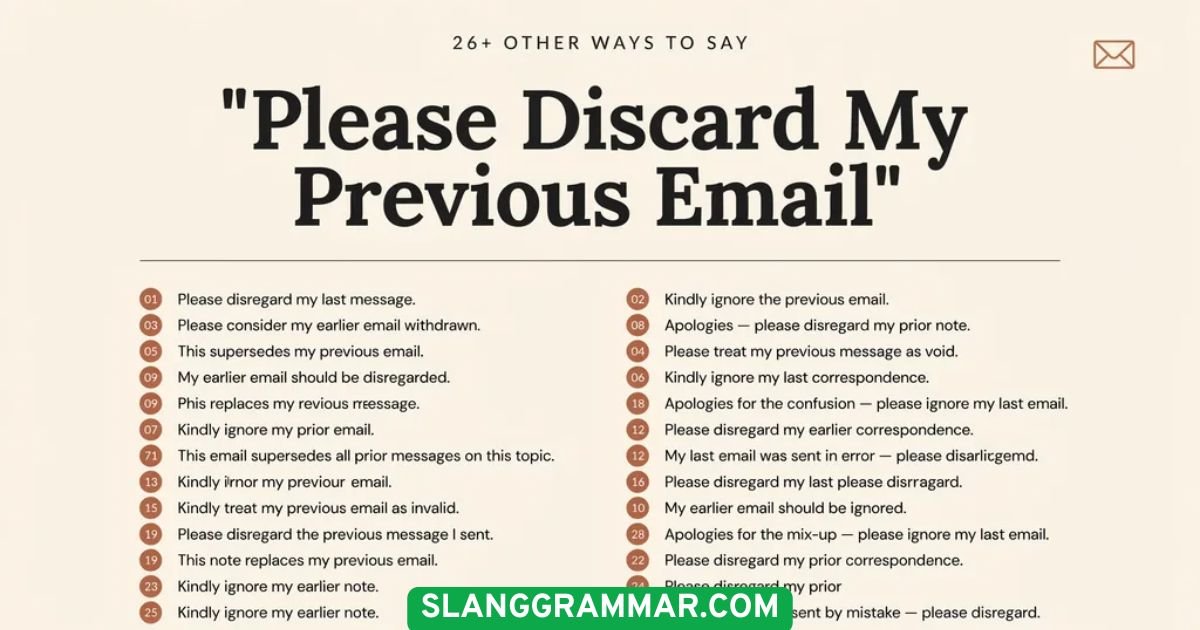
26 Other Ways to Say “Please Discard My Previous Email”
Let us get into the good stuff. Below you will find over twenty alternatives, each with its own personality. Some are warm, some are quick, and some are formal enough for your most buttoned-up clients. I have written each one as a full paragraph under its own heading so you can see exactly how to use it in real life.
1. Please ignore my previous email
This is the most direct swap you can make. Instead of asking someone to discard the first message, you simply ask them to ignore it. The difference in tone is subtle but meaningful. Ignore feels less aggressive because it asks for inaction (just look away) rather than action (throw this away). Use this when you need to send a quick correction to a coworker or a regular client. It is safe, neutral, and widely understood.
Example: “Please ignore my previous email about the team lunch. I sent the wrong time. The correct time is 1:00 PM.”
Best use: Internal teams and casual work friendships.
Not ideal for: A client who is already frustrated with you. In that case, add an apology.
2. Kindly disregard my earlier message
The word kindly gives this phrase a slightly old-fashioned, polite feel. It is not something most Americans say in casual conversation, but in email, it works beautifully for formal situations. Disregard is softer than discard because it means “pay no attention to” rather than “physically delete.” This is an excellent choice when emailing someone more senior than you or when you work in a traditional industry like banking or higher education.
Example: “Kindly disregard my earlier message about the budget report. I have attached the corrected version here.”
Best use: Formal workplaces or when emailing a boss you do not know well.
Not ideal for: Slack messages or very casual startup environments.
3. Please disregard the email I sent earlier
This version is nearly identical to the one above, but dropping the word kindly makes it sound more modern and straightforward. Please disregard the email I sent earlier is a solid middle-ground option. It is formal enough for a client but not so stiff that your coworkers will laugh at you. I recommend this when you have made a minor error, like a typo or a mislabeled attachment, and you want to correct it without making a big deal.
Example: “Please disregard the email I sent earlier regarding the shipping dates. The correct dates are listed below.”
Best use: Standard business communication with people you respect but are not nervous around.
Not ideal for: Emails where you have already apologized twice that week. At that point, keep it even shorter.
4. Apologies—please ignore my last email
See how the word apologies changes everything? You are no longer just giving a command. You are acknowledging that you made a mistake. This small human touch goes a long way in American workplace culture, where people value humility and collaboration. Use this phrase when you have a decent relationship with the recipient and you want to keep things friendly but professional. The em dash adds a nice natural rhythm, too.
Example: “Apologies—please ignore my last email. I hit send before adding the attachment. It is included now.”
Best use: Daily email corrections with teammates or regular clients.
Not ideal for: Extremely formal legal correspondence where you should avoid casual punctuation.
5. Please treat my previous email as void
This one sounds much more serious. Void is a legal and financial term that means “null and empty, as if it never existed.” You should only use this when the first email contained something truly important, like a contract offer, a pricing quote, or a deadline that has completely changed. For a simple typo, this is overkill. But for high-stakes corrections, it works perfectly because it leaves no doubt.
Example: “Please treat my previous email as void. The promotion details have changed, and this email contains the official offer.”
Best use: Legal documents, contracts, or official company announcements.
Not ideal for: Emailing a friendly coworker about lunch plans.
6. Please consider this email instead
Notice what this phrase does differently. It does not even mention the mistake. Instead, it focuses entirely on the solution. Please consider this email instead is positive, forward-looking, and respectful of the reader’s time. You are not asking them to do extra work (discarding or ignoring). You are simply saying, “Here is the correct information. Use this one.” This is one of my personal favorites for busy professionals.
Example: “Please consider this email instead of my previous one. The meeting link has been updated here.”
Best use: Fast-paced environments where everyone makes mistakes and no one wants to dwell on them.
Not ideal for: Situations where the original error was major and deserves an explicit apology.
7. Please use this updated message
This is another solution-focused alternative. Updated is a positive word. It suggests improvement rather than failure. When you say please use this updated message, you are telling the reader that the new email is better, not just different. This works especially well for project management, design files, or any situation where you are sending a second draft or a revised version.
Example: “Please use this updated message for the client proposal. I have corrected the pricing errors from my earlier email.”
Best use: Creative or collaborative work where revisions are normal and expected.
Not ideal for: One-off personal emails where an update sounds too technical.
Read Also: 30 Other Ways to Say “Please Note” With Clear Examples
8. Please note the correction below
Short, sweet, and to the point. Please note the correction below does not waste anyone’s time. It assumes the reader saw the first email, and now you are simply providing the fix. The word correction is neutral and professional. It does not apologize excessively, but it also does not demand action. This is a fantastic choice when you have a good relationship with the recipient and you both value efficiency over lengthy apologies.
Example: “Please note the correction below. The original email said Tuesday, but the correct day is Wednesday.”
Best use: Internal emails, team updates, or any workplace with a no-drama culture.
Not ideal for: Customer-facing emails where a warmer tone would be more appropriate.
9. Please ignore the earlier version
Earlier version is softer language than previous email. It sounds less like you are pointing out your own failure and more like you are managing different drafts. This is especially useful in creative fields or any job where you send multiple iterations of a document. You can use this without feeling embarrassed because revisions are simply part of the process.
Example: “Please ignore the earlier version of the flyer. This new version has the correct date and location.”
Best use: Design, writing, marketing, or any field where version control matters.
Not ideal for: A one-time personal email where “version” sounds too technical.
10. Please accept my correction
This phrase carries a tone of responsibility. By saying please accept my correction, you are acknowledging that you made an error and asking the reader to receive the fix graciously. It is humble without being groveling. Use this when you want to show respect, especially if the person on the other end is a supervisor, a long-term client, or someone you deeply respect.
Example: “Please accept my correction to the invoice total. The correct amount is $450, not $540 as previously stated.”
Best use: Financial corrections, formal apologies, or situations where trust matters greatly.
Not ideal for: Very casual corrections with peers who might find this too stiff.
11. I sent that email in error—please ignore it
This is one of the most honest and clear options. I sent that email in error takes full ownership. You are not hiding behind passive language or fancy words. You are simply saying, “That was my mistake.” The em dash keeps the sentence moving smoothly, and please ignore it is short and familiar. Americans respond well to this kind of straightforward accountability.
Example: “I sent that email in error—please ignore it. The correct information is below.”
Best use: Any situation where you want to build trust by admitting fault clearly.
Not ideal for: Extremely formal emails where an em dash might feel too casual.
12. Sorry for the confusion—please see the updated email
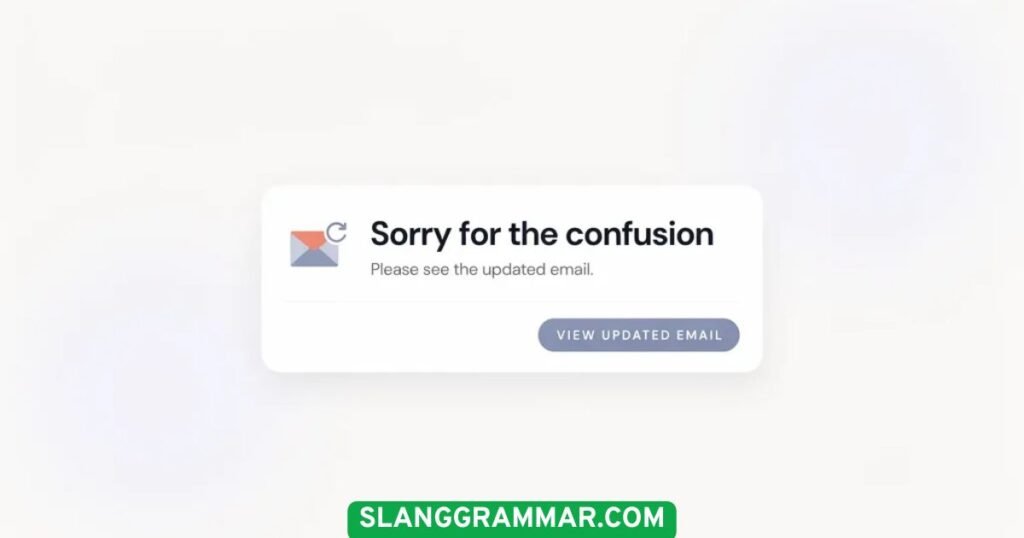
If I had to pick a single winner for the average American workplace, this would be it. Sorry for the confusion is warm and relatable. Everyone has been confused before. By apologizing for the confusion rather than the error, you make the problem feel shared rather than personal. Then please see the updated email gives a clear, positive action. This phrase works for almost any situation: clients, bosses, coworkers, even customers.
Example: “Sorry for the confusion—please see the updated email with the correct attachment this time.”
Best use: Almost every email correction situation, especially with people you like and respect.
Not ideal for: Legal notices where “confusion” sounds too informal.
13. Please refer to this message instead
Refer is a slightly formal verb, but it works beautifully in written business communication. When you say please refer to this message instead, you are politely directing the reader’s attention away from the old email and toward the new one. This is less about apologizing and more about redirecting. It is efficient and professional without being cold.
Example: “Please refer to this message instead of my previous email for the correct login instructions.”
Best use: Instructional emails, how-to guides, or any situation where accuracy matters.
Not ideal for: Emotional or personal corrections where a warmer tone would help.
14. Kindly ignore the previous version
Here is that word kindly again, paired with previous version for a double dose of politeness. This is a great choice when you need to be extremely respectful, such as when emailing a high-level executive or a new client you have not built rapport with yet. It is formal but not cold, and the word version makes the mistake feel smaller and more technical.
Example: “Kindly ignore the previous version of the presentation. I have made the requested changes in this version.”
Best use: High-stakes formal emails where you need to be extra polite.
Not ideal for: Casual team chats where this would sound overly fancy.
15. Please accept my apologies and ignore my last email
This is the most formal and apologetic option on the list. Please accept my apologies is a complete sentence on its own, and adding ignore my last email makes your request crystal clear. Use this when you have made a significant error that might have cost someone time, money, or embarrassment. It shows that you understand the weight of your mistake and you are taking it seriously.
Example: “Please accept my apologies and ignore my last email. The wrong date was sent to the entire client list, and I deeply regret the confusion.”
Best use: Major errors that affected multiple people or caused real problems.
Not ideal for: Small typos or missing attachments where this would be dramatic overkill.
16. The previous email was sent by mistake
This alternative uses the passive voice, which is usually weaker in writing. But in this specific case, it works. The previous email was sent by mistake focuses on the email rather than on you. That can be helpful if you feel like you have already apologized too much this week, or if you want to state the facts without making yourself the center of attention. It is neutral, clean, and professional.
Example: “The previous email was sent by mistake. Please use the information below for the correct shipping address.”
Best use: Situations where you want to be factual without adding emotion.
Not ideal for: Warm, friendly workplaces where this might feel cold.
17. Please disregard the earlier draft
Draft is a magical word because it lowers the stakes. Everyone sends early drafts. Everyone revises. When you say please disregard the earlier draft, you are framing your mistake as a normal part of the creative or planning process. This is perfect for writers, designers, marketers, or anyone who sends work in progress. It makes you look organized rather than careless.
Example: “Please disregard the earlier draft of the blog post. This draft includes the final edits from the client.”
Best use: Creative and collaborative fields where drafts are expected.
Not ideal for: Final, legal, or financial emails where “draft” sounds unprofessional.
18. Please note that my earlier email is no longer valid
No longer valid is a strong, clear phrase. It communicates that something has changed, usually due to new information or a deadline passing. This is excellent for time-sensitive corrections. For example, if you sent an email about a sale price that expired, or a meeting time that got moved, this phrase handles it perfectly without any extra fluff.
Example: “Please note that my earlier email is no longer valid. The webinar has been rescheduled to Friday at 2:00 PM.”
Best use: Time-sensitive updates, expired offers, or changed deadlines.
Not ideal for: Simple typos that do not affect validity.
19. Please ignore the message sent earlier today
Adding today makes this phrase very specific. This is helpful when you send multiple emails in a single day and you want to be clear about which one you are retracting. It is also a gentle way to say, “I know I have been emailing a lot, but this one specific message was wrong.” The specificity helps reduce confusion for busy readers.
Example: “Please ignore the message sent earlier today about the server maintenance. The correct time is 10:00 PM, not 10:00 AM.”
Best use: Days when you send multiple updates and need to be very clear.
Not ideal for: Corrections that come days later, where “earlier today” would be inaccurate.
Read Also: Better Formal Wording: 30 Ways to Say “It Would Be Greatly Appreciated”
20. Please see the corrected information below
This is another short and efficient option. Corrected information tells the reader exactly what changed, and below tells them where to find it. You are not asking them to delete anything or even ignore anything. You are simply providing the fix and trusting them to use it. This works best when the original error was minor and the correction is obvious.
Example: “Please see the corrected information below. The original email had the wrong phone number for support.”
Best use: Minor data corrections like phone numbers, addresses, or dates.
Not ideal for: Complex errors where the entire email needs to be replaced.
21. Please accept this as the correct version
This phrase has a tone of finality. Please accept this as the correct version tells the reader that the discussion is over and this is the definitive answer. Use this after you have already sent one or two corrections and you want to make sure everyone is on the same page. It is confident without being arrogant.
Example: “Please accept this as the correct version of the contract. All previous versions should be deleted.”
Best use: Final approvals, legal documents, or any situation with version confusion.
Not ideal for: First-time corrections where this would sound too heavy.
22. My apologies—please refer to this updated email
This is a warm, professional hybrid. My apologies takes ownership, but it is shorter and less formal than “please accept my apologies.” Please refer to this updated email gives a clear instruction. The combination is friendly but still serious enough for most business situations. I recommend this for client emails where you have a good relationship but still want to be respectful.
Example: “My apologies—please refer to this updated email for the correct project timeline.”
Best use: Client communication, agency work, or any external business email.
Not ideal for: Internal team emails where this might sound too formal.
23. Scratch that—here is the correct version
Yes, you can use this in professional emails, depending on your workplace culture. Scratch that is informal and friendly. It sounds like something you would say out loud to a coworker. Use this only with people you know well, like your work bestie or your small startup team. In the right context, it is charming and efficient. In the wrong context, it looks unprofessional.
Example: “Scratch that—here is the correct version of the agenda. Sorry for the double email.”
Best use: Casual workplaces, startups, or teams with a close friendship culture.
Not ideal for: Clients, bosses, or any formal environment.
24. Please ignore my previous email about this subject
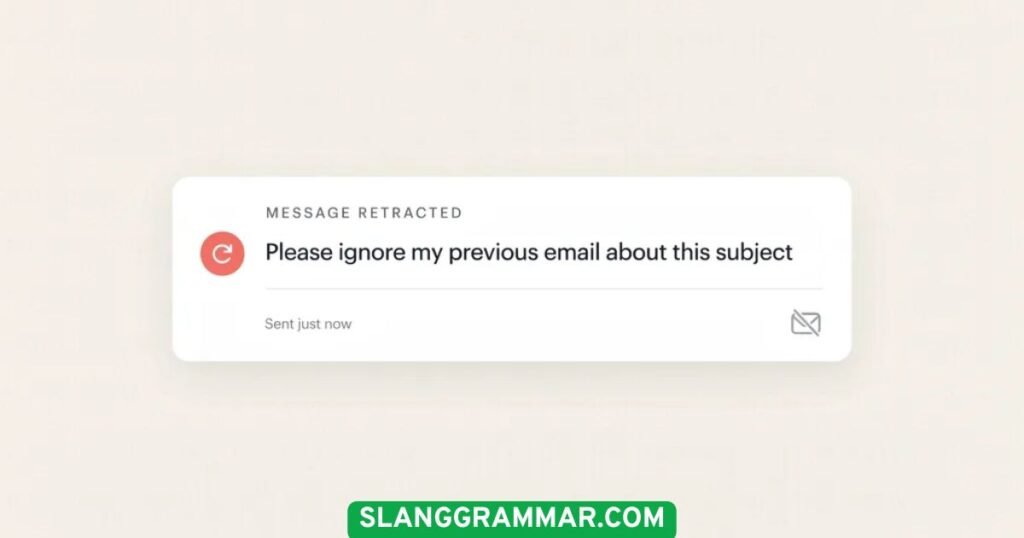
Adding about this subject helps when you have multiple email threads going at once. It tells the reader exactly which previous email you mean, even if you have emailed them several times that day. This is a great clarifying phrase for project managers, team leads, or anyone juggling many conversations.
Example: “Please ignore my previous email about this subject. I have since received updated numbers from the finance team.”
Best use: Complex projects with many email threads.
Not ideal for: Simple one-off emails where this is unnecessary detail.
25. Correction: Please use the details below
Sometimes the shortest option is the best. Correction: works like a subject line inside your email. It signals immediately that something was wrong. Then please use the details below tells the reader exactly what to do. This is brutally efficient, and many busy American professionals will appreciate that.
Example: “Correction: Please use the details below for the new client address. My previous email had an old address.”
Best use: High-volume workplaces where everyone values speed.
Not ideal for: Sensitive situations where a warmer opening would help.
26. Let us pretend my previous email did not happen
This one is intentionally humorous and friendly. Let us pretend my previous email did not happen works beautifully in close teams, with regular clients who have a sense of humor, or in creative industries. It acknowledges the mistake lightly and moves on. Only use this when you are confident the other person will smile rather than frown.
Example: “Let us pretend my previous email did not happen. Here is the actual meeting link. Sorry about that!”
Best use: Friendly, low-stakes environments with people you trust.
Not ideal for: Formal or high-stakes professional settings.
Quick Reference Table
Before we wrap up, here is a simple table to help you choose the right phrase in seconds. It shows each alternative, its tone, and the best situation to use it.
| Alternative Phrase | Tone | Best Use Case |
| Please ignore my previous email | Neutral | Everyday workplace corrections |
| Kindly disregard my earlier message | Formal polite | Senior colleagues or conservative industries |
| Please disregard the email I sent earlier | Semi-formal | Standard business communication |
| Apologies—please ignore my last email | Warm professional | Friendly client or coworker emails |
| Please treat my previous email as void | Very formal | Legal or financial corrections |
| Please consider this email instead | Positive & efficient | Busy professionals, solution-focused |
| Please use this updated message | Neutral helpful | Drafts and revised documents |
| Please note the correction below | Short & neutral | Minor typos or data fixes |
| Please ignore the earlier version | Collaborative | Creative fields with version control |
| Please accept my correction | Humble formal | Respectful corrections to superiors |
| I sent that email in error—please ignore it | Honest & direct | Building trust through accountability |
| Sorry for the confusion—please see the updated email | Warm & friendly (best overall) | Almost any situation with real people |
| Please refer to this message instead | Slightly formal | Instructional or directional emails |
| Kindly ignore the previous version | Very formal polite | High-stakes formal corrections |
| Please accept my apologies and ignore my last email | Strongly apologetic | Major errors affecting others |
| The previous email was sent by mistake | Neutral factual | Emotionally neutral corrections |
| Please disregard the earlier draft | Casual professional | Writing, design, and creative work |
| Please note that my earlier email is no longer valid | Time-sensitive | Expired offers or changed deadlines |
| Please ignore the message sent earlier today | Specific & clear | Days with multiple email updates |
| Please see the corrected information below | Short & direct | Simple data corrections |
| Please accept this as the correct version | Confident & final | Final approvals and legal documents |
| My apologies—please refer to this updated email | Warm formal | Client and external business emails |
| Scratch that—here is the correct version | Very casual | Startups and close teams |
| Please ignore my previous email about this subject | Clarifying | Complex projects with many threads |
| Correction: Please use the details below | Ultra-efficient | Fast-paced, high-volume workplaces |
| Let us pretend my previous email did not happen | Humorous friendly | Creative or low-stakes friendly teams |
Frequently Asked Questions
How do you say “please disregard my previous email”?
Say “Sorry for the confusion—please see the updated email instead” or simply “Please ignore my last email.”
What does please disregard this email mean?
It means “pretend you never received that message and do not act on any information it contained.”
How do you apologize for the previous email?
Send a quick follow-up saying “My apologies—I sent that in error” or “Sorry for the mix-up, here is the corrected version.”
How do you say “disregard” professionally?
Use “Please ignore my earlier message,” “Please set aside my previous email,” or “Please refer to this updated message instead.”
What is a better word for disregard?
“Ignore,” “set aside,” “overlook,” or “set no store by” — though in email contexts, “ignore” is the most natural and common choice.
Putting It All Together
You do not need to keep using the phrase please discard my previous email every time you make an email mistake. Many better options exist for fixing errors like wrong attachments or incorrect dates. You can say “sorry for the confusion” or “please ignore my last email” instead. These alternatives sound more natural and friendly to your readers. They also help you look professional without feeling too stiff or robotic.
Choose the right phrase based on who receives your email. Use warm words like “my apologies” for a boss or a client. Use short and direct words like “correction below” for a coworker you know well. Remember that please discard my previous email works best only in very formal situations like legal notices. For everyday workplace corrections, pick a softer phrase. This small change will make your email communication clearer and more polite.
Related Guides:
1: Better Encouragement: 28 Other Ways to Say Rooting for You
2: 30 Other Ways to Say “Infectious Smile” With Clear Examples
3: 24+ Other Ways to Say “Thank You for Having Me” Naturally and Politely
4: 30 Other Ways to Say “Please Confirm Receipt of This Email”
5: 32 Other Ways to Say “Family Emergency” With Examples