28 Other Ways to Say “Thank You for Your Consideration” (With Examples)
Sending a job application email, submitting a proposal, or closing a client follow-up email always comes with one small moment of pressure: how do you wrap it up? Most people reach for the same default phrase — thank you for your consideration — without thinking twice. It does the job, but it can start to feel a little hollow after a while, especially when every email in someone’s inbox ends the same way.
The truth is, the closing line of any professional email carries more weight than most people realize. It’s the last impression you leave. It shapes whether you sound warm and genuine, or just going through the motions. That’s why knowing a few strong alternatives to thank you for your consideration can make a real difference — not just in how polished you sound, but in how you make the reader feel.
This article walks you through 28 natural, effective alternatives you can use right away. Each one fits a slightly different context, and understanding when to reach for which phrase is what separates a good communicator from a great one.
What Does “Thank You for Your Consideration” Mean?
At its core, thank you for your consideration is a polite closing phrase used to acknowledge that someone is giving your request, application, or proposal their time and attention. It’s a way of saying: “I recognize that you have a choice in how you spend your time, and I appreciate that you’re spending some of it on me.”
The phrase grew out of formal business communication and has roots in letter-writing conventions from decades ago, when correspondence was more ceremonially structured. Back then, phrases like this signaled respect and deference — important qualities in professional relationships. Over time, it migrated seamlessly into email etiquette and is now a standard fixture in everything from cover letter closings to request approval emails.
You’ll most commonly see it at the end of messages where someone is asking for something — a job, a contract, a favor, feedback, or a decision. It’s a graceful way to close without sounding demanding, while also expressing genuine gratitude before the reader has even responded.
When to Use “Thank You for Your Consideration”
Knowing when this phrase is the right fit helps you use it confidently — and know when to swap it for something better.
It works naturally at the end of a job application email or cover letter, where you want to acknowledge the hiring manager’s time before they’ve made any decision. It also fits well in proposal submission emails, where a vendor, consultant, or freelancer is waiting for a client to review their work. Any time you’re asking someone to evaluate something you’ve put effort into, this phrase carries a respectful, humble tone that’s entirely appropriate.
The phrase also suits feedback request emails and approval emails sent to a manager or stakeholder. When you need someone to review and respond to something, closing with this line signals that you understand their time is valuable and you don’t take their attention for granted. Similarly, it works in client email phrases at the end of a proposal, especially in industries like finance, law, or consulting where formal tone is the default.
Where it becomes less effective is in ongoing, casual working relationships. If you email a colleague you speak with daily and sign off with this phrase, it can feel oddly stiff — like you suddenly turned the conversation into a formal letter. In those cases, something warmer and more conversational fits better, which is exactly what many of the alternatives below offer.
Is It Professional or Polite to Say “Thank You for Your Consideration”?
Yes — and genuinely so. But with a small caveat.
The phrase is both professional and polite. It signals respect, gratitude, and an awareness of the reader’s time. In formal appreciation contexts, it holds up perfectly. Hiring managers, clients, and senior stakeholders all receive it without a second thought, and it never reads as inappropriate.
The caveat is that it can sometimes feel generic. When someone reads dozens of emails a day, and half of them close with the exact same phrase, the words can start to blur together. This doesn’t make the phrase wrong — it just means that choosing a more specific or heartfelt alternative can help your message stand out and feel more genuine.
Here’s a quick look at both sides:
| Aspect | Verdict |
| Professionalism | ✅ Universally appropriate in formal settings |
| Politeness | ✅ Always courteous, never offensive |
| Warmth | ⚠️ Can feel impersonal if overused |
| Memorability | ⚠️ Generic — rarely makes an impression |
| Versatility | ✅ Works in almost any professional context |
| Uniqueness | ❌ Very common — blends into the background |
The bottom line: use it when it fits and you genuinely mean it. But if you want your email to feel a little more human, a little more tailored, or simply more memorable, one of the alternatives below is likely a better pick.
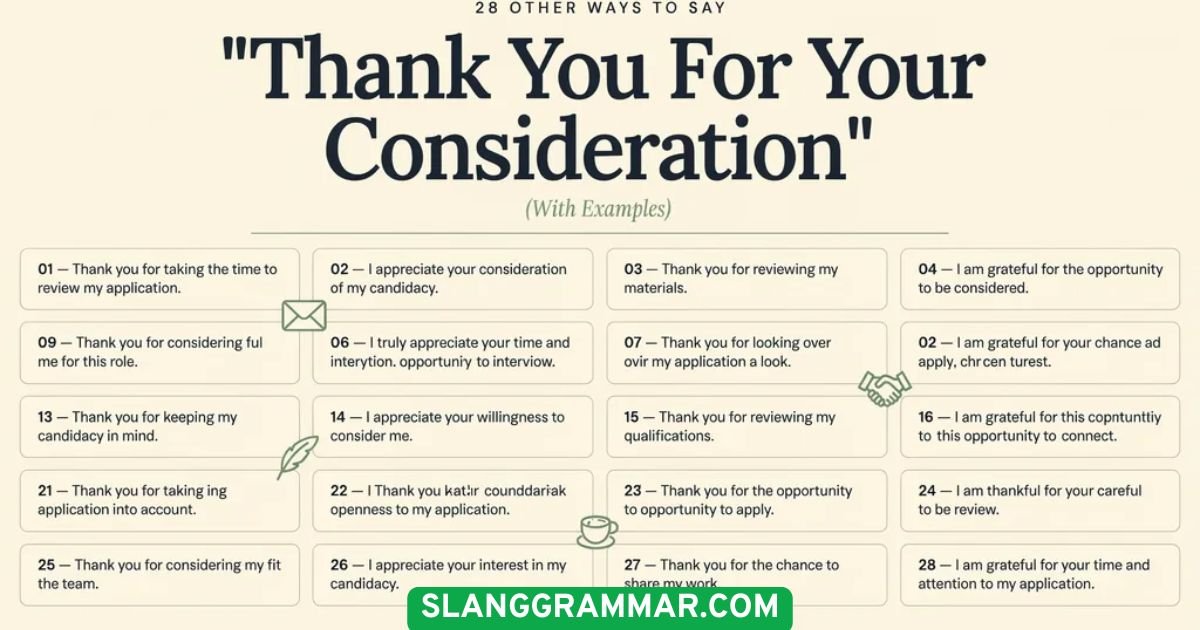
28 Other Ways to Say “Thank You for Your Consideration”
Here is the main section — 28 genuine, practical alternatives with context on when and how to use each one.
1. I Appreciate Your Time and Attention
This phrase is one of the warmest and most natural-sounding alternatives. It goes beyond just thanking someone for reviewing your request — it acknowledges the two things they’re really giving you: time and focused attention. The tone is warm yet professional, which makes it ideal for semi-formal contexts.
Example: “I appreciate your time and attention, and I look forward to your response.”
It’s a great fit for follow-up emails to clients or potential employers. It does feel slightly less formal than the original phrase, so for very stiff, formal business communication — think legal correspondence or executive-level proposals — you might want to stick with something more traditional.
2. Thank You for Your Time
Simple, clean, and never out of place. Thank you for your time is one of those phrases that works almost everywhere. It’s direct and respectful without any extra weight or ceremony. The tone is neutral to warm, making it comfortable across both formal and semi-formal settings.
Example: “Thank you for your time — I hope to hear from you soon.”
It fits especially well in job application emails and business email etiquette scenarios where you don’t want to come across as overly formal or sycophantic. The one situation where it falls short is when you want to specifically acknowledge a review process — in that case, something more specific (like the phrase below) does a better job.
3. Thank You for Reviewing My Application
When you’re specifically submitting a job application, a proposal, or a document for review, this phrase is more precise than the general alternatives. It names exactly what you’re grateful for — not just their time in general, but the act of reading and evaluating what you sent.
Example: “Thank you for reviewing my application — I’m excited about the opportunity and would welcome the chance to discuss further.”
The tone is professional and grounded. It works beautifully in cover letter closings and follows up nicely in second-round interview requests. It would feel a little odd in an email where no document is being reviewed, so use it only when there’s actually something they’ve read or evaluated.
4. I Appreciate Your Thoughtful Review
Adding the word “thoughtful” elevates this phrase in a subtle but meaningful way. It signals that you trust the reader to take your submission seriously — it’s a small expression of confidence in them. The tone is warm and slightly flattering, without being over the top.
Example: “I appreciate your thoughtful review and look forward to any feedback you may have.”
This phrase suits proposal submission emails and feedback request emails especially well. It doesn’t quite fit a situation where you’re sending something very routine and don’t expect much evaluation — calling it a “thoughtful review” in that context might come across as unintentionally ironic.
5. Thank You for Your Careful Consideration
This is a close cousin to the original phrase, but the addition of “careful” does meaningful work. It implies that the decision or evaluation involves some real judgment, and that you respect that process. The tone is formal and respectful, fitting neatly alongside the original in most professional contexts.
Example: “Thank you for your careful consideration of this proposal.”
It’s especially effective in request approval emails, legal or financial correspondence, and formal business communication contexts. In casual or fast-moving workplace exchanges, “careful” can feel a bit heavy — lighter alternatives work better there.
6. I’m Grateful for Your Consideration
Swapping “thank you” for “I’m grateful” adds a touch of personal sincerity. Gratitude expressed in first-person often feels more genuine than the formulaic third-person structure of the original phrase. The tone is warm and genuine, landing somewhere between formal and semi-formal.
Example: “I’m grateful for your consideration and hope we can connect soon.”
This works well in emails where there’s already a slight personal connection — perhaps you met the person briefly, or you’ve had a prior exchange. It would feel mismatched in a very cold, first-contact email to a large institution where personal warmth isn’t really the register you’re going for.
7. Thank You for Your Kind Consideration
The word “kind” adds a layer of warmth that transforms this into something noticeably more personal. It softens the formal edges and feels like something you’d write to a mentor, a generous contact, or someone who has already done you a favor. The tone is warm and courteous, leaning formal but with genuine feeling.
Example: “Thank you for your kind consideration — your support means a great deal to me.”
Ideal for emails to mentors, senior colleagues, or contacts where the relationship has a more personal dimension. It would feel excessive or mismatched in a cold outreach email to a company you’ve never engaged with before.
8. I Value Your Time and Consideration
This phrase subtly shifts the emphasis from thanks to value — implying that you genuinely hold their attention in high regard, not just as a formality. The tone is respectful and professional, fitting naturally in formal appreciation contexts.
Example: “I value your time and consideration and will make myself available at your convenience.”
It pairs nicely with offers of flexibility, like suggesting a meeting time or saying you’ll follow up at their preference. It’s not the right fit for very short, transactional emails where the level of formality in this phrase would feel out of proportion.
9. Thank You for Your Prompt Attention
When your email involves something time-sensitive — a client follow-up email, a deadline-driven request, or an urgent approval — this phrase threads in an acknowledgment of speed. The tone is professional and efficient, appropriate in semi-formal to formal contexts.
Example: “Thank you for your prompt attention to this matter — I look forward to your reply.”
It’s especially useful in operations, procurement, or account management emails where timely responses genuinely matter. Use it only when speed is actually relevant to the situation — asking for “prompt attention” in a non-urgent context might create unnecessary pressure.
10. I Look Forward to Your Response
This one flips the focus from gratitude to anticipation. Rather than just saying thank you and closing, it opens a forward-looking expectation. The tone is confident and professional, sitting comfortably in both formal and semi-formal emails.
Example: “I look forward to your response and am happy to provide any additional information you need.”
It’s a strong closer for job application emails, proposal submissions, and business email etiquette contexts where you want to signal engagement and openness. It can feel presumptuous if you’ve just made a very new, cold introduction — it’s best used when some kind of reply is genuinely expected.
11. Thank You for Your Evaluation and Feedback
When you’ve submitted creative work, a report, a proposal, or any deliverable that involves judgment, this phrase acknowledges both parts of what you’re asking for: evaluation and feedback. The tone is professional and collaborative, fitting well in semi-formal settings.
Example: “Thank you for your evaluation and feedback — I’ll incorporate your suggestions into the next revision.”
Works well in creative, consulting, or academic contexts. It doesn’t suit emails where you’re not actually expecting feedback — if you’re just requesting a decision (yes or no), this phrase implies a more open-ended exchange than you actually need.
Read Also: 28 Other Ways to Say “You Got This” (With Real Examples)
12. I Appreciate Your Attention to This Matter
A slightly more formal, almost legal-sounding alternative that’s useful when the subject is genuinely serious — a complaint, a policy review, or a significant request. The tone is formal and composed, appropriate in official communications.
Example: “I appreciate your attention to this matter and look forward to your response.”
It’s a solid choice for HR communications, formal escalations, or any email where the subject deserves serious weight. In a light, everyday professional context, this phrase can come across as overwrought — save it for moments that call for it.
13. Thank You for Your Time and Consideration
A slight variation on the original that adds “time” to the mix, making it a little more personal. Acknowledging time specifically is often more meaningful than just thanking someone for “consideration,” which can feel abstract. The tone is professional and warm.
Example: “Thank you for your time and consideration — I hope to hear from you shortly.”
This works in nearly every professional context, from cover letter closings to client email phrases. It’s slightly warmer than the original without being too casual, which makes it one of the most versatile entries on this list.
14. I Appreciate You Taking the Time to Consider This
This phrase reads as more conversational and genuine than the formal alternatives. It acknowledges the active effort of considering something, rather than treating “consideration” as an abstract noun. The tone is friendly and professional, fitting semi-formal contexts especially well.
Example: “I appreciate you taking the time to consider this — please feel free to reach out with any questions.”
Excellent for emails to clients, collaborators, or peers. It’s too casual for very formal or official correspondence — if you’re writing to a government office, a board of directors, or a legal team, stick to the more structured phrasing.
15. Thank You for Your Ongoing Support
If you’re writing to someone who has already been helpful, supportive, or engaged with your work over time, this phrase acknowledges the relationship rather than just a single act of review. The tone is warm and appreciative, with a relational quality.
Example: “Thank you for your ongoing support — I truly value our working relationship.”
Perfect for emails to long-term clients, sponsors, mentors, or managers. It would feel premature in a first-contact email where no relationship exists yet.
16. Thank You for Considering My Request
Straightforward and specific, this phrase names exactly what you’re grateful for: the act of considering your specific request. It’s slightly more grounded than the original because it reminds both parties what the email is actually about. The tone is polite and direct, fitting most professional tone contexts.
Example: “Thank you for considering my request — I’m happy to provide additional information if needed.”
Works in request approval emails, vendor communications, and internal requests. It sounds slightly self-centered in some contexts — the word “my” can occasionally feel transactional if the email is meant to feel collaborative.
17. I’m Grateful for Your Time
Clean, simple, and genuinely warm. This phrase does what many overcomplicated closings fail to do — it sounds like a real human wrote it. The tone is warm and personal, leaning slightly informal while still being appropriate in most professional settings.
Example: “I’m grateful for your time and look forward to speaking with you soon.”
A natural fit for job application thank-you emails, networking follow-ups, and client communications. In very stiff formal correspondence, “I’m grateful” might feel a touch too personal — use “I appreciate” instead for those contexts.
18. Thank You for Your Thoughtful Attention
Pairing “thoughtful” with “attention” signals that you expect the reader to bring genuine care to what they’re reviewing — which, in turn, makes them more likely to do so. The tone is warm, professional, and slightly elevating, fitting in formal to semi-formal settings.
Example: “Thank you for your thoughtful attention to this proposal.”
Excellent for proposal emails, research submissions, and thoughtful requests. Avoid it in routine operational emails where “thoughtful attention” isn’t really the expectation — it might come across as slightly odd.
19. I Appreciate Your Consideration of This Proposal
Specific, precise, and business-ready, this phrase is tailored for proposal submission contexts. It names the deliverable and signals professionalism. The tone is formal and business-appropriate.
Example: “I appreciate your consideration of this proposal and welcome any questions.”
A near-perfect fit for vendor proposals, consulting pitches, and grant applications. The specificity makes it feel out of place in contexts where no proposal has actually been submitted.
20. Thank You in Advance for Your Consideration
This phrase does something none of the others do — it thanks the reader before they’ve acted, implying trust and confidence that they will give your message proper attention. Used well, it’s warm and forward-thinking. The tone is confident and polite, appropriate in semi-formal contexts.
Example: “Thank you in advance for your consideration — I’ll follow up if I don’t hear back within the week.”
Works well when paired with a clear next step. It can feel presumptuous or passive-aggressive if used in a demanding context, so pair it with a reasonable timeframe and a courteous follow-up plan.
21. I Hope You’ll Give This Your Consideration
A softer, slightly more deferential phrasing that doesn’t assume — it hopes. This makes it feel humble and respectful rather than expectant. The tone is gentle and polite, landing in semi-formal territory.
Example: “I hope you’ll give this your consideration — I believe it offers real value for our partnership.”
Works well in pitches or proposals where the power dynamic tilts in the reader’s favor, like approaching a potential investor or a very senior stakeholder. It’s too tentative for strong professional communications where you want to project confidence.
22. I Trust You’ll Find This Worth Your While
This phrase takes a confident, slightly assertive tone. Rather than simply asking for consideration, it signals that you believe your message has genuine merit. The tone is confident and professional, suited for semi-formal communications.
Example: “I trust you’ll find this proposal worth your while — I’d love the chance to walk you through the details.”
It works well in sales, pitch, or business development emails where projecting confidence is important. It can feel presumptuous if the message doesn’t actually deliver something noteworthy — make sure the substance backs up the confidence.
Read Also: 28 Other Ways to Say “It Was a Pleasure Meeting You” (Professional & Polite Alternatives)
23. Thank You for Your Attention and Review
A clean, two-part phrase that acknowledges both the reading and the evaluation. It works best when there’s an actual document involved — something to review, not just a request to consider. The tone is formal and professional.
Example: “Thank you for your attention and review — I welcome any comments or questions.”
Excellent for formal business communication, document submissions, and client correspondence. Less fitting when there’s nothing tangible to review, like a brief introduction or a calendar request.
24. I Appreciate Your Willingness to Consider This
Acknowledging someone’s willingness — rather than just the act itself — is a subtle but effective move. It recognizes that they had a choice and they chose to engage. The tone is gracious and professional, fitting in formal to semi-formal settings.
Example: “I appreciate your willingness to consider this and hope we can find a workable arrangement.”
Strong in negotiation follow-ups, partnership proposals, and requests where the outcome is uncertain. It can feel a bit overblown in a standard email exchange where their consideration was expected rather than notably generous.
25. Thank You for Giving This Your Time
A natural-sounding phrase that feels conversational without sacrificing professionalism. The phrasing “giving this your time” acknowledges that time is a finite resource and they’re choosing to spend it here. The tone is warm and genuine, sitting comfortably in semi-formal contexts.
Example: “Thank you for giving this your time — I look forward to discussing it further.”
Works well in client emails, collaborative proposals, and mid-tier professional communications. It’s a little too casual for highly formal correspondence, but perfect for most day-to-day professional situations.
26. I’m Thankful for the Opportunity to Be Considered
This one flips the direction slightly — instead of thanking the reader for reviewing something, it thanks them for the opportunity itself. It’s humble, grateful, and forward-looking. The tone is warm and modest, fitting in formal job application contexts.
Example: “I’m thankful for the opportunity to be considered for this role — it would be a privilege to join such a talented team.”
Ideal for job application emails and competitive opportunities. It would feel misplaced in a business-to-business context where you’re a vendor or service provider — in that context, you’re not asking for an “opportunity,” you’re offering a solution.
27. Thank You for Your Time and Favorable Consideration

A slightly older, more formal variation that adds “favorable” to the mix. The addition signals that you’re hoping for a positive outcome, while still leaving the decision entirely in their hands. The tone is formal and traditional, more at home in official correspondence.
Example: “Thank you for your time and favorable consideration of this application.”
Best reserved for formal grant applications, official institutional requests, or traditional formal letters. In a modern email context, “favorable consideration” can come across as stiff or old-fashioned — most contemporary professional emails skip this level of ceremony.
28. Thank You for Your Kind Attention
A graceful, understated way to close an email. “Kind attention” has a gentle, courteous quality that conveys warmth without being overly informal. The tone is polite and warm, appropriate across a range of professional settings.
Example: “Thank you for your kind attention — please don’t hesitate to reach out with any questions.”
Works well as a closer in client communications, stakeholder updates, and any situation where you want to leave a warm, positive impression. It doesn’t carry the same specificity as some of the other phrases here, so if precision matters in context, opt for something that names the specific action you’re grateful for.
Quick Reference Table
Here’s a side-by-side comparison of all 28 alternatives so you can find the right phrase quickly for any situation.
| Alternative Phrase | Best Use Case | Tone | Setting |
| I Appreciate Your Time and Attention | Follow-up emails, proposals | Warm, professional | Semi-formal |
| Thank You for Your Time | Job applications, general emails | Neutral, clean | Formal / Semi-formal |
| Thank You for Reviewing My Application | Job applications, submissions | Professional | Formal |
| I Appreciate Your Thoughtful Review | Proposals, feedback requests | Warm, appreciative | Semi-formal |
| Thank You for Your Careful Consideration | Approvals, legal/financial emails | Formal, respectful | Formal |
| I’m Grateful for Your Consideration | Personal connections, referrals | Warm, genuine | Semi-formal |
| Thank You for Your Kind Consideration | Mentors, senior contacts | Warm, courteous | Formal |
| I Value Your Time and Consideration | Formal requests, flexible scheduling | Respectful | Formal |
| Thank You for Your Prompt Attention | Urgent or time-sensitive emails | Efficient | Semi-formal |
| I Look Forward to Your Response | Proposals, applications | Confident | Formal / Semi-formal |
| Thank You for Your Evaluation and Feedback | Creative or consulting work | Collaborative | Semi-formal |
| I Appreciate Your Attention to This Matter | Complaints, serious requests | Formal, composed | Formal |
| Thank You for Your Time and Consideration | Most professional emails | Warm, versatile | Any |
| I Appreciate You Taking the Time | Client emails, peer communications | Friendly | Semi-formal |
| Thank You for Your Ongoing Support | Long-term clients, mentors | Relational, warm | Semi-formal |
| Thank You for Considering My Request | Approval requests | Polite, direct | Semi-formal |
| I’m Grateful for Your Time | Job thank-yous, networking | Personal, warm | Semi-formal |
| Thank You for Your Thoughtful Attention | Proposals, research | Warm, elevating | Formal |
| I Appreciate Your Consideration of This Proposal | Vendor/consulting proposals | Formal | Formal |
| Thank You in Advance for Your Consideration | Proactive requests | Confident, polite | Semi-formal |
| I Hope You’ll Give This Your Consideration | Pitches, senior stakeholders | Gentle, humble | Semi-formal |
| I Trust You’ll Find This Worth Your While | Sales, business development | Confident | Semi-formal |
| Thank You for Your Attention and Review | Document submissions | Formal | Formal |
| I Appreciate Your Willingness to Consider This | Negotiations, partnerships | Gracious | Formal / Semi-formal |
| Thank You for Giving This Your Time | Client and collaborative emails | Warm | Semi-formal |
| I’m Thankful for the Opportunity to Be Considered | Job applications | Humble, warm | Formal |
| Thank You for Your Time and Favorable Consideration | Official/grant applications | Traditional | Very formal |
| Thank You for Your Kind Attention | Client updates, stakeholder emails | Polite, warm | Professional |
FAQ’s
Is it correct to say thank you for your consideration?
Yes, “Thank you for your consideration” is correct and professional.
It is commonly used in emails, job applications, proposals, and formal requests.
What can I say instead of thank you for your consideration?
You can say “I appreciate your time and attention” or “Thank you for reviewing my request.”
These alternatives sound polite, professional, and natural.
What does thank you for your consideration mean?
“Thank you for your consideration” means you are grateful that someone is thinking about your request.
It shows respect for their time, attention, and decision-making.
Is it appropriate to say thank you for the consideration?
Yes, it is appropriate, but “Thank you for your consideration” sounds more natural.
It is the better choice for professional writing.
How to say thank you professionally?
You can say “Thank you for your time,” “I appreciate your support,” or “Thank you for your assistance.”
Choose the phrase that best fits the situation and level of formality.
Choosing the Right Phrase Every Time
The phrase you use to close a professional email is a small thing, but small things add up. Thank you for your consideration has served communicators well for a long time, and it’s not going anywhere — it’s a reliable, respectful choice that never causes offense. But now you have 28 alternatives at your fingertips, each carrying its own shade of meaning, warmth, and formality.
The simplest way to decide which one to use: think about who is reading your email and what kind of relationship you have with them. For formal first-contact emails, lean toward the structured phrases like “I appreciate your careful consideration” or “thank you for your time and consideration.” For emails to people you know, phrases like “I appreciate you taking the time” or “I’m grateful for your time” will feel more human and genuine. For job applications and proposals, be specific — name what they’re reviewing rather than just offering a general thank-you.
Getting this right doesn’t take long. It just takes a moment to think before you hit send — and that moment of respectful communication is something every reader will notice, even if they can’t quite say why.
Related Guides:
1: 26 Other Ways to Say Okay (Formal, Casual & Professional)
2: 28 Professional Ways to Say “I Am Interested in This Position”
3: 25 Other Ways to Say “Sorry I Missed Your Call” (Professional & Polite Alternatives)
4: 25 Other Ways to Say “I Appreciate Your Help” (With Real Examples)
5: How to Say Thank You for Your Partnership Without Sounding Like a Broken Record