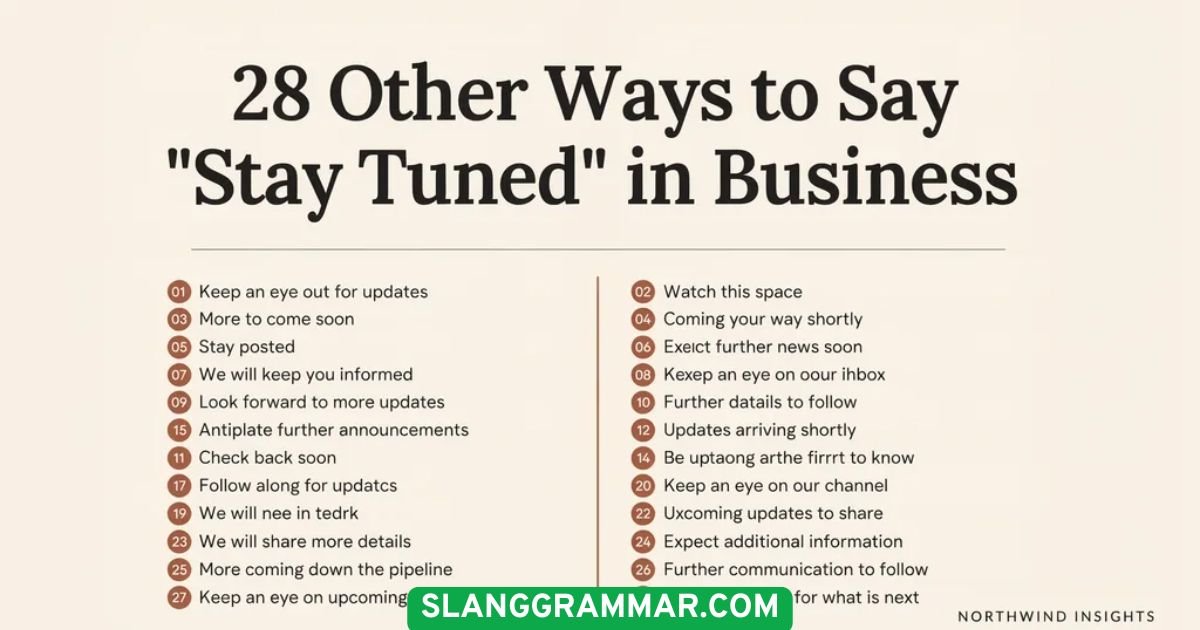
28 Other Ways to Say “Stay Tuned” in Business and Social Media
Picture this — you’ve just wrapped up a great social media post, a podcast episode, or a company update, and now you need one last line to keep your audience hooked for what’s coming next. Almost on autopilot, your fingers type out “stay tuned,” because it’s the phrase everyone reaches for. It’s quick, it’s familiar, and it gets the job done most of the time.
But here’s the thing: stay tuned has been used so often across social media announcement posts, broadcasts, and business updates that it’s started to lose some of its spark. When every brand, every host, and every newsletter signs off with the exact same two words, it stops feeling special and starts feeling like background noise. Audiences today are sharp, and they notice when language feels copy-pasted rather than genuine.
That’s exactly why having a stocked toolbox of alternatives matters so much for professional communication and casual content alike. Whether you’re writing a formal client email, hosting a livestream, or crafting a punchy Instagram caption, swapping in the right phrase keeps your audience attention locked in instead of letting it drift. This article breaks down what the phrase actually means, when it works best, and gives you twenty-eight fresh alternatives — each with its own tone, a real example, and guidance on exactly where it shines.
What Does “Stay Tuned” Mean?
At its heart, stay tuned is an invitation to keep paying attention because more content, news, or updates are on their way. The phrase has roots in old-school radio and television broadcasting, back when hosts would literally ask listeners not to change the channel or station during a commercial break. “Stay tuned” meant keep your dial right where it is, because the show isn’t over yet.
Even though almost nobody touches a physical radio dial anymore, the phrase stuck around because the underlying idea translated perfectly to modern media. Podcasts, YouTube channels, social media accounts, and even corporate newsletters all borrowed the phrase to signal the same basic message: don’t go away, something else is coming. It works as a soft promise rather than a hard deadline, which is part of why it’s so widely used across both casual and semi-formal communication phrases.
In practice, the phrase shows up most often as a closing line. You’ll see it at the end of video segments, social captions, email sign-offs, and press releases, almost always paired with a hint about what’s coming — a new product, an announcement, a follow-up episode, or simply “more updates.” It’s flexible enough to apply to nearly any situation involving anticipation, which explains why it’s become such a default choice, and also why finding stay tuned alternatives can make your writing stand out more.
When to Use “Stay Tuned”
Knowing exactly where this phrase fits naturally helps you decide when to use it as-is and when reaching for something else might serve you better.
The first situation is wrapping up a piece of content that’s part of an ongoing series, like a podcast season, a YouTube playlist, or a multi-part blog series. Telling your audience to stay tuned right after an episode ends gives them a reason to come back, almost like a soft cliffhanger that keeps the relationship alive between posts.
The second common use is in marketing and product announcements, where a company wants to build excitement before a launch without revealing too much too soon. Saying “stay tuned for our big reveal next week” creates anticipation while keeping the actual details under wraps, which works especially well for upcoming announcement campaigns and product teasers.
A third situation involves live events or broadcasts, where the phrase signals a short pause rather than a true ending — think livestreams cutting to a break, awards shows transitioning between segments, or webinars pausing for a Q&A. It tells viewers the experience isn’t finished, just briefly interrupted.
The fourth case shows up in internal business communication, particularly project updates where a full answer isn’t ready yet but the team wants to acknowledge that progress is happening. A quick “stay tuned for more details” in a project channel keeps stakeholders informed without forcing a premature commitment to specifics.
And finally, the phrase fits naturally at the close of newsletters or email campaigns, especially when a brand wants to remind subscribers that this isn’t the last message they’ll receive. It works as a gentle nudge that keeps the relationship ongoing rather than treating each email as a one-off.
Is It Professional or Polite to Say “Stay Tuned”?
The honest answer is that it depends heavily on context, but generally speaking, it leans more casual than formal, even though it’s widely accepted across most industries. In marketing, entertainment, and social media, it reads as completely normal and even expected. In stiffer, more traditional professional communication — legal notices, formal board updates, or executive memos — it can feel a touch too breezy for the occasion.
Part of what makes it tricky is that the phrase doesn’t actually commit to anything concrete. It signals that something is coming without saying what, when, or how significant it’ll be, which works great for building suspense but less well when your audience genuinely needs specifics rather than vague anticipation.
| Pros of using it | Cons of using it |
| Familiar and instantly understood by almost any audience | Feels generic or overused when every brand says the same thing |
| Builds light anticipation without overpromising details | Lacks specificity, which can frustrate audiences wanting real updates |
| Works well across social media, broadcast, and casual emails | Can sound too informal for legal, financial, or executive communication |
| Short and easy to drop into almost any closing line | Repetition across many posts makes content feel less original |
So it’s not a phrase to avoid, but treating it as your only option limits your range. Having a mix of announcement phrases and teaser phrases on hand lets you match your tone more precisely to the situation, rather than defaulting to the same closing line every single time.
Before going through each alternative individually, here’s a quick look at how some of the most common options compare in terms of formality and overall feel.
| Alternative Phrase | Best Use Case | Tone |
| Keep an eye out | Informal | Friendly |
| Don’t go anywhere | Informal | Playful |
| Hang tight | Semi-formal | Warm |
| Stay alert | Formal | Professional |
| More details soon | Semi-formal | Neutral |
| Keep you posted | Semi-formal | Professional |
| Something big is coming | Informal | Bold |
28 Other Ways to Say “Stay Tuned”
Each phrase below carries its own personality, so think of this less as a one-for-one swap list and more as a set of tools suited to different platforms, audiences, and moods.
Keep an Eye Out
This phrase reads as a light, friendly heads-up rather than a firm instruction, the kind of wording you’d drop into a casual caption or quick message between teammates. It goes beyond simply asking for attention — it suggests something is approaching that’s worth noticing, without giving away what or when. The tone is casual and friendly, which makes it ideal for social media announcement posts and informal team chats.
Example: “Keep an eye out for our new product drop later this week.”
It’s a great fit for casual social posts and quick internal notes. It does feel too relaxed for a formal investor update, so for that kind of message, more precise wording would land better.
Don’t Go Anywhere
This phrase reads as an energetic, almost theatrical command, the kind of line you’d hear from a live host trying to hold an audience’s attention through a break. It goes beyond a simple request to wait — it physically positions the audience as staying put, which adds urgency and excitement. The tone is upbeat and playful, which makes it ideal for live broadcasts, podcasts, and video content.
Example: “Don’t go anywhere — we’ve got a huge announcement coming right after this break.”
It’s a great fit for live or recorded media segments building suspense. It does feel oddly forceful in written business correspondence, so for a formal status email, something calmer would land better.
Keep Watching
This phrase reads as direct and visual, the kind of wording made specifically for content people are literally looking at rather than reading. It goes beyond a generic prompt — it ties the anticipation directly to a screen, which works well for serialized video. The tone is casual and engaging, which makes it ideal for video series and episodic social content.
Example: “Keep watching for part two of this story, coming next week.”
It’s a great fit for video-based content with a visual hook. It does feel mismatched for written-only formats, so for a printed memo or text-based newsletter, a different phrase would land better.
We’ll Be Back Shortly
This phrase reads as warm and reassuring, the kind of wording you’d expect right before a live broadcast cuts to a quick pause. It goes beyond a simple pause notice — it promises the gap will be brief, which keeps viewers from wandering off. The tone is warm and dependable, which makes it ideal for live streams and real-time broadcasts.
Example: “We’ll be back shortly with more updates after this quick break.”
It’s a great fit for live events with a genuinely short pause. It does feel misleading when the wait actually stretches into weeks, so for longer delays, more honest wording would land better.
Hang Tight
This phrase reads as relaxed and approachable, the kind of wording you’d use to calm someone down without sounding distant or robotic. It goes beyond asking for patience — it carries a reassuring, almost personal warmth that softens the wait. The tone is warm and casual, which makes it ideal for customer support replies and quick internal updates.
Example: “Hang tight, the report should be ready within the hour.”
It’s a great fit for informal support conversations and quick team messages. It does feel too casual for a formal press release, so for that kind of announcement, more polished wording would land better.
Keep Your Ears Open
This phrase reads as conversational and sound-focused, the kind of wording built for podcasts, radio spots, or anything meant to be heard rather than read. It goes beyond a generic heads-up — it specifically points toward audio content coming the audience’s way. The tone is friendly and casual, which makes it ideal for podcast promotions and event announcements.
Example: “Keep your ears open for our podcast episode dropping this Friday.”
It’s a great fit for audio-based content and spoken announcements. It does feel out of place in a written-only newsletter, so for that format, a more visual or neutral phrase would land better.
Read Also: 28 Professional Ways to Say “Please See Below” in Emails
Something Big Is Coming
This phrase reads as bold and deliberately vague, the kind of wording marketing teams use when they want excitement without giving anything away. It goes beyond a simple update notice — it builds genuine mystery around an upcoming reveal. The tone is bold and confident, which makes it ideal for product launches and brand teasers.
Example: “Something big is coming this fall — get ready.”
It’s a great fit for marketing campaigns building toward a reveal. It does feel overly dramatic for a routine internal memo, so for everyday updates, something calmer would land better.
Stay Alert
This phrase reads as serious and attentive, the kind of wording reserved for situations where missing an update could genuinely cause a problem. It goes beyond casual anticipation — it implies real consequences for not paying attention. The tone is formal and direct, which makes it ideal for safety notices and operational alerts.
Example: “Stay alert for further instructions regarding the system outage.”
It’s a great fit for safety-related or time-sensitive operational messages. It does feel far too intense for a lighthearted social post, so for a casual giveaway announcement, something lighter would land better.
Be Ready for More
This phrase reads as upbeat and forward-looking, the kind of wording that frames current content as just the beginning of something larger. It goes beyond a simple promise of updates — it signals momentum and ongoing energy behind the project. The tone is encouraging and energetic, which makes it ideal for ongoing content series and multi-part campaigns.
Example: “Be ready for more episodes dropping throughout the month.”
It’s a great fit for serialized content with a clear sense of momentum. It does feel vague in professional business updates, so for those, a phrase with a specific timeline would land better.
Keep Your Eyes Peeled
This phrase reads as playful and idiomatic, the kind of wording that suggests something might pop up unexpectedly rather than on a fixed schedule. It goes beyond a plain request to watch — it adds a layer of fun, scavenger-hunt energy to the anticipation. The tone is casual and playful, which makes it ideal for interactive social campaigns and contests.
Example: “Keep your eyes peeled for hidden clues in our next post.”
It’s a great fit for playful, interactive social media content. It does feel too informal for client-facing communication, so for that, more straightforward wording would land better.
Get Ready for More
This phrase reads as energetic and motivating, the kind of wording that nudges the audience to mentally prepare rather than just passively wait. It goes beyond a neutral announcement — it asks for active anticipation, almost like a small call to action. The tone is energetic and motivating, which makes it ideal for event promotions and ongoing content series.
Example: “Get ready for more behind-the-scenes content next week.”
It’s a great fit for promotional content building toward future releases. It does feel overly enthusiastic in a calm business report, so for that setting, more measured wording would land better.
Stick Around
This phrase reads as relaxed and inviting, the kind of wording you’d use to make an audience feel welcome rather than instructed. It goes beyond a simple wait request — it frames staying engaged as a friendly choice rather than an obligation. The tone is warm and inviting, which makes it ideal for live content and ongoing social engagement.
Example: “Stick around — we’ve got more updates dropping all week.”
It’s a great fit for casual, ongoing audience engagement. It does feel too relaxed for a formal shareholder letter, so for that kind of document, more formal phrasing would land better.
Stay Close
This phrase reads as personal and warm, the kind of wording that leans into connection rather than simple attention. It goes beyond asking someone to wait — it frames the relationship itself as something worth maintaining. The tone is warm and personal, which makes it ideal for community-building posts and personal brand updates.
Example: “Stay close — we’ll be sharing exciting news very soon.”
It’s a great fit for community-focused or personal brand content. It does feel a little vague for precise business communication, so for that, something more specific would land better.
The Best Is Yet to Come
This phrase reads as confident and uplifting, the kind of wording that promises future content will outshine what’s already been shared. It goes beyond simple anticipation — it sets an expectation of escalating quality or excitement. The tone is confident and uplifting, which makes it ideal for long-term brand storytelling and loyalty campaigns.
Example: “The best is yet to come for our loyal subscribers.”
It’s a great fit for ongoing campaigns built around growth and momentum. It does feel overly grand for a simple operational update, so for that, more grounded wording would land better.
You Won’t Want to Miss What’s Next
This phrase reads as urgent and persuasive, the kind of wording built to spark a small fear of missing out. It goes beyond a neutral heads-up — it actively pushes the reader toward staying engaged out of curiosity. The tone is energetic and persuasive, which makes it ideal for entertainment teasers and marketing campaigns.
Example: “You won’t want to miss what’s next in this series.”
It’s a great fit for entertainment content and product reveals. It does feel overly salesy in formal professional communication, so for that, more neutral wording would land better.
The Countdown Begins
This phrase reads as exciting and time-bound, the kind of wording that works best when there’s an actual date attached to what’s coming. It goes beyond general anticipation — it implies precision and a fixed schedule worth watching. The tone is exciting and energetic, which makes it ideal for event promotions and scheduled product launches.
Example: “The countdown begins for our biggest sale of the year.”
It’s a great fit for announcements tied to a specific date. It does feel misleading when there’s no real timeline involved, so for vague updates, something less time-specific would land better.
Something’s Brewing
This phrase reads as mysterious and playful, the kind of wording that hints at development without giving away any real details. It goes beyond a plain notice — it deliberately leans into curiosity and behind-the-scenes intrigue. The tone is mysterious and playful, which makes it ideal for teaser campaigns and behind-the-scenes content.
Example: “Something’s brewing in our development team — more details soon.”
It’s a great fit for early-stage teasers before a reveal. It does feel too vague and casual for formal business announcements, so for those, clearer wording would land better.
We’re Not Done Yet
This phrase reads as confident and reassuring, the kind of wording that pushes back gently on the idea that something has already wrapped up. It goes beyond a simple update — it reframes an apparent ending as just a pause. The tone is confident and reassuring, which makes it ideal for ongoing product updates and content series.
Example: “We’re not done yet — more features are on the way.”
It’s a great fit for situations where audiences might assume things have concluded. It does feel slightly defensive in a formal report, so for that, more straightforward wording would land better.
Wait for It
This phrase reads as playful and dramatic, the kind of wording that leans into humor or suspense rather than straightforward information. It goes beyond a basic request for patience — it builds a small comedic or theatrical pause before a payoff. The tone is playful and energetic, which makes it ideal for entertainment content and lighthearted social posts.
Example: “Wait for it — the next announcement is going to be huge.”
It’s a great fit for casual, fun audience build-up. It does feel too theatrical for serious business correspondence, so for that, calmer wording would land better.
The Show’s Not Over
This phrase reads as upbeat and performance-themed, the kind of wording that fits naturally into entertainment or event-based content. It goes beyond a generic update — it borrows the language of live performance to reassure the audience more is coming. The tone is upbeat and engaging, which makes it ideal for live event coverage and entertainment branding.
Example: “The show’s not over — we’ve got an encore update coming soon.”
It’s a great fit for entertainment or performance-related content. It does feel out of place outside that context, so for a technical or financial update, more literal wording would land better.
The Next Chapter Is Coming Soon
This phrase reads as warm and narrative-driven, the kind of wording that frames updates as part of an ongoing story rather than isolated announcements. It goes beyond a simple notice — it gives the audience a sense of continuity and emotional investment. The tone is warm and engaging, which makes it ideal for brand storytelling and serialized content.
Example: “The next chapter is coming soon for our growing community.”
It’s a great fit for content built around an evolving narrative. It does feel overly metaphorical for a precise technical update, so for that, plainer wording would land better.
Read Also: 28 Other Ways to Say “More Than Happy to Help” (With Examples)
More Details Soon
This phrase reads as practical and understated, the kind of wording that simply states a fact without embellishment. It goes beyond vague anticipation — it commits clearly to a follow-up without overselling it. The tone is neutral and professional, which makes it ideal for business updates and professional correspondence.
Example: “More details soon regarding the new partnership.”
It’s a great fit for professional updates where clarity matters most. It does feel a bit flat for marketing content, so for that, something with more energy would land better.
Keep You Posted
This phrase reads as professional yet approachable, the kind of wording that signals ongoing communication rather than a single announcement. It goes beyond a one-time notice — it implies a continuing relationship of updates over time. The tone is professional and warm, which makes it ideal for project updates and client communication.
Example: “We’ll keep you posted as soon as we have confirmed dates.”
It’s a great fit for client emails and project status updates. It does feel slightly informal for major public announcements, so for those, a stronger phrase would land better.
Check Back Soon
This phrase reads as simple and neutral, the kind of wording built for static content rather than live or real-time interaction. It goes beyond a generic prompt — it specifically invites the reader to return later on their own initiative. The tone is neutral and practical, which makes it ideal for websites and content pages still being updated.
Example: “Check back soon for updated pricing information.”
It’s a great fit for website pages and static content. It does feel mismatched for live or real-time content, so for that, something more immediate would land better.
More to Come
This phrase reads as short and versatile, the kind of wording that works across nearly any context without much adjustment. It goes beyond a single update — it signals an ongoing stream of information without specifying form or timing. The tone is neutral and adaptable, which makes it ideal for news updates and ongoing coverage.
Example: “More to come on this story as it develops.”
It’s a great fit for evolving news stories and rolling coverage. It does feel a little flat when you actually want to build strong anticipation, so for that, a more vivid phrase would land better.
Stay With Us
This phrase reads as warm and inclusive, the kind of wording that frames the audience as part of an ongoing journey rather than a passive recipient. It goes beyond a simple request to wait — it builds a sense of belonging and shared experience. The tone is friendly and welcoming, which makes it ideal for community-focused content and ongoing series.
Example: “Stay with us as we share more stories from the team.”
It’s a great fit for community-building and long-term audience relationships. It does feel a touch too soft for time-sensitive business updates, so for those, more urgent wording would land better.
Keep Following Along
This phrase reads as friendly and ongoing, the kind of wording built for content meant to be tracked over time rather than consumed once. It goes beyond a single update — it invites the audience into a continuing routine of checking in. The tone is friendly and engaging, which makes it ideal for educational series and long-term social campaigns.
Example: “Keep following along for weekly tips and updates.”
It’s a great fit for recurring content with a clear ongoing rhythm. It does feel mismatched for one-off announcements, so for those, a simpler phrase would land better.
Big News Coming
This phrase reads as bold and direct, the kind of wording that skips buildup and gets straight to signaling something significant. It goes beyond a vague teaser — it commits to the idea that what’s coming truly matters. The tone is bold and confident, which makes it ideal for major announcements and product reveals.
Example: “Big news coming next week — we can’t wait to share it.”
It’s a great fit for genuinely significant announcements. It does feel like overpromising when the news turns out to be minor, so for smaller updates, more modest wording would land better.
Quick Reference Table
Here’s a condensed view of every alternative covered above, organized by tone and best-fit setting so you can scan quickly when you’re drafting a post, email, or script and need the right line fast.
| Alternative Phrase | Tone | Best Use Case |
| Keep an eye out | Friendly | Informal |
| Don’t go anywhere | Playful | Informal |
| Keep watching | Casual | Informal |
| We’ll be back shortly | Warm | Semi-formal |
| Hang tight | Warm | Semi-formal |
| Keep your ears open | Friendly | Informal |
| Something big is coming | Bold | Informal |
| Stay alert | Professional | Formal |
| Be ready for more | Encouraging | Semi-formal |
| Keep your eyes peeled | Playful | Informal |
| Get ready for more | Energetic | Semi-formal |
| Stick around | Warm | Informal |
| Stay close | Personal | Informal |
| The best is yet to come | Uplifting | Semi-formal |
| You won’t want to miss what’s next | Persuasive | Informal |
| The countdown begins | Exciting | Semi-formal |
| Something’s brewing | Mysterious | Informal |
| We’re not done yet | Reassuring | Semi-formal |
| Wait for it | Playful | Informal |
| The show’s not over | Upbeat | Informal |
| The next chapter is coming soon | Warm | Semi-formal |
| More details soon | Neutral | Formal |
| Keep you posted | Professional | Semi-formal |
| Check back soon | Neutral | Semi-formal |
| More to come | Neutral | Semi-formal |
| Stay with us | Friendly | Semi-formal |
| Keep following along | Friendly | Semi-formal |
| Big news coming | Confident | Informal |
FAQ’s
Is it correct to say “stay tuned”?
Yes, “stay tuned” is correct and commonly used.
It means to keep watching, listening, or waiting for more updates.
What does stay tuned mean?
“Stay tuned” means to remain connected for upcoming news or information.
People use it when more details will be shared soon.
Why do people say stay tuned?
People say “stay tuned” to create interest and keep the audience engaged.
It tells readers or viewers that something important is coming.
What is another word for stay tuned?
Another way to say “stay tuned” is “keep watching” or “stay updated.”
You can also say “more details coming soon.”
How do I professionally say “stay tuned”?
Professionally, you can say “Please look forward to further updates.”
You can also say “We will share more information soon.”
Conclusion
Choosing the right way to say stay tuned really comes down to matching your tone to your platform and your audience’s expectations. A casual social media caption can handle something playful like “don’t go anywhere” or “something big is coming,” while a formal business update is usually better served by a calmer phrase like “more details soon” or “we’ll keep you posted.” None of these alternatives are inherently better than the original phrase — they’re simply different tools suited to different moments, and having a wider range means your writing never feels stuck repeating the same line.
If you’re working on building anticipation across multiple channels, picking two or three go-to phrases for each context — one for social media, one for client emails, one for internal updates — keeps things consistent without ever feeling stale or copy-pasted.
If you found this useful, you might also want to look into alternatives for other commonly overused phrases, like different ways to say “thank you for your patience” or “please see below,” since these tend to show up just as often in everyday writing and benefit from the same kind of variety.
Related Guides:
1: 28 Other Ways to Say “Thanks for the Clarification” (With Examples)
2: 28 Other Ways to Say “Thank You for Your Consideration” (With Examples)
3: 28 Other Ways to Say “You Got This” (With Real Examples)
4: 28 Other Ways to Say “It Was a Pleasure Meeting You” (Professional & Polite Alternatives)
5: 26 Other Ways to Say Okay (Formal, Casual & Professional)