28 Other Ways to Say “It Was a Pleasure Meeting You” (Professional & Polite Alternatives)
Picture this: you just wrapped up a job interview, a client lunch, or a networking event. You want to leave a great impression, but when you reach for the words, all you can think of is the same tired phrase everyone uses. Saying it was a pleasure meeting you is perfectly fine — but when the same line appears in every email and every handshake, it starts to lose its warmth. The right words at the right moment can quietly set you apart.
This phrase is one of those small social tools that carries more weight than it might seem. It signals respect, warmth, and professionalism — all at once. But depending on the context, a slightly different expression might land better. A formal business email calls for something more polished, while a casual introduction at a conference might feel more natural with a friendlier, looser phrase. Having a range of professional alternatives and polite meeting responses in your vocabulary means you always sound genuine rather than scripted.
This article walks you through 28 strong alternatives, when to use each one, what tone it carries, and which situations suit it best. Whether you’re writing a meeting follow-up email, leaving a voice message, or wrapping up a call, you’ll find the right phrase here.
What Does “It Was a Pleasure Meeting You” Mean?
At its core, this phrase is an expression of appreciation — you’re telling someone that the time you spent meeting them was genuinely worthwhile. It comes from the noun “pleasure,” meaning enjoyment or satisfaction, combined with the past tense “meeting,” which places the experience in the recent past. Together, the phrase politely signals that the encounter was positive and that you valued it.
The expression became a staple of professional communication because it does a lot of subtle work. It acknowledges the other person, closes the interaction on a warm note, and implies that you’d welcome future contact. It works in person, in emails, and in networking follow-up messages. The reason so many people reach for it is because it’s reliable — it rarely offends, never sounds aggressive, and communicates exactly what it means.
That said, it can sometimes feel a little automatic, especially when overused. When you write the same phrase in every post-meeting email, it stops feeling personal. Exploring other ways to say it was a pleasure meeting you lets you match the energy and tone of each specific situation rather than using a one-size-fits-all line.
When to Use “It Was a Pleasure Meeting You”
This phrase fits naturally in several real-world contexts, and knowing those situations helps you decide when to use it as-is versus when to reach for something different.
After a job interview, it’s one of the most appropriate things you can say. It signals professionalism and gratitude without being over-the-top. In a thank-you email sent after the interview, it sets a respectful, warm tone right at the start. Similarly, after a first client meeting, this phrase reassures the other person that the relationship is off to a good start. It’s a quiet way of saying, “I’m glad we connected, and I’m looking forward to working together.”
At a networking event or conference, using this phrase — either in person or in a follow-up note — reinforces the connection you made. It gives the interaction a proper close and makes the other person more likely to remember you positively. Business introductions where you’ve just met a senior colleague, a potential partner, or a new vendor are also ideal moments for this phrase.
Finally, it works well after any kind of formal call or video meeting where you’re wrapping up a significant conversation. It doesn’t need to be a grand occasion — even a short but productive first call with a new collaborator warrants a sincere, polite closing.
Is It Professional or Polite to Say “It Was a Pleasure Meeting You”?
The short answer is yes — it’s both professional and polite. But like any phrase used frequently in business communication, it has its strengths and its limits. Here’s an honest look at both sides.
| Aspect | Strength | Limitation |
| Professionalism | Universally accepted in formal contexts | Can sound formulaic if used in every interaction |
| Warmth | Carries a genuine, friendly tone | May feel impersonal when not paired with specifics |
| Versatility | Works in emails, in person, on calls | Sometimes too casual for very high-stakes formal documents |
| Clarity | Message is immediately understood | Lacks differentiation — everyone says the same thing |
The phrase earns its place in formal email phrases and professional relationship building without question. Where it falls slightly short is in situations that call for something more specific or heartfelt. If you met someone after a particularly meaningful conversation, telling them only that it was “a pleasure” might feel like you undersold it. In those moments, a more personal variation creates a stronger impression.
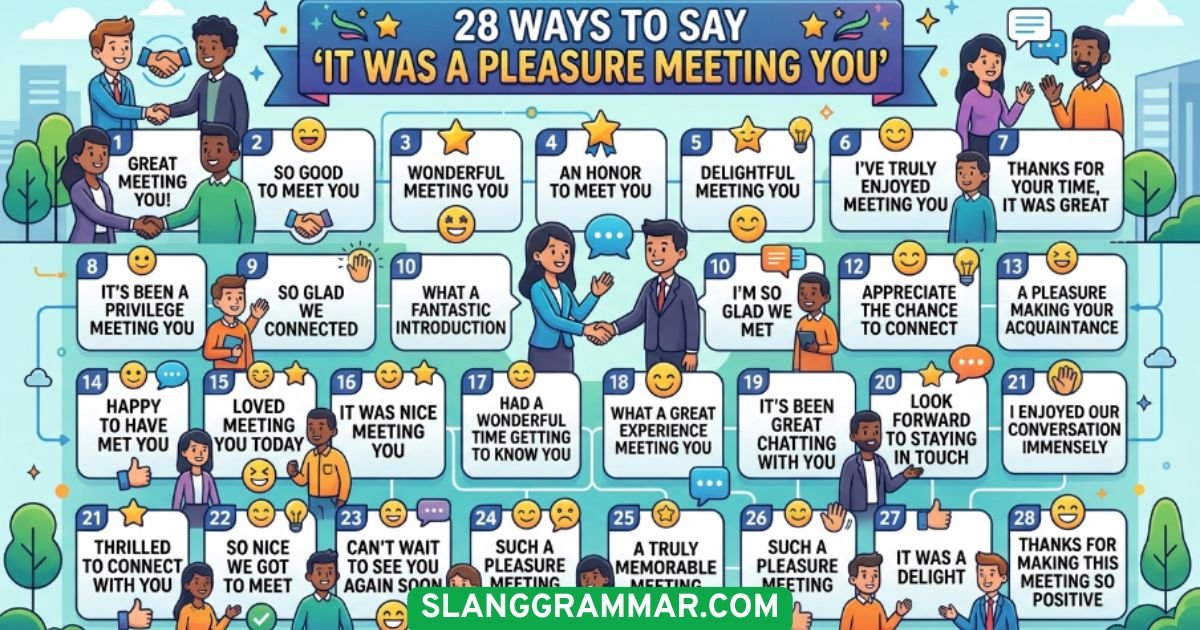
28 Other Ways to Say “It Was a Pleasure Meeting You”
Here is where things get genuinely useful. Each alternative below has its own personality — some are warmer, some more formal, some more energetic. Reading through them will help you match the right phrase to the right moment.
1. “It Was Great Meeting You”
“Great” is one of those words that carries casual warmth without sacrificing professionalism. It’s upbeat and approachable — the verbal equivalent of a confident smile — and it sits comfortably in the semi-formal range. Swapping “pleasure” for “great” doesn’t lower the register significantly, but it does make the phrase feel less scripted and more genuine. It works especially well in networking follow-up emails and post-conference messages where you want to sound personable rather than stiff.
Example: “It was great meeting you at the marketing summit yesterday — your take on community-led growth gave me a lot to think about.”
It fits naturally in most professional follow-up emails, casual business introductions, and peer-to-peer networking messages. Where it can feel slightly underpowered is in a very formal first email to a senior executive or board-level contact — those situations call for something with a bit more polish.
2. “It Was Lovely Meeting You”
“Lovely” brings a softness that the original phrase doesn’t quite have. It’s warm and humanizing, the kind of word that makes an email feel like it came from a person rather than a template. Popular in British English, this version works beautifully in fields where emotional warmth is part of the professional culture — think education, nonprofits, healthcare, and creative industries. It signals that the meeting left a genuinely positive impression, not just a neutral one.
Example: “It was lovely meeting you at the workshop on Friday — the discussion on team dynamics was one of the most energizing conversations I’ve had in a while.”
It’s a strong choice for semi-formal professional settings where warmth is valued and expected. It would feel out of place in industries with a traditionally sharp or transactional tone, such as investment banking or high-pressure sales environments.
3. “It Was Wonderful Meeting You”
“Wonderful” steps up the energy noticeably — it’s more expressive than “great” and carries a sense that the meeting was genuinely memorable rather than merely pleasant. The tone is warm and enthusiastic, sitting in the semi-formal to professional range. Using it signals that the encounter meant something to you, which can quietly reinforce a new professional relationship right from the start. The key is to mean it — this phrase has more impact when paired with a specific observation about the meeting.
Example: “It was wonderful meeting you and the rest of the product team — the clarity of vision behind the platform really came through in the conversation.”
It’s well-suited to first client meetings, introductions with potential collaborators, or any encounter where something genuinely interesting was discussed. Used after a brief, routine exchange, it can sound like an overstatement, so reserve it for moments that actually warrant the enthusiasm.
4. “I Really Enjoyed Our Conversation”
This phrase does something subtle that most alternatives don’t — it shifts the focus from the act of meeting to the substance of what was said. That makes it feel far more personal and specific, because it implies the conversation itself had real value. The tone is engaged and sincere, landing in a friendly-to-professional register. It works especially well in post-meeting thank you emails where you want to signal that you were genuinely present and paying attention, not just going through the motions.
Example: “I really enjoyed our conversation about the restructuring plan — the way you framed the change management challenge gave me a fresh perspective on our own situation.”
It’s ideal any time the dialogue itself was the highlight of the meeting. It loses some of its punch in situations where the meeting was short, logistical, or mostly one-directional — in those cases, a simpler phrase feels more honest.
5. “It Was a Pleasure Connecting with You”
Replacing “meeting” with “connecting” gives this phrase a modern, professional and forward-looking quality. “Connecting” implies that something lasting was established — a professional link, a potential relationship — rather than a one-time encounter. It’s the natural language of professional networking in the digital era, and it reads particularly well in written form. The tone sits firmly in the professional range without being stiff.
Example: “It was a pleasure connecting with you — I’d love to continue the conversation about your expansion plans when the timing works for you.”
It fits especially well in LinkedIn messages, follow-up emails after virtual meetings, and any networking follow-up where you want to signal that the connection has ongoing potential. It can feel slightly buzzword-heavy in very traditional or formal correspondence, where “meeting” or “speaking” is the cleaner word choice.
6. “Nice to Meet You”
There’s something to be said for simplicity. This phrase is clean, universally understood, and carries zero risk of sounding over-the-top. The tone is casual and friendly, which makes it the right choice for in-person farewells, brief follow-up notes, and situations where a longer closing phrase would feel like too much. It’s the professional equivalent of a relaxed, genuine handshake — unpretentious and warm.
Example: “Nice to meet you — I’ll get those project documents over to you by end of day Thursday.”
It works well in most semi-formal and informal professional settings, especially when said in person or in a short follow-up message. Where it can fall slightly flat is in formal written correspondence with a senior contact or high-stakes client — in those cases, a more complete phrase better matches the weight of the relationship.
7. “It Was a Pleasure Speaking with You”
When the meeting happened by phone or video call, this phrase is often the more accurate choice — and accuracy matters in professional communication. Saying you’re glad to have “spoken with” someone is specific to voice-based interaction, which makes the phrase feel considered rather than copy-pasted. The tone is courteous and professional, landing solidly in formal-to-semi-formal territory and working particularly well in written follow-ups after calls.
Example: “It was a pleasure speaking with you this afternoon — thank you for walking me through the technical requirements in such detail.”
It’s a strong default for meeting follow-up emails after discovery calls, client calls, phone interviews, or any remote meeting where your interaction was primarily conversational. It’s slightly less natural for in-person meetings, where “meeting you” is the more fitting word choice.
8. “I’m Glad We Had the Chance to Meet”

This phrase carries a subtle implication that the meeting was an opportunity — not something that was guaranteed or routine. That framing adds a layer of genuine appreciation. The tone is warm and sincere, and it works especially well when the meeting required some effort to arrange, when schedules were tight, or when the person is someone you’d been hoping to connect with for a while. It tells the other person that you recognized the value of their time and weren’t taking the meeting for granted.
Example: “I’m glad we had the chance to meet — I’ve been following your work on supply chain resilience for some time and it was great to finally discuss it directly.”
It fits best in semi-formal contexts where the meeting had a degree of significance. It would feel slightly overstated after a routine, five-minute introduction where no real effort was required to make it happen.
9. “Thank You for Your Time”
This phrase takes a different angle entirely — rather than expressing warmth about the meeting itself, it acknowledges the value of what the other person gave you: their attention. That makes it fundamentally respectful and professional, and it works especially well in client-facing situations, post-interview emails, or any context where you want to signal that you understand the other person’s time is a real resource. Used well, it can feel more considerate than the standard phrase.
Example: “Thank you for your time today — the context you shared about the company’s direction was exactly what I needed to move forward with the proposal.”
It’s a strong pairing with any formal business email or client communication phrase where professional courtesy is the primary goal. Used alone without any reference to the meeting’s content, it can feel slightly transactional — adding one specific sentence after it turns it into something much more meaningful.
Read Also: 28 Professional Ways to Say “I Am Interested in This Position”
10. “It Was Great Connecting with You”
This phrase blends the upbeat energy of “great” with the relational undertone of “connecting,” landing at a friendly and professional midpoint that suits the modern workplace well. It feels natural in digital communication especially — LinkedIn messages, email follow-ups after virtual events, or any context where the relationship is still forming and you want to sound approachable rather than stiff. It’s not as formal as some alternatives, but it’s rarely out of place in professional settings.
Example: “It was great connecting with you at the innovation roundtable — your perspective on cross-industry collaboration really stood out.”
It’s particularly well-suited to networking follow-up messages and LinkedIn correspondence. Like all the “connecting” variations, it can feel slightly modern or tech-forward, which means it may not be the ideal choice for very traditional industries or audiences who prefer more conventional phrasing.
11. “I Enjoyed Meeting You”
“Enjoyed” is an active, personal word — it says that you, specifically, found something worthwhile in the experience. That personal quality is exactly what makes this phrase feel more genuine than many of its alternatives. The tone is warm and semi-formal, sitting comfortably across a wide range of professional contexts without feeling forced in either direction. It’s the kind of phrase that’s hard to say wrong, which makes it a reliable fallback when you’re not sure which register to aim for.
Example: “I enjoyed meeting you and hearing more about the mentorship program you’ve been building — it sounds like something that could have real impact at scale.”
It works well across most professional introduction phrases and follow-up emails. Where it may fall slightly short is in very high-formality correspondence — with a senior diplomat, a C-suite contact you’ve never met, or a formal written introduction — where a more elevated phrase might better match the occasion.
12. “It Was a Delight to Meet You”
“Delight” lives in a slightly elevated register — it’s not quite formal, but it’s distinctly more gracious than everyday language. That quality makes it well-suited to situations where you want to communicate genuine appreciation in a composed, polished way. The tone is gracious and warm, with a touch of the old-fashioned that actually works in its favor in traditional professional environments. It signals that you have both warmth and poise, which is a combination that tends to land well with senior contacts.
Example: “It was a delight to meet you at the industry forum — your remarks on regulatory innovation were the highlight of the afternoon for many of us.”
It fits beautifully in formal business communication, correspondence with senior leadership, and events with a higher degree of ceremony or formality. In startup culture, fast-paced creative environments, or very casual professional relationships, it can come across as slightly stiff — so read the room before reaching for it.
13. “I Was Glad to Meet You”
This is a quiet, understated phrase — and that restraint is actually a strength. It communicates warmth without overreaching, which can feel more authentic than phrases that pile on enthusiasm. The tone is sincere and conversational, making it a natural-sounding choice for in-person farewells and brief written follow-ups. It’s the phrase you use when you mean it but don’t need to dramatize it — when the meeting was good and you want to acknowledge that simply.
Example: “I was glad to meet you — after all the back-and-forth over email, it was much easier to align once we could just talk through it directly.”
It’s well-suited to peer-level professional relationships, follow-up notes after quick introductions, and any situation where a lower-key closing feels more honest than an effusive one. It’s not the phrase to reach for when you want to express strong enthusiasm or leave a particularly memorable impression.
14. “It’s Been a Pleasure”
Brevity is this phrase’s defining quality. It’s compact, polished, and carries a quiet authority — the kind of thing someone says when they’re composed enough not to over-explain. The tone is formal and refined, sitting toward the more traditional end of the spectrum. It works especially well as a verbal closing in person, or as the opening line of a brief follow-up note where you want to sound confident and professional without being verbose.
Example: “It’s been a pleasure — I’ll have the revised terms over to you by Wednesday morning.”
It’s a strong fit for formal professional settings: business dinners, executive introductions, end-of-meeting closings, and brief written notes to senior contacts. In a casual networking email or a follow-up to a peer, the brevity can tip into coldness, making a warmer and more complete phrase the better choice.
15. “I’m Delighted to Have Met You”
This phrase leans into elevated, expressive language in a way that works best on paper. In spoken form it can feel slightly rehearsed, but in writing — especially formal correspondence — it reads as articulate and genuinely appreciative. The tone is formal and expressive, communicating that the meeting carried real significance. It suits contexts where the register of the overall communication is already elevated and a more ordinary closing phrase would feel like a let-down.
Example: “I’m delighted to have met you and to learn more about the work your foundation is doing in early childhood literacy — it’s a cause I care about deeply.”
It fits well in formal introductory letters, academic correspondence, written communication with senior figures, or any situation where you’re writing to someone for the first time and the overall tone is considered and deliberate. In casual or conversational contexts, the elevated language can feel mismatched with the rest of the message.
16. “It Was So Nice to Meet You”
Adding “so” is a small move, but it shifts the phrase meaningfully — it signals a personal warmth that the unmodified version doesn’t quite carry. The tone is friendly and genuine, with a slight informality that makes it feel human rather than corporate. It’s the kind of phrase that tends to make people smile, which is why it works well in contexts where the relationship is still forming and you want to come across as warm and approachable rather than buttoned-up.
Example: “It was so nice to meet you — the energy you brought to the discussion about community engagement was genuinely infectious.”
It’s a natural fit for informal professional settings, creative industries, small business relationships, and any context where the interpersonal dynamic is warm rather than transactional. In a highly formal email — say, a first written communication to a board member or a very senior contact — the “so” can feel a touch too casual for the setting.
17. “It Was an Honor to Meet You”
“Honor” is one of the strongest words in this list, and it should be used accordingly. This phrase communicates deep respect — it tells the other person that you genuinely look up to them, that meeting them meant more than a routine professional encounter. The tone is humble and deeply respectful, and it carries the most emotional weight of any phrase here. When it’s earned, it can leave a lasting impression; when it’s used loosely, it feels hollow.
Example: “It was an honor to meet you — your research on equitable urban housing has shaped the way I think about policy design, and hearing your perspective directly was invaluable.”
Reserve it for people you’ve genuinely admired — a mentor, a recognized expert in your field, someone whose work has influenced your thinking. In everyday professional encounters or routine first meetings, using “honor” feels like an overstatement that can actually undercut your credibility.
18. “I Appreciated the Opportunity to Meet You”
Framing the meeting as an “opportunity” is a quiet but meaningful choice — it tells the other person that you recognized the value of the encounter and didn’t take it for granted. The tone is professional and appreciative, without crossing into effusiveness. It reads particularly well in formal written communication because it sounds considered rather than automatic, which is exactly the impression you want to leave with a client, a hiring manager, or a new business contact.
Example: “I appreciated the opportunity to meet you and walk through the proposal in person — it gave me a much clearer sense of the priorities going into the next phase.”
It’s a strong fit for formal business email wording, post-interview follow-ups, and client communication phrases where professionalism is the priority. For very casual professional relationships or peer-level contacts, the formal framing can feel slightly overstated — a warmer, simpler phrase usually lands better in those situations.
19. “Looking Forward to Staying in Touch”
Unlike most phrases in this list, this one faces forward rather than backward. Instead of reflecting on the meeting, it signals intention — it says that the relationship has a future and that you’re genuinely interested in maintaining it. The tone is optimistic and professional, and it works best as a closing line that follows a more reflective opener rather than standing alone. Together, the two phrases give the message both warmth and direction.
Example: “It was a pleasure meeting the team this week — I’m looking forward to staying in touch as the project develops.”
It’s a natural fit for business networking contexts, professional relationship building, and any follow-up where the implication of future contact is genuine and appropriate. It’s not the right choice when there’s no clear reason to maintain the relationship — using it in a one-off interaction can feel like empty social signaling.
20. “It Was a Pleasure to Make Your Acquaintance”
This phrase is drawn from a notably formal, older register of English. It’s the kind of closing that would feel at home in a written letter, a formal introduction, or a ceremony of some kind — contexts where traditional language is expected and appreciated. The tone is formal and ceremonious, and it signals a degree of respect and deliberateness. Used in the right setting, it communicates that you take the professional relationship seriously.
Example: “It was a pleasure to make your acquaintance, and I hope we will have the opportunity to collaborate further as the partnership develops.”
It works well in legal, diplomatic, or high-formality professional settings where the overall register of communication is already elevated. In a casual email, a modern corporate environment, or any context where informality is the norm, this phrase can come across as stiff or even unintentionally ironic — so it’s one to deploy carefully.
21. “I’m Happy We Got to Connect”
This one is relaxed, warm, and feels entirely natural in spoken conversation. It’s the kind of thing you’d actually say in real life, which is part of what makes it work — it doesn’t sound rehearsed. The tone is warm and conversational, landing in the casual to semi-formal range. It’s a good choice when you want to sound like a person rather than a professional template, especially in industries or relationships where authenticity is valued over formality.
Example: “I’m happy we got to connect — it’s rare to meet someone working on the same challenge from such a different angle, and the conversation was genuinely useful.”
It fits well in peer relationships, creative industries, informal networking follow-up messages, and any context where the dynamic is friendly and collegial. It would feel out of step in a very formal business email to a senior contact or in a written communication that otherwise maintains a high degree of professionalism throughout.
Read Also: 26 Other Ways to Say Okay (Formal, Casual & Professional)
22. “I Thoroughly Enjoyed Our Meeting”
“Thoroughly” is doing real work here. It doesn’t just say you enjoyed the meeting — it says the enjoyment ran deep, that there was real substance to what happened and you were engaged the whole way through. The tone is professional and genuinely enthusiastic, sitting in the formal-to-semi-formal range. It reads best in writing, where the deliberateness of the word “thoroughly” comes across as considered rather than stiff.
Example: “I thoroughly enjoyed our meeting this morning — the roadmap you walked me through was impressive, and I left with a much clearer sense of where things are heading.”
It’s especially strong in follow-up emails after productive business meetings, detailed briefings, or sessions that involved substantive discussion or planning. In casual or brief encounters, “thoroughly enjoyed” can feel like too much weight for the occasion — simpler alternatives tend to fit better there.
23. “It Was Great to Finally Put a Face to the Name”
This phrase only works — but works really well — when there’s been prior communication before the in-person meeting. That backstory is the whole point: you’re acknowledging that the two of you had a history of interaction before finally meeting, and that closing the loop felt good. The tone is friendly and relatable, with a naturalness that makes it stand out from more generic closings. It signals warmth, memory, and attentiveness all at once.
Example: “It was great to finally put a face to the name — after all the emails back and forth over the past few months, meeting in person felt long overdue.”
It’s a perfect fit for first in-person meetings with someone you’ve already corresponded with over email, LinkedIn, or through mutual contacts. It makes no sense at all in introductions where there’s been no prior contact — and using it in that context would simply be confusing.
24. “I Look Forward to Working with You”
This phrase skips the backward glance entirely and moves directly to the future, which gives it a notably different energy from most alternatives. The tone is professional and forward-focused, and it subtly communicates confidence — you’re not just hoping things will work out, you’re looking forward to actually collaborating. It works best when a next step has been agreed upon or is clearly on the horizon, because in that context it feels purposeful rather than presumptuous.
Example: “I look forward to working with you on the brand refresh — it’s clear we’re aligned on the direction, and I’m excited to get started.”
It fits well when roles or next steps have already been established — after a successful interview, a signed agreement, or a meeting where collaboration was confirmed. It’s not the right fit for introductory meetings where no concrete relationship has been agreed upon, because it can come across as presuming more than was decided.
25. “Glad to Have Had the Chance to Speak with You”
There’s an unhurried, genuine quality to this phrase — it sounds like something you’d actually say rather than something you’d read off a template. The tone is conversational and sincere, fitting comfortably in the semi-formal range. It references the conversation specifically, which adds a touch of intentionality without being elaborate about it. It works equally well spoken aloud or written in a follow-up note.
Example: “Glad to have had the chance to speak with you — the context you gave me on the stakeholder landscape was exactly what I needed going into next week’s presentation.”
It’s a natural choice for follow-up emails after calls, brief check-ins, or informal first meetings where you want to sound genuine without being formal. In very high-stakes or formal correspondence, it can feel a touch too casual — something with more structure and polish tends to fit those situations better.
26. “I Really Valued Our Conversation”
“Valued” is a more deliberate word than “enjoyed” — it implies that the conversation had real worth, that you walked away with something meaningful. That quality makes this phrase feel substantive and specific, even before you’ve said what you got out of it. The tone is warm and professional, and it’s one of the more memorable alternatives on this list precisely because it signals depth of engagement. It tells the other person that the exchange wasn’t just pleasant — it was genuinely useful or meaningful.
Example: “I really valued our conversation about the transition in leadership — the perspective you offered helped me think through some things I’d been turning over for a while.”
It’s best reserved for meetings where the dialogue genuinely had substance — a meaningful discussion, a candid exchange, or a conversation that shifted your thinking in some way. After a surface-level or logistical meeting, “valued” can come across as an exaggeration, which can undermine the sincerity you’re trying to project.
27. “It Was a Genuine Pleasure to Meet You”
Adding “genuine” to the standard phrase is a small change with a noticeable effect. It preempts the sense that the phrase is being said on autopilot by explicitly flagging that the pleasure was real — and that quiet insistence on sincerity is exactly what gives the phrase its edge. The tone is warm and sincere, sitting in a semi-formal to professional range that suits most business contexts well. It’s a reliable way to say something familiar while making it feel freshly meant.
Example: “It was a genuine pleasure to meet you — conversations like that don’t come along as often as they should, and I appreciated the candor.”
It works well across a wide range of professional contexts wherever the standard phrase would also be appropriate, but where you want it to land with a little more weight. Use it selectively — “genuine” loses its meaning quickly if it appears in every follow-up you send.
28. “It Was a Privilege to Meet You”
“Privilege” sits between “pleasure” and “honor” on the spectrum of formal respect — it’s more elevated than the everyday phrase, but not quite as reverential as saying it was an honor. That middle ground makes it useful in situations where you want to express real admiration without quite reaching the emotional pitch of “honor.” The tone is formal and deeply respectful, and it works best with people of significant professional stature or with individuals whose work has had a meaningful impact in their field.
Example: “It was a privilege to meet you and to hear your firsthand perspective on the early days of the organization — that kind of institutional knowledge is rare and genuinely valuable.”
It fits well in formal professional settings, academic or policy contexts, or any first meeting with someone whose career or contributions you genuinely admire. Like “honor,” it carries too much weight for routine professional encounters — using it in an ordinary introduction makes it sound either exaggerated or sycophantic.
Quick Reference Table
This table gives you a fast overview of all 28 alternatives so you can compare them at a glance and pick the right phrase for your situation.
| Alternative Phrase | Best Use Case | Tone | Context |
| It was great meeting you | Networking, follow-ups | Friendly | Semi-formal |
| It was lovely meeting you | Creative/nonprofit fields | Warm | Semi-formal |
| It was wonderful meeting you | Memorable first meetings | Expressive | Semi-formal |
| I really enjoyed our conversation | Substantive discussions | Personal | Professional |
| It was a pleasure connecting with you | LinkedIn, virtual meetings | Modern/professional | Professional |
| Nice to meet you | Quick in-person closings | Casual | Informal |
| It was a pleasure speaking with you | Phone/video call follow-ups | Courteous | Professional |
| I’m glad we had the chance to meet | Rare or arranged meetings | Genuine | Semi-formal |
| Thank you for your time | Client/interview follow-ups | Respectful | Formal |
| It was great connecting with you | Networking messages | Friendly | Semi-formal |
| I enjoyed meeting you | General follow-ups | Warm | Semi-formal |
| It was a delight to meet you | Senior/formal contexts | Gracious | Formal |
| I was glad to meet you | Brief follow-ups | Sincere | Conversational |
| It’s been a pleasure | Verbal/brief closings | Polished | Formal |
| I’m delighted to have met you | Written formal correspondence | Elevated | Formal |
| It was so nice to meet you | Informal professional events | Friendly | Casual |
| It was an honor to meet you | Admired figures | Humble | High-formality |
| I appreciated the opportunity to meet you | Business emails | Appreciative | Professional |
| Looking forward to staying in touch | Networking follow-ups | Optimistic | Semi-formal |
| It was a pleasure to make your acquaintance | Formal/traditional settings | Old-school | High-formality |
| I’m happy we got to connect | Peer relationships | Relaxed | Casual |
| I thoroughly enjoyed our meeting | Productive meetings | Enthusiastic | Professional |
| It was great to finally put a face to the name | Prior email/online contact | Relatable | Casual |
| I look forward to working with you | When next steps are agreed | Forward-focused | Professional |
| Glad to have had the chance to speak with you | Calls, brief meetings | Conversational | Semi-formal |
| I really valued our conversation | Substantive discussions | Sincere | Professional |
| It was a genuine pleasure to meet you | Any context, added sincerity | Warm | Semi-formal |
| It was a privilege to meet you | Respected professionals | Respectful | Formal |
FAQ’s
How do you say it was pleasure meeting you?
You can say, “It was a pleasure meeting you.”
It sounds polite, warm, and respectful.
How do you say it was a pleasure professionally?
Say, “It was a pleasure speaking with you today.”
This sounds professional and friendly.
What can I say instead of “it was a pleasure to meet you”?
You can say, “I really enjoyed meeting you.”
Another good option is, “It was great connecting with you.”
How do you say it was really nice meeting you?
Say, “It was truly nice meeting you.”
You can also say, “I really enjoyed our conversation.”
How to professionally say it was nice to meet you?
Use, “It was a pleasure meeting you, and I appreciate your time.”
This is polished, respectful, and suitable for business settings.
Conclusion
Knowing how to express it was a pleasure meeting you in different ways isn’t about sounding clever — it’s about making sure your words actually match the moment. A phrase that suits a casual networking coffee might feel off in a formal client email, and vice versa. The 28 alternatives covered here span the full range from very formal to warmly casual, giving you options across every professional context.
The simplest rule for choosing the right phrase is to think about three things: the formality of the setting, the nature of your relationship with the other person, and whether the meeting had specific content worth referencing. When in doubt, the original phrase is always safe — but when you want to leave a stronger impression, a more considered choice goes a long way. A warm professional tone, paired with even one specific detail from your conversation, turns a routine closing line into something genuinely memorable.
Related Guides:
1: 25 Other Ways to Say “Sorry I Missed Your Call” (Professional & Polite Alternatives)
2: 25 Other Ways to Say “I Appreciate Your Help” (With Real Examples)
3: How to Say Thank You for Your Partnership Without Sounding Like a Broken Record
4: 25+ Polite Ways to Say “Sorry for the Short Notice” (Informal & Professional Alternatives 2026 updated)
5: 30 Other Ways to Say “I Can’t Wait to See What the Future Holds”