26 Other Ways to Say Okay (Formal, Casual & Professional)
Have you ever sent a message that just said “okay” and immediately wondered if it came across as flat, dismissive, or even a little passive-aggressive? You are not alone. That one small word carries a surprising amount of weight depending on the context, the relationship, and the tone of the conversation around it. Whether you are replying to a colleague’s email, texting a friend, or wrapping up a business call, the way you express agreement or acknowledgment can shape how the other person feels about the interaction.
Okay is one of those everyday words that does a lot of work. It signals acceptance, confirms understanding, and moves a conversation forward. But when used repetitively — especially in professional settings — it can feel lazy or even passive. Knowing a range of alternatives to okay gives you the flexibility to match your language to the moment, whether you need something warm and friendly, crisp and professional, or relaxed and casual. The right agreement phrase can make you sound more thoughtful, more engaged, and genuinely present in the conversation.
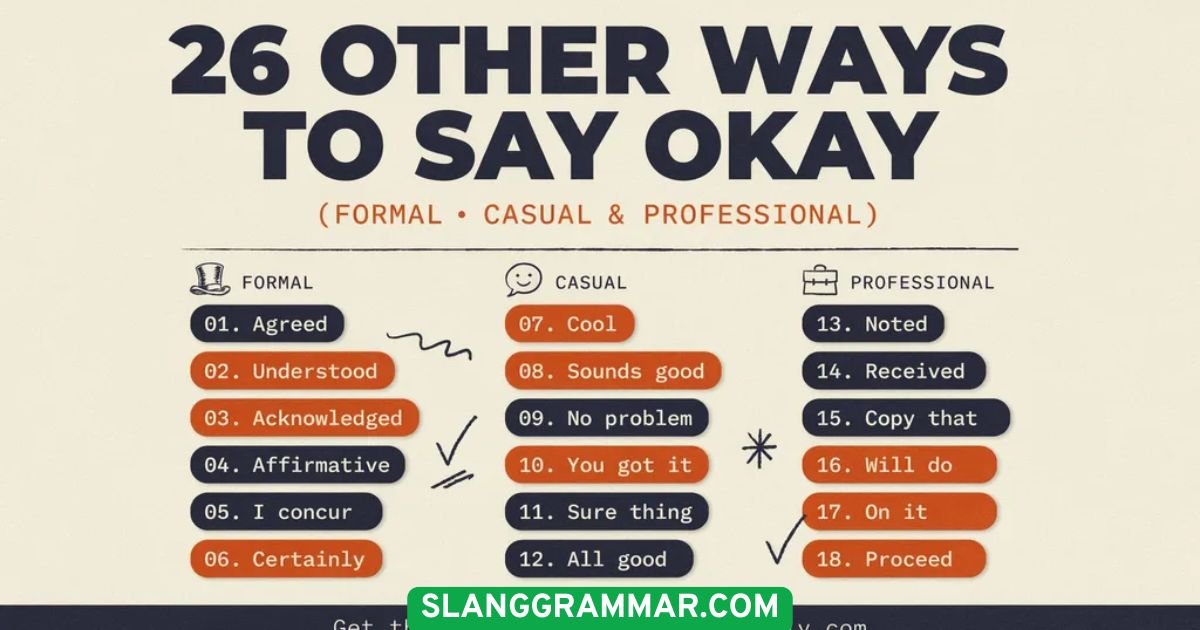
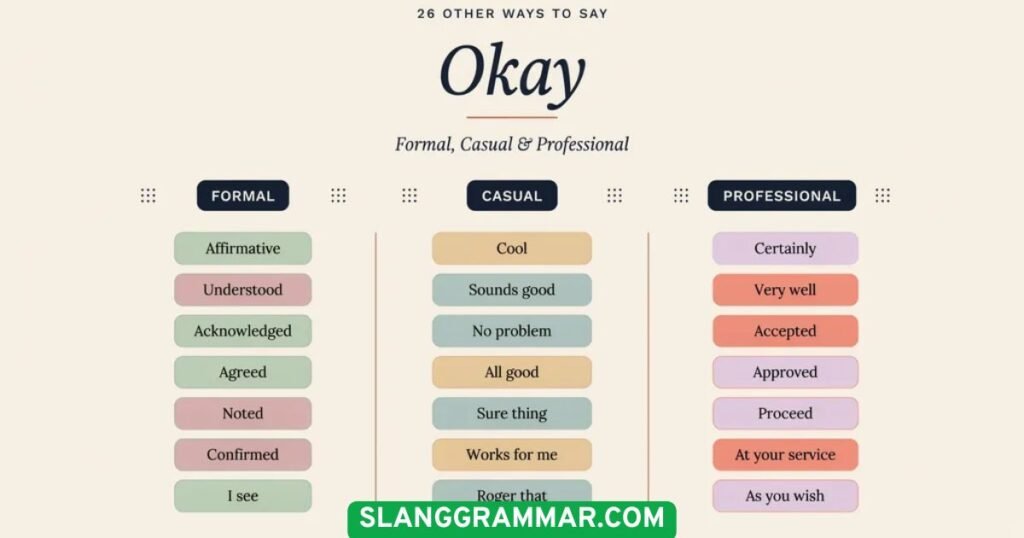
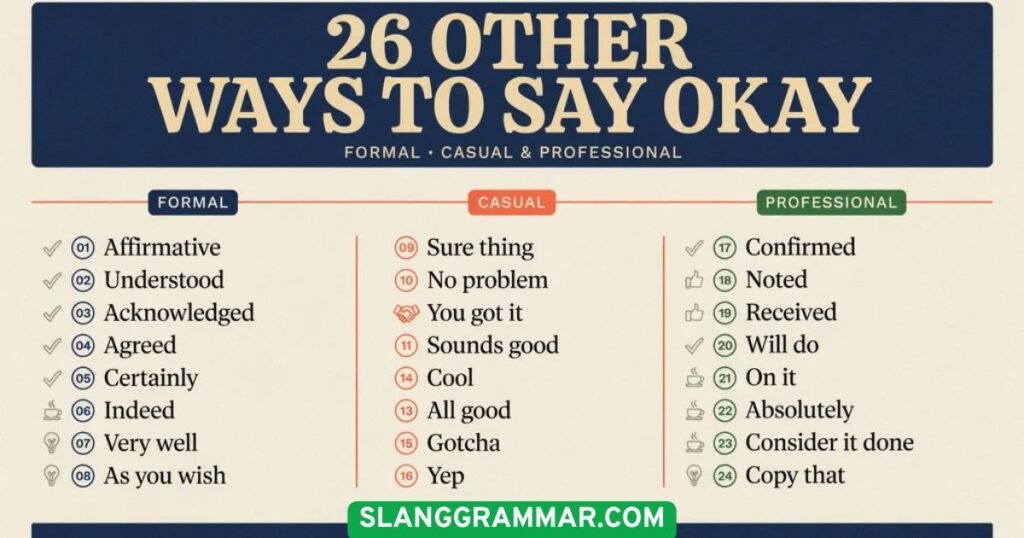
This article walks you through 26 strong, natural alternatives — covering everything from formal ways to say okay to casual ways to say okay — so you always have the right word for the right moment.
What Does Okay Mean?
At its core, okay is an expression of agreement, acceptance, or acknowledgment. It tells the other person that you have received their message, that you are on board with a plan, or that something meets your standard. Linguists believe the word originated in American English in the early 19th century, likely as a playful misspelling of “all correct” (written as “ol’ korrect” in a newspaper joke), and it has since become one of the most widely understood words in the world.
In everyday communication, okay functions across multiple roles. It can confirm understanding (“Okay, I got it”), signal mild agreement (“Okay, that works”), or express lukewarm acceptance (“Yeah… okay, I guess”). That last variation is exactly why context matters so much. Depending on delivery and tone, “okay” can sound enthusiastic, neutral, or reluctant. When you write it in a text or email — stripped of facial expression and vocal tone — the word’s ambiguity becomes even more pronounced. That is why having a rich toolkit of okay synonyms and acknowledgment phrases is genuinely useful.
When to Use Okay
Okay fits naturally in a wide variety of everyday situations. In a text conversation with a friend making weekend plans, replying “okay, I’ll be there by noon” is perfectly warm and casual. In a quick internal chat at work — especially in a relaxed team environment — saying “okay, noted” or “okay, sounds good” keeps things moving without overthinking.
It also works well when someone gives you a brief instruction and you want to confirm without adding unnecessary words. If your manager says “please send that report by 3 PM” and you fire back “okay, will do,” that is efficient and clear. Similarly, when you are processing new information and need a moment to think, saying “okay, let me check on that” buys you time naturally and politely.
That said, in more formal written communications — performance reviews, client-facing emails, contracts, or senior leadership correspondence — “okay” can feel slightly underdeveloped. That is when one of the professional ways to say okay listed below will serve you much better.
Is It Professional or Polite to Say Okay?
The honest answer is: it depends. “Okay” is perfectly acceptable in many professional contexts, particularly in fast-paced, informal workplaces where brevity is valued. But it can also read as indifferent or even terse if the situation calls for warmth or formality. Here is a quick look at both sides:
| Aspect | Pros of Using “Okay” | Cons of Using “Okay” |
| Tone | Neutral and efficient | Can feel flat or dismissive |
| Formality | Fine for casual or internal use | Too informal for client-facing or formal emails |
| Clarity | Clear and direct | Doesn’t convey enthusiasm or full acknowledgment |
| Versatility | Works in speech and text | Loses warmth in written form without context |
The takeaway here is not that “okay” is a bad word — it is just a limited one. When you want to show genuine engagement, signal respect, or match the formality of a situation, swapping it for a more deliberate polite reply or clear acknowledgment makes a real difference.
26 Other Ways to Say Okay
1. Understood
When you want to confirm that you have fully grasped what was communicated, “understood” is one of the most effective single-word responses available. It carries a professional tone that reads as attentive and capable — you are not just agreeing, you are signaling that the information has been properly received. Example: “The deadline has been moved to Friday.” — “Understood, I will adjust my schedule accordingly.” This phrase works perfectly in workplace emails, messages from supervisors, or any situation involving instructions. It would feel overly stiff in casual small talk, but in business communication it is exactly right.
2. Sounds Good
This one is a warm, semi-formal response that strikes a nice balance between professional and friendly. It implies not just agreement but a positive feeling about whatever is being proposed. Example: “Let’s catch up over a call at 2 PM.” — “Sounds good, I’ll send a calendar invite.” You will hear this constantly in team settings, client check-ins, and colleague exchanges. It is a bit too casual for a formal legal document or executive briefing, but for most day-to-day professional interactions it is a natural, likable response.
3. Certainly
“Certainly” is a formal, polished alternative that conveys willingness, readiness, and a confident yes. It is frequently used in customer service, hospitality, and professional service industries where a composed tone matters. Example: “Could you send me the updated contract by end of day?” — “Certainly, I’ll have that to you within the hour.” It fits beautifully in client-facing communications but can feel a touch formal or even stiff if used in a casual group chat or with close colleagues.
4. Absolutely
There is an enthusiasm built into “absolutely” that plain “okay” simply cannot match. This is a confident, warm confirmation that signals full agreement without hesitation. Example: “Are you comfortable presenting the quarterly results?” — “Absolutely, I have everything ready.” Use it when you want to sound eager and capable — job interviews, client proposals, and collaborative team situations are all ideal. If someone asks a very minor question, “absolutely” might feel like an overreaction, so match the energy of the moment.
5. No Problem
This friendly, reassuring phrase is popular in both casual and semi-professional contexts because it tells the other person not to worry about asking. Example: “Could you double-check those numbers for me?” — “No problem, I’ll get back to you shortly.” It is warm and approachable, making it great for teammates, friends, and service situations. However, in formal professional writing or with senior stakeholders who prefer polished language, “no problem” can come across as too casual. Some people also find it slightly dismissive, so read your audience.
6. Of Course
“Of course” is graceful. It signals that whatever is being asked is not only agreeable but entirely expected — you are happy to do it without reservation. It carries a warm, professional tone and works particularly well when someone is hesitant to ask for a favor. Example: “Is it okay if I borrow your notes before the meeting?” — “Of course, I’ll send them over now.” It suits most professional and social situations. The one note of caution: in written form it can occasionally sound slightly presumptuous depending on context, so use it where genuine warmth is appropriate.
7. Got It
Short, direct, and casual-friendly, “got it” is excellent for quick confirmations — especially in messaging apps, Slack, or text chains where brevity is appreciated. Example: “Meet me at the front entrance, not the lobby.” — “Got it, see you there.” It reads as switched-on and efficient. In formal emails or when responding to a senior executive or client, it may come across as too breezy. Save it for fast-paced internal communication where a snappy response signals engagement rather than dismissal.
8. Noted
“Noted” is a crisp, professional acknowledgment that confirms information has been registered. It is especially useful when you are receiving instructions, feedback, or changes and want to confirm receipt without elaborating. Example: “Please ensure all reports use the new template from next quarter.” — “Noted, I’ll update the format starting Q3.” It is clean and efficient, but on its own it can feel cold or minimal. Adding a follow-up sentence or action step warms it up considerably. Avoid it in casual or personal conversations where it might come across as dismissive or robotic.
Read Also: 28 Professional Ways to Say “I Am Interested in This Position”
9. Works for Me
This phrase is an excellent informal-to-semi-formal confirmation that adds a personal, agreeable touch. It communicates that the proposed plan fits into your world without any friction. Example: “Can we reschedule to Thursday afternoon?” — “Works for me, I’m free after 1 PM.” It is widely used in workplace scheduling, collaborative planning, and team agreements. It is a bit too casual for formal correspondence, but for internal emails or messages with people you know well, it keeps the tone approachable and human.
10. Perfect
When something genuinely aligns with what you needed, “perfect” expresses that alignment with enthusiasm. It is a positive, energetic response that signals not just agreement but satisfaction. Example: “I’ve attached the revised version for your review.” — “Perfect, I’ll take a look this afternoon.” It fits well in both professional and casual contexts when the other person has done something right or delivered what was asked. Use it sparingly though — if you say “perfect” in response to every message, it quickly loses its sincerity.
11. Very Well
Carrying a distinctly formal, somewhat old-fashioned tone, “very well” is appropriate in highly formal written English or in specific professional cultures (law, diplomacy, academia, formal British English) where elevated register is the norm. Example: “The board has requested your presence at Thursday’s session.” — “Very well, I shall prepare my remarks.” It sounds authoritative and composed. In modern casual or corporate-casual environments, it can feel archaic or overly stiff, so deploy it only where the setting clearly calls for that level of formality.
12. Agreed
When two parties are aligning on a position, plan, or decision, “agreed” is the cleanest way to confirm mutual understanding. It is a professional, collaborative phrase that signals consensus rather than just personal compliance. Example: “We should prioritize the client presentation before the internal review.” — “Agreed, let’s block time for it this week.” It works well in meetings, negotiations, and team decisions. It is best used when there has been genuine back-and-forth discussion — saying “agreed” out of nowhere without prior conversation might confuse people.
13. Sure
Sitting comfortably in the casual-to-semi-formal range, “sure” is easy, breezy, and universally understood. It conveys relaxed agreement without any fuss. Example: “Can you grab the coffee order on your way in?” — “Sure, what does everyone want?” It is perfect for friendly conversations, light requests, and low-stakes confirmations. In a formal or high-stakes professional environment, though, it can make you sound indifferent or uncommitted — particularly in writing, where tone is harder to read correctly.
14. I Understand
More thorough than a simple “okay,” this phrase shows that you have genuinely processed what was communicated — not just heard the words, but grasped the meaning. It is a thoughtful, empathetic acknowledgment that works well when someone has explained something complex or shared something sensitive. Example: “The client’s expectations have shifted and we need to adjust the scope.” — “I understand, let me review the current plan and suggest some changes.” It is appropriate in almost every professional and personal setting. In quick exchanges where brevity is expected, it may feel slightly over-explained.
15. Right
“Right” is a casual spoken or typed affirmation — common in British English especially, though widely used globally. It can mean “I’m with you,” “that makes sense,” or “I agree,” depending on delivery. Example: “So the meeting is in the east wing, not the main conference room.” — “Right, got it.” It works well in conversation, informal writing, and quick exchanges. In formal written correspondence, it might come across as vague or insufficiently committed. It is best used where the tone is already relaxed.
16. For Sure
A confident, casual alternative with strong positive energy, “for sure” communicates enthusiastic agreement. Example: “Are you in for the team dinner on Friday?” — “For sure, I’ll be there.” It is popular in American English and widely recognized internationally. The casualness level is fairly high, so this one is best reserved for friendly conversations, informal workplace chats, and social plans. In professional emails or formal communications, it would feel out of place.
17. Roger That
Originally military and aviation radio communication terminology for “message received,” “roger that” has made its way into everyday speech as a playful, slightly humorous acknowledgment. Example: “Don’t forget to bring the printed slides.” — “Roger that, already packed them.” It adds a fun, lighthearted flavor to a confirmation and can be great for lightening the mood in team conversations. In serious or formal contexts, it would seem flippant, so know your room before using it.
18. Consider It Done
This phrase goes a step further than simple agreement — it promises action and expresses high confidence in your ability to deliver. Example: “Can you have the summary ready for the morning meeting?” — “Consider it done.” It is assertive and slightly bold, which makes it great for situations where you want to demonstrate capability and initiative. It would feel excessive for minor requests (“pass the salt” — “consider it done”) but is perfectly proportional for meaningful tasks or when building professional trust.
19. You Bet
A warm, friendly, American-English expression of enthusiastic agreement, “you bet” adds personality and affirmation to a response. Example: “Thanks for staying late to help with this.” — “You bet, happy to do it.” It works beautifully in casual and semi-casual settings where the relationship is warm. In formal writing or cross-cultural communication, it may not land the way you intend, since it is idiomatic and region-specific.
20. No Worries
This phrase does double duty — it simultaneously confirms agreement and reassures the other person that no inconvenience was caused. It has a casual, easygoing warmth that is especially useful when someone has apologized or been hesitant to ask for something. Example: “Sorry to ask at the last minute — can you proofread this?” — “No worries at all, I’ll take a look now.” It is common in Australian English and has spread widely. In strictly formal contexts, it can seem too breezy, but for most modern workplaces it fits perfectly.
21. Fair Enough
When you do not fully agree but you accept the reasoning or the outcome, “fair enough” is an honest and mature way to acknowledge a point without being fake about your enthusiasm. Example: “We’ll need to cut the social media budget for this quarter.” — “Fair enough, I’ll revise the plan accordingly.” It signals intellectual honesty and acceptance. It is best in situations where there has been a discussion or negotiation. Using it when someone has just stated a fact can sound like mild pushback, so be aware of that nuance.
22. I’m On It
This phrase is less of a pure agreement and more of an action-oriented confirmation — it tells the other person that you are not just accepting the instruction but actively starting on it right now. Example: “Can you look into the delivery delay with the supplier?” — “I’m on it, I’ll call them in the next ten minutes.” It projects competence and urgency. It works best in workplace contexts where action is expected. In casual personal conversations, it might sound slightly dramatic for small tasks.
23. Copy That
Like “roger that,” this phrase comes from communications and military vocabulary and has entered casual usage as a punchy confirmation. Example: “Bring the signed contract to the 4 PM meeting.” — “Copy that.” It is efficient, a little playful, and signals clear receipt of information. Best for informal team settings, group chats, or when a bit of personality in communication is welcome. In formal writing, it would seem out of place.
24. That Works
A relaxed and collaborative-sounding confirmation, “that works” communicates that a proposal or plan fits into your life or schedule without any friction. Example: “How about we connect via video call at 11 on Wednesday?” — “That works perfectly for me.” It is casual enough for friendly exchanges and polished enough for internal professional communication. It carries a collaborative, agreeable feeling that makes conversations feel easy. For very formal documents or executive-level correspondence, something more deliberate would serve you better.
Read Also: 25 Other Ways to Say “Sorry I Missed Your Call” (Professional & Polite Alternatives)
25. Alright
Sitting somewhere between casual and semi-formal, “alright” is a conversational staple that communicates acceptance, often with a sense of moving forward. Example: “Let’s wrap up and reconvene after lunch.” — “Alright, I’ll see everyone at 1.” It works well in spoken and written informal communication. In formal business writing it can feel a bit loose, but in most modern workplaces it reads as professional and natural. It is slightly warmer than “okay” because of its speech-like quality.
26. I’ll Take Care of It
When you want to go beyond acknowledgment and make a clear ownership statement, this phrase is powerful. It is a confident, responsible confirmation that tells the other person they can stop worrying — you have it handled. Example: “Someone needs to follow up with the client about the delay.” — “I’ll take care of it this afternoon.” It projects reliability and initiative, making it a strong phrase for leadership contexts or anytime you want to demonstrate ownership. For simple, quick confirmations it might be a bit heavy, but for meaningful delegations or responsibilities it is spot on.
Quick Reference Table
Here is a side-by-side look at all 26 alternatives so you can choose the right one at a glance.
| Alternative | Best Use Case | Tone | Formality Level |
| Understood | Instructions, formal acknowledgment | Professional | Formal |
| Sounds Good | Planning, scheduling, team chats | Friendly | Semi-formal |
| Certainly | Client-facing, service contexts | Polished | Formal |
| Absolutely | Eager agreement, interviews | Confident | Semi-formal |
| No Problem | Casual requests, team favors | Warm | Casual–Semi-formal |
| Of Course | Gracious agreement, social contexts | Warm | Semi-formal |
| Got It | Quick confirmations, messaging | Snappy | Casual |
| Noted | Receiving feedback or instructions | Professional | Formal |
| Works for Me | Scheduling, planning | Agreeable | Casual–Semi-formal |
| Perfect | Expressing satisfaction | Enthusiastic | Semi-formal |
| Very Well | Formal written English | Elevated | Formal |
| Agreed | Meetings, negotiations, decisions | Collaborative | Semi-formal–Formal |
| Sure | Light requests, friendly chats | Easygoing | Casual |
| I Understand | Complex information, sensitive topics | Empathetic | Semi-formal |
| Right | Conversational affirmation | Casual | Casual |
| For Sure | Enthusiastic social agreement | Energetic | Casual |
| Roger That | Playful confirmation, team chats | Humorous | Casual |
| Consider It Done | High-confidence task acceptance | Assertive | Semi-formal |
| You Bet | Warm, enthusiastic agreement | Friendly | Casual |
| No Worries | Reassuring agreement | Relaxed | Casual–Semi-formal |
| Fair Enough | Accepting a point after discussion | Honest | Semi-formal |
| I’m On It | Immediate action confirmation | Proactive | Semi-formal |
| Copy That | Quick receipt of instructions | Punchy | Casual |
| That Works | Scheduling, collaborative planning | Agreeable | Casual–Semi-formal |
| Alright | Conversational acceptance | Natural | Casual–Semi-formal |
| I’ll Take Care of It | Task ownership, delegation | Responsible | Semi-formal |
FAQ’s
How to say “OK” in a cool way?
You can say “cool,” “sounds good,” “for sure,” “alright,” or “bet” instead of OK. These words sound more casual and friendly in daily conversations.
How to say OK in Gen Z way?
Gen Z often says “bet,” “say less,” “slay,” “valid,” or “I’m down” to mean OK. These phrases are mostly used in casual chats, texts, and social media.
What can I say instead of good?
You can say great, nice, awesome, solid, perfect, excellent, cool, or amazing instead of good. The best word depends on how positive or casual you want to sound.
Can I say cool instead of okay?
Yes, you can say “cool” instead of “okay” in casual situations. It shows that you agree, understand, or accept something in a relaxed way.
How does Gen Z say “okay”?
Gen Z may say “bet,” “say less,” “cool,” “valid,” or “for sure” instead of okay. These phrases sound modern, casual, and natural in friendly conversations.
Choosing the Right Word Every Time
Language is one of those tools that rewards intentionality. The difference between “okay” and “understood” might seem trivial in isolation, but across dozens of messages a day — emails to clients, replies to colleagues, responses to your manager — it adds up to a distinct impression of who you are in a professional and social context. Choosing the right agreement expression signals that you are present, thoughtful, and tuned in to the tone of the conversation.
The key is to match the phrase to three things: the relationship (how well you know the person), the setting (formal meeting vs. team Slack channel), and the weight of what is being agreed upon (major project vs. minor schedule change). For formal situations, reach for “understood,” “certainly,” or “noted.” For friendly professional exchanges, “sounds good,” “agreed,” or “that works” will serve you well. For casual conversations, “got it,” “for sure,” or “no worries” keeps things warm and natural.
Okay is a perfectly good word — it has survived over 180 years of English usage for a reason. But the 26 alternatives you have just explored give you the full vocabulary range to communicate clearly, professionally, and authentically in every situation. Use them well, and your conversations will feel noticeably more intentional.
Related Guides:
1: 25 Other Ways to Say “I Appreciate Your Help” (With Real Examples)
2: How to Say Thank You for Your Partnership Without Sounding Like a Broken Record
3: 25+ Polite Ways to Say “Sorry for the Short Notice” (Informal & Professional Alternatives 2026 updated)
4: 30 Other Ways to Say “I Can’t Wait to See What the Future Holds”
5: Better Ways to Say Received With Thanks in Emails, Gifts, and Daily Messages