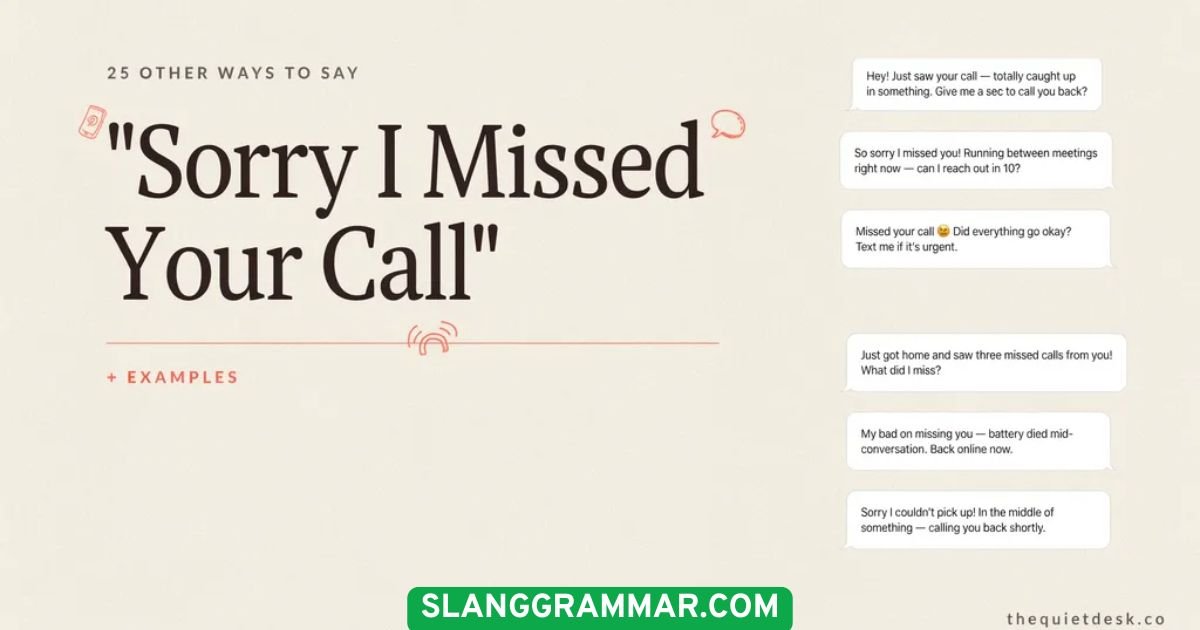
25 Other Ways to Say “Sorry I Missed Your Call” (Professional & Polite Alternatives)
Picking up the phone only to see a missed call notification is one of those small, everyday moments that can feel surprisingly awkward — especially when it involves a client, a manager, or someone you genuinely needed to speak with. The phrase sorry I missed your call has become a reflex response for most people, typed out in a text or voicemail without a second thought. And while it works, it can sometimes come across as flat, overly casual, or just a little too routine to feel sincere.
The truth is, the words you choose when responding to a missed phone call say more about you than you might realize. A quick, thoughtful follow-up message reassures the other person that you value their time. A rushed or generic one can do the opposite. Whether you are writing a business call reply, crafting a professional apology message, or just texting a colleague back, having a few go-to alternatives ready makes the whole thing feel less robotic and far more human.
This article covers 25 polished, practical alternatives to the default phrase — ranging from formal apology options for workplace settings to warmer, more personal variations for friends and semi-professional contacts. You will also find context-specific advice, a quick reference table, and answers to the most common questions people have about phone call etiquette.
What Does “Sorry I Missed Your Call” Mean?
At its core, sorry I missed your call is an acknowledgment — a way of letting someone know you saw their attempt to reach you and that you are aware they went unanswered. The phrase combines a brief apology with a factual statement, making it both communicative and considerate in a single breath.
The expression has its roots in basic phone etiquette that predates smartphones. Back when answering machines were common, leaving a call back message was the expected courtesy after missing someone’s ring. As texting and messaging apps became the norm, the phrase migrated naturally into written communication — and stayed there, perhaps a little too comfortably.
Its most common use cases include replying via text after a missed personal call, leaving a voicemail when returning someone’s missed ring, opening a professional email response after not picking up a business call, and sending a quick message to a client or colleague who reached out while you were unavailable. It fits naturally in most situations, but as you will see, context matters quite a bit when choosing exactly how to phrase it.
When to Use “Sorry I Missed Your Call”
There are plenty of situations where this phrase is perfectly appropriate — even ideal. Knowing when it works well helps you also recognize when something a little more tailored might land better.
When a friend or family member calls and you simply could not pick up, a quick “sorry I missed your call” in a text is warm enough and gets the point across without overthinking it. The informality suits the relationship, and nobody is going to scrutinize the phrasing.
For workplace communication, the phrase works well in semi-formal settings — say, with a colleague you speak with regularly, or in a team where communication tends to be casual. It also fits neatly into a voicemail when you are returning a call and want to open with a quick acknowledgment before diving into the reason for calling back.
In client communication, it works as a starting point, though pairing it with a line about your availability or offering a specific time to reconnect will make it feel more complete. A polite follow-up that just says “sorry I missed your call” without anything else can sometimes feel like a dead end — the other person is left wondering what happens next.
When reaching out to someone you do not know well — a new business contact, a potential employer, or a stakeholder — you will almost always want a more considered phrase. The default version is a little too casual for high-stakes professional communication, and one of the alternatives below will serve you much better.
Is It Professional or Polite to Say “Sorry I Missed Your Call”?
This is a fair question, and the honest answer is: it depends on the context. The phrase is polite, certainly, but whether it reads as professional depends on who you are talking to and how you are communicating.
Here is a simple breakdown to help you think it through:
| Factor | “Sorry I Missed Your Call” Works Well | Consider an Alternative When |
| Relationship | Friend, regular colleague, familiar client | New contact, senior stakeholder, formal client |
| Channel | Text message, casual voicemail | Formal email, executive communication |
| Tone | Informal or semi-formal | Formal or high-stakes |
| Context | Quick acknowledgment is enough | A more detailed, courteous response is expected |
The phrase’s biggest strength is its simplicity. It is quick, clear, and universally understood. Its limitation is that it can feel a little dismissive — like you are checking a box rather than genuinely engaging. For a sincere apology in a professional setting, pairing it with a brief explanation or an offer to reconnect goes a long way. On its own, it is polite. In context, with a follow-up line, it becomes genuinely professional.
25 Other Ways to Say “Sorry I Missed Your Call”
1. “I Apologize for Missing Your Call”
This is the most direct formal apology alternative and is ideal when sorry i missed your call feels too casual for the situation. The word “apologize” elevates the register noticeably — it signals that you are taking the missed connection seriously rather than brushing it off. The professional tone here suits emails to clients, senior colleagues, or business contacts you do not know well. You would not use this in a quick text to a friend, but in a formal email opener, it works beautifully: “I apologize for missing your call this afternoon — please let me know a convenient time to reconnect.” Avoid it in everyday casual exchanges, where it can feel stiff.
2. “I’m Sorry I Wasn’t Available When You Called”
This phrase adds a layer of context that the standard version lacks. By noting that you were unavailable when called, you subtly signal that your absence was circumstantial rather than intentional. It carries a warm, professional tone that works well in both text messages and business emails. A realistic example: “I’m sorry I wasn’t available when you called — I was in a meeting but would love to connect soon.” It fits semi-formal situations well and works particularly nicely when speaking with clients who might otherwise wonder why you did not pick up. It would feel over-explained in a text to a close friend.
3. “Thank You for Reaching Out — I’m Sorry I Missed Your Call”
Leading with gratitude before the apology is a small but meaningful shift. It frames the interaction positively and acknowledges the other person’s effort in a way the plain apology does not. The friendly professional tone makes this a strong choice for client follow-up messages or business emails where you want to maintain warmth alongside professionalism. Example: “Thank you for reaching out — I’m sorry I missed your call and will get back to you shortly.” This works particularly well when you want the response to feel relationship-focused rather than transactional. It would feel slightly formal in a personal context, but in business? It hits just right.
4. “I Missed Your Call — I’d Love to Connect Soon”
Rather than dwelling on the apology, this version moves straight toward action. It acknowledges the missed communication and immediately redirects to next steps, which is exactly what busy professionals appreciate. The tone is confident and friendly, making it ideal for peer-level business communication, networking follow-ups, or reconnecting with a contact after a gap. Example: “I missed your call — I’d love to connect soon. Are you free later this week?” The gentle pivot toward scheduling keeps the conversation moving forward. It is slightly too forward for formal or executive contexts, where a more explicit apology might be expected first.
5. “Please Accept My Apologies for Missing Your Call”
This is one of the more formal options available, and it is deliberately chosen for situations where the missed call carries weight. The phrase please accept my apologies has an almost ceremonial quality — it shows deference and respect, which is valuable when communicating with senior stakeholders, executives, or in any context where the relationship is formal or newly established. Example: “Please accept my apologies for missing your call today — I will be in touch shortly.” Do not use this for casual texts or with colleagues you are on first-name terms with; it will feel out of place.
6. “I’m Sorry I Couldn’t Answer — I Was Tied Up”
This is a casual, approachable alternative that works well with colleagues and familiar contacts. The phrase “tied up” is a well-understood, friendly shorthand for being busy, and it softens the apology with a brief, relatable explanation without sounding overly formal or defensive. Example: “Sorry I couldn’t answer — I was tied up in a meeting. Give me a call back when you’re free!” This tone suits internal work communication, group chats, or texts to contacts you see regularly. For anything formal or client-facing, swap “tied up” for something a little more polished.
7. “I Was Unable to Take Your Call — Apologies for the Inconvenience”
This phrasing carries a formal, corporate tone that works well in professional emails, customer service responses, or any setting where there is some distance between the two parties. The phrase apologies for the inconvenience is a recognized business convention that signals you are aware the missed call may have caused disruption. Example: “I was unable to take your call this morning — apologies for the inconvenience, and I will reach out to you by end of day.” It reads as thorough and considerate in a corporate context, though in personal messages it can feel oddly clinical.
8. “I’m Returning Your Call — Sorry for the Delay”
This one is particularly well-suited to voicemail openings, because it serves a dual purpose: it tells the listener exactly why you are calling while simultaneously offering a quick apology for the time that has passed. The sorry for the delay framing is also effective in professional email responses that arrive a few hours or even a day after the original call. Example: “Hi, this is Sarah — I’m returning your call from earlier today. Sorry for the delay, and I look forward to speaking with you.” It keeps things moving and is appropriate across a wide range of professional relationships.
9. “My Apologies — I Was in a Meeting When You Called”
Providing a specific reason, like being in a meeting, gives the missed call apology an extra note of credibility and context. It is not making excuses — it is giving the other person enough information to understand the situation without requiring them to guess. The semi-formal tone here works in most workplace settings. Example: “My apologies — I was in a meeting when you called, but I’m free now if you’d like to reconnect.” Adding availability at the end turns it from a passive acknowledgment into an active invitation, which is almost always better.
Read Also: 25 Other Ways to Say “I Appreciate Your Help” (With Real Examples)
10. “Sorry I Missed You — Can We Schedule a Time to Talk?”
This variation treats the missed call as the starting point for something more deliberate: a proper, scheduled conversation. It works especially well when the missed call was likely about something important, and you want to give it the attention it deserves. The friendly, action-oriented tone suits business development emails, client communication, and professional networking. Example: “Sorry I missed you — can we schedule a time to talk this week? I want to make sure we connect properly.” It would feel over-formal in a quick exchange with a friend, but in a business context, it shows initiative and respect.
11. “I Regret That I Was Unavailable When You Reached Out”
This is a formal, written-English construction that works well in professional correspondence — particularly letters, formal emails, or messages to contacts in industries with traditionally high communication standards, such as law, finance, or consulting. The word “regret” elevates the tone considerably, and “reached out” keeps it modern without being slangy. Example: “I regret that I was unavailable when you reached out and will ensure I get back to you promptly.” This phrasing is not suited to casual or everyday conversation and would feel overly stiff in most texting contexts.
12. “Thanks for Calling — I’ll Get Back to You Shortly”
Sometimes the most effective response is less about the apology and more about the reassurance. This phrase shifts the focus to what happens next, which is often what the other person most wants to know. The warm, professional tone makes it a reliable choice for voicemail greetings, out-of-office style responses, or quick texts to clients and colleagues. Example: “Thanks for calling — I’ll get back to you shortly, likely within the next hour.” Adding a time frame makes it even more reassuring. This does not lean heavily on apology, so for situations where a sincere acknowledgment of error is expected, pair it with something a bit more apologetic.
13. “I’m So Sorry I Missed Your Call — I Was Thinking of You”
This is a warmer, more personal option suited to close friendships, family, or long-standing relationships where emotional warmth matters more than professional formality. It signals genuine care and gives the missed call a sense of personal significance. Example: “I’m so sorry I missed your call — I was thinking of you and will ring you back tonight!” This is not for workplace use and would feel oddly intimate in a business email, but among people you care about, it adds a lovely personal touch.
14. “I Noticed I Missed Your Call — Is Everything Okay?”
This alternative works particularly well when the call came from someone who does not call often, or at an unusual time, and you want to signal that you noticed and that you care. It shifts the frame from apology to concern, which often means more to the other person. Example: “I noticed I missed your call earlier — is everything okay? Let me know when you’re free to chat.” Best used with friends, family, or close colleagues. In a strictly professional context, it may come across as overly personal unless the relationship warrants it.
15. “Sorry for Not Picking Up — I’m Available Now”
Directness has its own kind of warmth. This phrase wastes no time and immediately offers a solution: availability right now. For fast-paced work environments or clients who appreciate concise business messages, this is a winner. Example: “Sorry for not picking up earlier — I’m available now if you’d like to talk.” The real-time availability offer makes it feel proactive rather than passive. It works well over text and messaging apps, though in formal email correspondence, you might want to expand it slightly to sound less abrupt.
16. “I Missed Your Call and Wanted to Follow Up Right Away”
The phrase “right away” does a lot of heavy lifting here. It communicates urgency and priority, signaling to the other person that they mattered enough to prompt an immediate response. This works well as an opener in a professional follow-up email or text to a client you do not want to feel neglected. Example: “I missed your call and wanted to follow up right away — please let me know when you are available for a quick chat.” Best suited to business and professional contexts; in casual personal communication, it might come across as unnecessarily intense.
17. “I’m Sorry We Missed Each Other — Let’s Try Again Soon”
This phrasing is notable because it uses “we” rather than placing the burden entirely on one side. The implied mutuality — we missed each other — makes it feel more collaborative and less like an apology for a failure. The friendly, neutral tone suits both professional and personal contexts where you want to keep things light and positive. Example: “I’m sorry we missed each other — let’s try again soon. Would Thursday afternoon work for you?” Adding a proposed time immediately demonstrates follow-through and keeps things moving.
18. “Apologies for the Missed Call — I Was Out of Range”
When you genuinely were not able to receive the call for a technical reason — no signal, on a flight, in a dead zone — this phrase gives a clear, credible explanation without sounding like an excuse. The professional, matter-of-fact tone works well in email and text. Example: “Apologies for the missed call — I was out of range for most of the afternoon. I’m back now and happy to connect.” Best when the explanation is genuine; using this when you simply did not want to pick up can come across as disingenuous if the other person follows up with questions.
19. “I Regret Missing Your Call — I’ll Reach Out to Reconnect Shortly”
This is a good fit for formal business correspondence where you want to signal both regret and proactive intention. Using “reach out to reconnect” rather than simply “call you back” gives it a slightly more personalized, relationship-focused quality. Example: “I regret missing your call this morning — I’ll reach out to reconnect shortly and look forward to speaking with you.” Best for emails or formal messages; a bit heavy for casual texting.
20. “I’m Sorry I Was Unavailable — Thank You for Your Patience”
Adding thank you for your patience at the end of a missed call apology is a particularly thoughtful touch in business settings. It acknowledges that the other person’s time was affected and thanks them for being understanding — a small gesture that often lands well with clients and professional contacts. Example: “I’m sorry I was unavailable earlier — thank you for your patience, and I will be in touch very soon.” This works best in client-facing communication, customer service contexts, and professional emails. In personal texts, it might feel overly formal.
Read Also: How to Say Thank You for Your Partnership Without Sounding Like a Broken Record
21. “Sorry I Couldn’t Get to the Phone — Let Me Know a Good Time to Call Back”
Practicality is the strength of this version. By immediately asking for a good callback time, you demonstrate respect for the other person’s schedule and position them as the one in control of when the next conversation happens. The polite, semi-formal tone makes it adaptable across many settings — works in texts, voice messages, and emails alike. Example: “Sorry I couldn’t get to the phone earlier — let me know a good time to call back and I’ll make sure I’m available.” The offer of flexibility on your part makes this one of the more considerate alternatives in the list.
22. “I Missed Your Call and I Want to Make Sure We Connect”
This variation is particularly effective because it expresses intentionality. “I want to make sure we connect” communicates that the conversation is something you are actively prioritizing, not just a box to check. It has a warm, purposeful tone that suits professional relationships where you want to signal genuine investment. Example: “I missed your call and I want to make sure we connect — would tomorrow morning work for a quick chat?” The strength of this phrase lies in how it turns a missed call into an affirmative statement of intent. Best for professional and semi-formal contexts; slightly over-considered for quick casual catch-ups.
23. “I Saw That You Called — My Sincerest Apologies for Missing You”
Acknowledging that you actively noticed the missed call — rather than just responding generically — adds a personal touch. “My sincerest apologies” elevates the formality for those situations where the missed call genuinely warranted more care and attention. Example: “I saw that you called earlier — my sincerest apologies for missing you. I will be in touch within the hour.” This is a strong opener for formal email responses to important contacts or whenever the tone of the conversation requires a little more gravitas. Skip it in casual texting; it will feel overdone.
24. “Returning Your Call — I Hope I Haven’t Kept You Waiting Too Long”
This is a gracious, slightly self-aware phrase that works beautifully as a voicemail opener or the first line of a professional email. It shows awareness that the other person may have been inconvenienced by the wait while also being gentle enough not to make the delay feel more dramatic than it was. Example: “Hi, this is Marcus — returning your call from this afternoon. I hope I haven’t kept you waiting too long and I’m happy to chat now.” The warmth of this phrase suits professional relationships where the polite call reply needs to feel personal rather than scripted.
25. “My Apologies for Not Being Reachable — I’m Available to Talk Now”
This is a solid, complete professional missed call apology that handles both the acknowledgment and the resolution in one clean sentence. “Not being reachable” is a slightly more formal and nuanced way of explaining the situation, and ending with your current availability immediately removes any friction for the other person. Example: “My apologies for not being reachable earlier — I’m available to talk now if that works for you.” Works well in email and text, suitable for clients, managers, and professional contacts. Would feel too formal in everyday personal exchanges.
Quick Reference Table
Here is a side-by-side view of all 25 alternatives, their tone, and the best context for each so you can find the right phrase at a glance.
| Alternative Phrase | Tone | Best Use Case |
| I apologize for missing your call | Formal | Professional email, client communication |
| I’m sorry I wasn’t available when you called | Warm, professional | Semi-formal email, client text |
| Thank you for reaching out — I’m sorry I missed your call | Friendly, professional | Client follow-up, business email |
| I missed your call — I’d love to connect soon | Confident, friendly | Networking, peer-level business |
| Please accept my apologies for missing your call | Formal | Executive, stakeholder communication |
| I’m sorry I couldn’t answer — I was tied up | Casual | Colleagues, familiar contacts |
| I was unable to take your call — apologies for the inconvenience | Formal, corporate | Customer service, formal emails |
| I’m returning your call — sorry for the delay | Neutral, professional | Voicemail, email follow-up |
| My apologies — I was in a meeting when you called | Semi-formal | Workplace, client text |
| Sorry I missed you — can we schedule a time to talk? | Action-oriented | Business development, networking |
| I regret that I was unavailable when you reached out | Formal, written | Letters, high-formality emails |
| Thanks for calling — I’ll get back to you shortly | Warm, reassuring | Quick text, voicemail greeting |
| I’m so sorry I missed your call — I was thinking of you | Personal, warm | Close friends, family |
| I noticed I missed your call — is everything okay? | Caring, personal | Close contacts, personal calls |
| Sorry for not picking up — I’m available now | Direct, casual | Fast-paced workplace, text |
| I missed your call and wanted to follow up right away | Urgent, professional | Client email, priority follow-up |
| I’m sorry we missed each other — let’s try again soon | Collaborative, friendly | Both professional and personal |
| Apologies for the missed call — I was out of range | Matter-of-fact | Email, text with context |
| I regret missing your call — I’ll reach out to reconnect shortly | Formal, intentional | Business correspondence |
| I’m sorry I was unavailable — thank you for your patience | Considerate, professional | Client-facing, customer service |
| Sorry I couldn’t get to the phone — let me know a good time | Polite, practical | Text, voicemail, email |
| I missed your call and I want to make sure we connect | Purposeful, warm | Professional relationships |
| I saw that you called — my sincerest apologies for missing you | Formal, personal | Important contacts, formal email |
| Returning your call — I hope I haven’t kept you waiting too long | Gracious, warm | Voicemail opener, professional email |
| My apologies for not being reachable — I’m available to talk now | Professional, complete | Email, text, professional contact |
Frequently Asked Questions
How do you apologize for a missed call?
You can say, “I’m sorry I missed your call. I was unavailable at that moment.”
Then add, “Please let me know a good time to call you back.”
How do you politely say you missed a call?
You can politely say, “Sorry I missed your call earlier. I hope it was not urgent.”
This sounds respectful, clear, and professional.
How do you say you missed a call?
You can say, “I missed your call earlier and wanted to get back to you.”
It is simple, natural, and suitable for casual or professional use.
Is it correct to say “I’m sorry I missed your call”?
Yes, “I’m sorry I missed your call” is correct and commonly used.
It sounds polite, professional, and natural in English.
How do I say sorry I missed your text?
You can say, “Sorry I missed your text. I just saw your message.”
Then reply clearly so the person knows you are now available.
Conclusion
The phrase sorry I missed your call is reliable, recognizable, and genuinely useful — but it is only one tool in what should be a broader toolkit. Depending on who you are speaking with, the formality of the context, and how you want the other person to feel after reading your message, there is almost always a version that fits a little better.
The 25 alternatives covered here give you options across every register: from the formal apology suited to executive-level emails, to the warm and personal phrases that work beautifully with friends and close colleagues. The key is matching the tone of your message to the tone of the relationship. A client you have just started working with deserves a more measured, considered response than a coworker you grab coffee with every morning — and both deserve more than a one-line afterthought.
When in doubt, combine a clear missed call acknowledgment with a brief reason and a specific next step. That combination — acknowledgment, context, action — covers most situations and turns a simple apology into a genuine, relationship-building moment. That is what good phone etiquette really comes down to: not the perfect phrase, but the intention behind it.
Related Guides:
1: 25+ Polite Ways to Say “Sorry for the Short Notice” (Informal & Professional Alternatives 2026 updated)
2: 30 Other Ways to Say “I Can’t Wait to See What the Future Holds”
3: Better Ways to Say Received With Thanks in Emails, Gifts, and Daily Messages
4: 28 Powerful Ways to Say Good To Know in Everyday and Professional Conversations
5: Professional Ways to Say “Thank You for Your Assistance in This Matter”