25 Other Ways to Say Nice-to-Have
Sit in on any product meeting, hiring chat, or planning session and you will hear the same label sooner or later: “That’s a nice-to-have.” Someone suggests dark mode for the app, a second language in a job advert, or a coffee machine for the office, and the phrase lands like a soft stamp — wanted, but not needed. Few labels sort wishes from needs so neatly.
The trouble is that nice-to-have can sound vague, even dismissive. Is it a pleasant extra, a genuine advantage, or something the team quietly hopes for? The word you choose changes how people hear the priority, which is why so many writers go looking for a nice to have synonym that pins it down precisely. A perk sounds generous, a luxury indulgent, and non-essential like a planning decision — three different messages in one small phrase.
Below are 25 alternatives, each explained in plain words with its tone, its best setting, and one situation where it falls flat. They range across product roadmaps, job descriptions, project plans, and shopping, so you can match the word to the moment.
What Does Nice-to-Have Mean?
A nice-to-have is something desirable but not essential — the project, product, or purchase works fine without it, yet would be better with it. A heated car seat is the textbook example: the car drives either way, but winter mornings feel kinder. The phrase sits between a firm requirement and something nobody wants at all.
It usually works as an adjective in front of a noun, as in “a nice-to-have feature,” and in planning meetings it often becomes a noun in its own right: “That’s a nice-to-have, not a must-have.” That contrast with must-have is the heart of the phrase. It comes from business and product language, where teams sort long lists into the truly non-negotiable and what can wait, and from there it spread into hiring, budgeting, and everyday talk.
When to Use Nice-to-Have
The phrase fits best wherever people are sorting, planning, or choosing. In product discussions it labels features that would improve the user experience without being part of the core functionality, so teams can ship on time and add polish later. Project managers use it while setting scope: the report must include the sales figures, while the animated charts are nice-to-have if time allows.
It is equally at home in job descriptions, where it separates essential criteria from desirable extras and quietly tells applicants to apply anyway. In daily life it softens requests and decisions — a balcony on a holiday flat, a dishwasher in a rental. And because it asks without demanding, it works well in polite emails and feedback, where you want to suggest an improvement without issuing an order.
Is It Professional or Polite to Say Nice-to-Have?
Yes — it is standard, professional language in professional settings and a business context, and nobody will blink at it in a meeting, a brief, or a job advert. It is polite precisely because it makes a wish sound like a wish rather than a demand, protecting the other person’s freedom to say no, or not yet.
Similar Posts
25 Other Ways to Say Unless Otherwise Specified
You are halfway through a tenancy agreement, coffee going cold, when one small clause stops you: the rent covers the utilities, unless otherwise specified. Specified by whom? Somewhere else in the same document? By the landlord, in an email? The phrase sits inside contracts, terms and conditions, employee handbooks and invoices, deciding what happens when…
25 Other Ways to Say Thank You for Taking the Time
The interview went well, the mentor call ran long, and now you face a blank follow-up email, typing the line you always type: thank you for taking the time to speak with me. A good line — warm, polite, safe — but you have sent it forty times this year. Time is the one thing…
30 Other Ways to Say “I Can’t Wait to See What the Future Holds”
There’s a quiet, electric charge in the air when you stand at the edge of a big change. The phrase “I can’t wait to see what the future holds” is simply a way to bottle that feeling. It means you are looking ahead with hope, curiosity, and a genuine belief that good things are on…
25 Other Ways to Say Thank You for Sharing
Your friend goes quiet, then tells you something she has never said out loud before — a diagnosis, a divorce, a fear she has carried for years. You want to respond well. A plain thank you for sharing is kind, but in that moment it can feel too small — like something said at the…
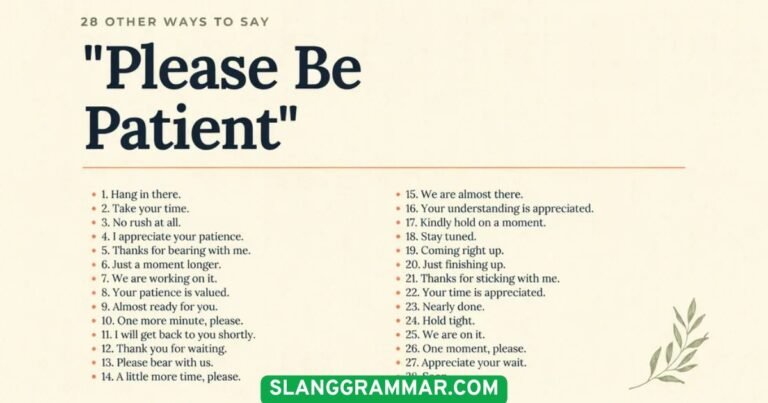
28 Other Ways to Say “Please Be Patient” in Customer Service and Business Emails
Picture a customer waiting on hold, a client expecting an email reply, or a team member stuck behind a delayed project update. At some point, almost everyone has to ask someone else to wait, and the easiest words to reach for are usually “please be patient.” It’s a familiar, polite request, the kind of line…
25 Other Ways to Say Speed Up the Process
Your client has emailed twice asking for an update, and the file they are waiting for sits in someone else’s inbox, and the launch date is not moving. You know something has to move faster — but typing speed up the process into an email can read like an order, especially when people are already…