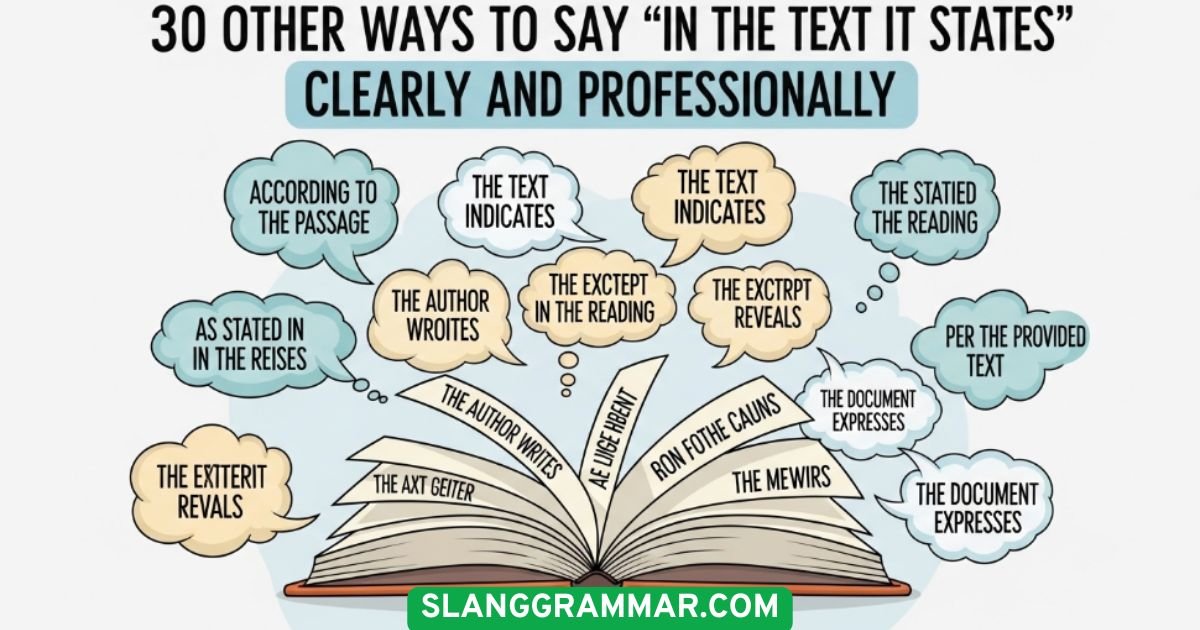
30 Other Ways to Say “In the Text It States” Clearly and Professionally
“In the Text It States” means the information is written in a passage, article, or document. People use this phrase when they want to show proof from a text. It helps readers know that the answer comes from the source.
Using the same phrase again and again can make writing sound boring. Better phrases can make your answer sound clear and smart. This is why learning other ways to say it is very helpful.
“In the Text It States” is common in school essays and reading answers. It is also useful when explaining facts from articles or books. With the right wording, your writing can sound more natural and polished.
What Does “In the Text It States” Mean?
“In the Text It States” means that a piece of information appears in a written source. The “text” could be a book, article, passage, essay, report, website, study, letter, or any other kind of written content. When someone says this phrase, they are usually trying to show where their answer came from.
For example, a student might write, “In the text it states that the main character felt nervous before the interview.” This tells the reader that the answer is based on the passage, not just the student’s guess. It is a way of citing text, using text evidence, and showing a content reference.
The phrase is common in classrooms because teachers often ask students to support answers with evidence. It also appears in summaries, reading responses, and simple essays. In more polished writing, though, people often use smoother professional phrases like “according to the text”, “the author states”, or “as noted in the text.”
When to Use “In the Text It States”
You can use “In the Text It States” when you need to connect your idea to something written. It works especially well when you are answering a question and need to prove your answer with text evidence. For example, if a reading question asks why a character made a certain choice, you can use this phrase before giving the line or idea that supports your answer.
It also works in school essays when you need to include source citation, paraphrasing, or quoting. You might use it before a direct quote, or you might use it before explaining a point in your own words. In both cases, it helps the reader see that your information comes from the text.
You may also use it in simple workplace writing when discussing document details. For example, if you are talking about company rules, a policy, or instructions, you might say that the text states a deadline or requirement. Still, in a formal context, phrases like “the document specifies” or “as indicated in the text” often sound more professional.
Is It Professional or Polite to Say “In the Text It States”?
Yes, “In the Text It States” is polite and understandable. It does not sound rude, unclear, or careless. It tells the reader that you are referencing information from a source. That makes it helpful for students, beginner writers, and anyone learning how to use text evidence properly.
However, it can sound basic if you use it too often. In stronger academic writing or formal writing, readers usually expect more natural wording. A phrase like “according to the text” sounds smoother, while “the document specifies” sounds better for business or legal-style writing. The best choice depends on your audience, your purpose, and the communication tone you want.
Here is a simple look at the strengths and weaknesses.
| Point | Explanation |
| Pros | It is clear, easy to understand, and useful for showing text evidence. It works well in school writing and reading responses. |
| Cons | It can sound repetitive, simple, or less polished in advanced essays, reports, and formal writing. |
| Best Use | Use it when writing short answers, beginner essays, or simple explanations based on a passage. |
| Better Choice for Formal Work | Use professional alternatives such as “according to the text,” “the author states,” or “the document specifies.” |
30 Other Ways to Say “In the Text It States”
The best replacement depends on what you are trying to say. Some phrases are better for direct facts, some are better for deeper analysis, and some are better for document wording or article reference. Below are 30 useful alternatives you can use to improve writing clarity, avoid repetition, and create more polished writing.
The Text Mentions
“The text mentions” means the source includes a certain detail, fact, or idea. It has a simple and neutral tone, so it works well in school answers, summaries, and short essays. It is a good choice when the information is present but not the main focus of the writing.
Example: “The text mentions that the family moved to California after the father found a new job.”
This phrase works best when you are pointing out a small detail from the passage. It may not fit well if the text strongly argues or explains something in depth, because “mentions” can sound a little light.
According to the Text
“According to the text” is one of the most common and useful alternatives. It means your information comes directly from the source. The tone is professional, clear, and appropriate for academic writing.
Example: “According to the text, regular exercise can improve both physical health and mood.”
This phrase works well in essays, reports, and reading responses. It may feel too formal for very casual writing, but it is one of the safest choices when you want a smooth formal expression.
As the Text States
“As the text states” means the source directly says something. It sounds slightly more formal than “the text mentions” and works well when you want to show a clear written statement.
Example: “As the text states, the new rule was created to protect workers from unsafe conditions.”
Use this phrase when the information is clearly written in the source. It may not be the best choice when you are making an inference, because “states” suggests the idea is direct.
The Document Specifies
“The document specifies” means the document gives exact details, rules, dates, numbers, or requirements. It has a professional tone and works very well in business, legal, workplace, or policy writing.
Example: “The document specifies that all forms must be submitted before 5 p.m. on Friday.”
This phrase is best for formal documents, instructions, contracts, and official notices. It would sound too stiff in a friendly paragraph about a story or personal reflection.
The Writing Explains
“The writing explains” means the source helps the reader understand a topic. It has a clear, helpful, and semi-formal tone. It is useful when the text gives reasons, steps, or background information.
Example: “The writing explains how water pollution affects fish, plants, and people.”
This phrase works best for educational articles, essays, and informational passages. It may not fit well if the text only briefly mentions a fact without explaining it.
The Author States
“The author states” gives credit to the person who wrote the source. It is a strong phrase for essays, literary analysis, and source citation because it connects the idea to the writer.
Example: “The author states that fear can stop people from making important choices.”
This phrase works best when you are discussing the writer’s message, opinion, or claim. It may not fit as well when the writer is unknown or when you are referring to a company document instead of a person.
The Text Highlights
“The text highlights” means the source gives special attention to an important point. It has a professional and analytical tone. This phrase is useful when you want to show that the idea matters.
Example: “The text highlights the importance of teamwork during difficult situations.”
Use this phrase when the source focuses strongly on a theme, lesson, or major idea. It is not the best fit for tiny details that are only briefly included.
The Article Points Out
“The article points out” means the article draws attention to a fact, problem, or idea. It sounds natural and semi-formal, making it useful for summaries, blog responses, and article analysis.
Example: “The article points out that many students struggle with time management during exam season.”
This phrase works best when discussing nonfiction articles or opinion pieces. It would not fit well if you are talking about a poem, story, or official form.
It Is Written in the Text
“It is written in the text” means the information appears directly in the source. The tone is simple and clear, but it can feel less polished than some other options.
Example: “It is written in the text that the event took place during the summer of 1998.”
This phrase works well for beginner writing or direct reading answers. It may not fit advanced essays because it can sound a little plain or mechanical.
Read Also:
The Source Mentions
“The source mentions” means the information appears in a source such as an article, website, book, or report. It has a useful neutral tone and works well when you are discussing research.
Example: “The source mentions that sleep affects memory and concentration.”
This phrase is best for research writing, summaries, and basic source information. It may not be strong enough when the source is making a major argument or giving detailed proof.
The Text Provides
“The text provides” means the source gives information, examples, reasons, or details. It sounds smooth and professional, especially when you want to connect a claim with support.
Example: “The text provides several examples of how kindness can change a community.”
This phrase works well in essays and analysis because it helps you introduce support. It may sound incomplete if you do not explain what the text provides, so always follow it with a clear detail.
It’s Stated in the Text
“It’s stated in the text” is a direct way to say the information is clearly included in the passage. The tone is simple, natural, and easy to understand.
Example: “It’s stated in the text that the main character missed the train because he woke up late.”
This phrase works best in classroom writing or short responses. It may not be the best option for professional reports because the contraction “it’s” can sound casual.
The Passage Indicates
“The passage indicates” means the passage shows or suggests something. It is especially useful when the meaning is not directly stated but can be understood from the details. The tone is formal and analytical.
Example: “The passage indicates that the speaker feels lonely even though she is surrounded by people.”
Use this phrase for inference, literary analysis, and deeper reading. Avoid it when the text gives a direct fact, because “indicates” can make direct information sound less certain.
The Text Refers To
“The text refers to” means the source points to a subject, person, event, idea, or topic. It has a clear and neutral tone.
Example: “The text refers to the Great Depression as a difficult period for many American families.”
This phrase works best when naming a topic that appears in the text. It may not be the best choice when explaining a full argument or detailed idea.
The Text Outlines
“The text outlines” means the source presents the main points, steps, or structure of something. It sounds professional and organized.
Example: “The text outlines three steps for creating a stronger study routine.”
This phrase works best for guides, instructions, reports, and process-based writing. It would not fit well if the text only gives one small detail rather than a clear structure.
As Noted in the Text
“As noted in the text” means the information has been mentioned or recorded in the source. It has a polished and formal tone, making it useful in essays and reports.
Example: “As noted in the text, the program helped improve attendance over several months.”
This phrase works well when referring back to a point already made. It may sound too formal in a casual conversation or very simple student answer.
The Passage Highlights
“The passage highlights” means a section of the text focuses attention on an important idea. It sounds thoughtful and analytical.
Example: “The passage highlights the courage of the young girl as she speaks up for her friend.”
This phrase works best for short sections of stories, articles, or speeches. It may not fit well when you are talking about an entire document rather than one passage.
The Document Elaborates
“The document elaborates” means the document gives more detail about a topic. It has a strong professional tone and works well in formal summaries or workplace writing.
Example: “The document elaborates on the safety rules that employees must follow during training.”
This phrase is best when the document gives extra explanation. It would not fit if the source only gives a short sentence or quick note.
The Text Acknowledges
“The text acknowledges” means the source recognizes a fact, problem, concern, or opposing idea. It has a mature and professional tone.
Example: “The text acknowledges that the plan may take time to show results.”
This phrase works best in argumentative writing, analysis, and balanced discussion. It may not fit simple factual sentences because “acknowledges” suggests the writer is recognizing something important.
It Is Suggested in the Text
“It is suggested in the text” means the idea is implied rather than directly stated. The tone is careful and semi-formal.
Example: “It is suggested in the text that the character regrets leaving home.”
Use this phrase when you are making an inference from clues in the passage. It would not fit well when the text clearly says the fact directly, because “suggested” sounds less direct.
The Article Mentions
“The article mentions” means a specific point appears in an article. It has a friendly and neutral tone, so it works well in summaries and simple explanations.
Example: “The article mentions that drinking water before meals may help some people manage hunger.”
This phrase is best for articles, blogs, and online sources. It does not fit well for novels, poems, contracts, or official forms.
As Described in the Text
“As described in the text” means the source gives details about a person, place, event, or situation. It has a smooth and semi-formal tone.
Example: “As described in the text, the town was small, quiet, and surrounded by mountains.”
This phrase works best when the source uses description. It may not fit well for facts, statistics, rules, or arguments where nothing is being described.
The Passage Refers To
“The passage refers to” means a specific section of the text points to a topic or idea. It has a clear and academic tone.
Example: “The passage refers to the speaker’s childhood memories and how they shaped her choices.”
This phrase works well in reading analysis and literature responses. It may not fit when you are discussing a full article or document instead of a short passage.
It Is Explained in the Text
“It is explained in the text” means the source gives a clear explanation of an idea. It is simple, useful, and neutral.
Example: “It is explained in the text that plants need sunlight, water, and air to grow.”
This phrase works well for educational writing and informational passages. It may not fit when the text only states a fact without giving reasons or details.
The Text Provides Evidence
“The text provides evidence” means the source gives proof or support for a claim. This phrase is very useful in academic writing, essays, and argumentative paragraphs.
Example: “The text provides evidence that the new reading program helped students improve their test scores.”
This phrase works best when you are connecting a claim to support. It would not fit well if the text only shares an opinion without proof.
The Text Emphasizes
“The text emphasizes” means the source strongly focuses on an important idea. It has a confident and professional tone.
Example: “The text emphasizes the importance of planning before starting a major project.”
This phrase works best when the author repeats, stresses, or strongly supports an idea. It may not fit if the point appears only once and is not central to the text.
Read Also:
The Document Discusses
“The document discusses” means the document talks about a topic in some detail. It sounds formal and works well in workplace, legal, business, and report writing.
Example: “The document discusses the company’s goals for improving customer service.”
This phrase is best for formal documents and reports. It may sound too stiff when writing about a short story or personal essay.
As Indicated in the Text
“As indicated in the text” means the text shows, points to, or supports an idea. It has a polished and formal tone.
Example: “As indicated in the text, the results improved after the new system was introduced.”
This phrase works well in essays, reports, and analysis. It may not be ideal for very simple writing because it can sound more advanced than needed.
The Text Provides Insight
“The text provides insight” means the text helps readers understand something more deeply. It has a thoughtful and professional tone.
Example: “The text provides insight into why the character hides his true feelings.”
This phrase works best in analysis, reflection, and literary writing. It may not fit well when the text only gives basic information or simple facts.
As Outlined in the Text
“As outlined in the text” means the source presents information in an organized way. It sounds clean, polished, and semi-formal.
Example: “As outlined in the text, the process includes planning, testing, and final review.”
This phrase works best when the text gives steps, stages, or main points. It is not the best fit when the text is emotional, descriptive, or story-based.
It’s Stated Clearly in the Text
“It’s stated clearly in the text” means the information is direct and easy to find. It has a simple but confident tone.
Example: “It’s stated clearly in the text that the meeting will begin at 9 a.m.”
This phrase works best when you want to show there is no confusion about the fact. It may not fit well in very formal writing because “it’s” is more conversational.
Quick Reference Table for Other Ways to Say “In the Text It States”
This table shows the best use case and tone for each alternative so you can choose the right phrase quickly.
| Alternative Phrase | Best Use Case | Tone |
| The text mentions | Simple details in essays or summaries | Neutral |
| According to the text | School essays and academic writing | Professional |
| As the text states | Direct facts from the source | Formal |
| The document specifies | Rules, policies, and official details | Professional |
| The writing explains | Educational or explanatory content | Friendly |
| The author states | Author claims or arguments | Professional |
| The text highlights | Important ideas or themes | Professional |
| The article points out | Article summaries and responses | Semi-formal |
| It is written in the text | Simple reading answers | Neutral |
| The source mentions | Research or source-based writing | Neutral |
| The text provides | Evidence, examples, or details | Professional |
| It’s stated in the text | Short classroom responses | Friendly |
| The passage indicates | Inference and analysis | Formal |
| The text refers to | Topic or subject references | Neutral |
| The text outlines | Steps, structure, or main points | Professional |
| As noted in the text | Polished essay writing | Formal |
| The passage highlights | Important ideas in a passage | Professional |
| The document elaborates | Detailed formal explanation | Professional |
| The text acknowledges | Balanced or argumentative writing | Professional |
| It is suggested in the text | Implied meaning or inference | Semi-formal |
| The article mentions | Blog or article summaries | Neutral |
| As described in the text | Descriptions of people, places, or events | Semi-formal |
| The passage refers to | Short passage analysis | Formal |
| It is explained in the text | Clear explanations from a source | Neutral |
| The text provides evidence | Claims supported by proof | Professional |
| The text emphasizes | Main ideas or repeated points | Professional |
| The document discusses | Reports and business writing | Formal |
| As indicated in the text | Formal analysis or reports | Formal |
| The text provides insight | Deeper understanding or reflection | Professional |
| As outlined in the text | Organized steps or structure | Semi-formal |
Why These Professional Alternatives Improve Your Writing
Using different phrases helps your writing sound more natural. Good writing variety keeps reader attention because your sentences do not all begin the same way. This is especially important in essays, where you may need to refer to a source several times.
These phrases also help you match your wording to your purpose. If you are talking about a direct quote, “as the text states” may work well. If you are explaining an implied idea, “the passage indicates” is better. If you are discussing a policy or report, “the document specifies” sounds more natural.
Strong writing is not about using the biggest words. It is about choosing words that fit the situation. The right communication tone makes your writing easier to read and more convincing.
FAQ
What’s another way to say “the text states”?
Another way to say “the text states” is “according to the text” or “the author states.”
What to say instead of “the text states” in an essay?
In an essay, you can say “as the text states,” “the passage indicates,” or “the text provides evidence.”
What’s another word for “in the text it states”?
Another phrase for “In the Text It States” is “it is written in the text” or “as noted in the text.”
What is the meaning of “text states”?
“Text states” means the information is clearly written in a passage, article, or document.
When the text states synonym?
A synonym for “when the text states” is “when the text mentions” or “as the text explains.”
Conclusion
“In the Text It States” helps writers show that their answer comes from a passage, article, or document. This phrase gives support to an idea and makes writing clear. Students can use it when they need to share proof from a text. It also helps readers understand where the information comes from.
Learning other ways to say “In the Text It States” makes writing stronger and more natural. Simple phrases like “according to the text” and “the author states” can help avoid repetition. These phrases also make essays, summaries, and reading answers sound more polished. Good word choice helps every writer explain ideas in a clear and confident way.
Related Guides:
1:
2:
3:
4:
5: